

The Journal · Cabinet Knobs
Kitchen Cabinet Hardware: A Sizing Guide for US Homes
A practical sizing and installation guide for US kitchen cabinet hardware — face-frame vs. frameless, standard centre-to-centre measurements, correct knob and pull placement, and how to specify screw lengths for ¾” American cabinet doors.
The right knob in the wrong size is the wrong knob. Almost every regret about kitchen hardware traces back to a measurement made once, in a hurry, and never re-checked. This is the piece to read before you order.
Face-frame and frameless — the first question
Almost every American kitchen falls into one of two constructions, and the placement rules differ slightly for each. Establishing which you have is the first, and often the only, step that goes wrong.
Face-frame cabinets are the American standard : a flat frame of solid timber, typically 1 ½" wide, is applied to the front of the box, and the doors are hung inside or overlaid onto that frame. Traditional Shaker kitchens, farmhouse kitchens, most kitchens in older American homes and the majority of new custom kitchens are face-frame. The stile — the vertical rail of the frame — is what the knob is placed on.
Frameless (or European-style) cabinets have no face frame ; the door sits directly over the front edge of the box, hinged from inside. Frameless construction is common in modern kitchens, IKEA installations, and any minimalist scheme. Placement rules are marginally different — the knob is set on the door itself, not on a frame.
If you are unsure which you have, look at the front of a cabinet with the door open. If you see a flat wooden frame around the opening, it is face-frame. If you see only the edge of the plywood or MDF box, it is frameless.
Standard cabinet knob sizes
Knob diameter is the key measurement, and the American standard runs slightly larger than the European. The reliable defaults :
- 1" (25 mm) — small upper cabinets, delicate schemes, Federal-period reproductions. Reads slightly reticent on standard modern cabinetry.
- 1 ¼" (32 mm) — the neat, quiet default for smaller upper cabinets in the 12"–15" range.
- 1 ⅜" (35 mm) — the reliable American default for standard face-frame Shaker cabinetry.
- 1 ½" (38 mm) — tall pantry doors, wider doors 18"+, statement pieces such as the Elizabeth Mother of Pearl range.
- 1 ¾" (44 mm) and up — oversized applications, some hand-thrown ceramic pieces, feature knobs on tall larder doors.
The rule of thumb — one that will serve almost any kitchen — is that a knob should read clearly against its door at four feet of distance. Undersizing is the more common mistake, and reads as an apology ; oversizing is rare and, when it happens, is usually because a designer specified a statement knob without checking the door dimensions first.
Standard drawer pull sizes — centre-to-centre
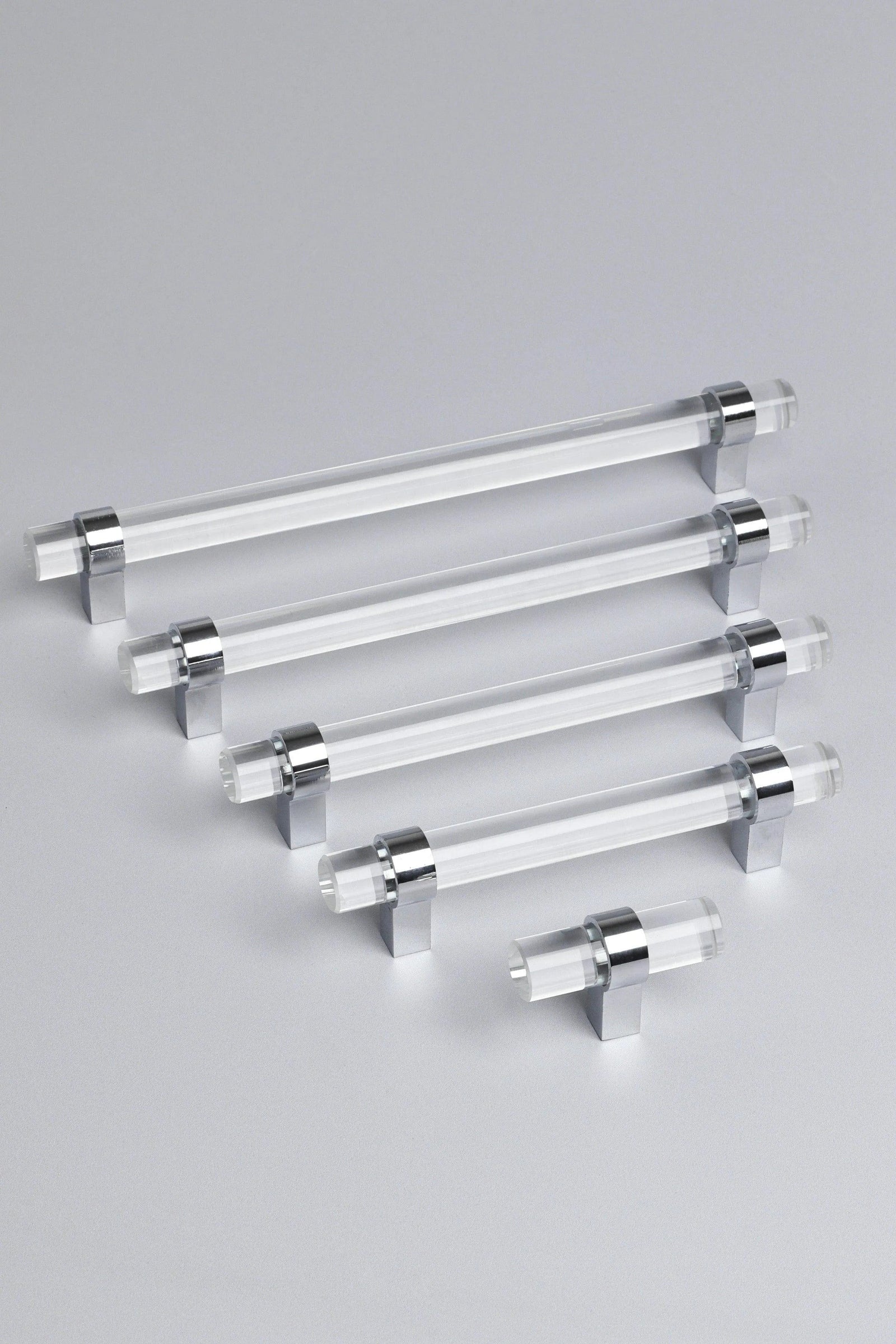
Pulls are quoted by centre-to-centre — the distance from the middle of one fixing hole to the middle of the other. This is the number that matters when ordering, because it is what determines whether the pull will line up with holes already drilled in the drawer front. The overall length of the pull is always slightly longer than the centre-to-centre — typically by 1" to 2".
- 3" (76 mm) — narrow cutlery drawers under 12" wide.
- 3 ¾" (96 mm) — standard American default, drawers 12"–18" wide.
- 5" (128 mm) — larger drawers, 18"–24" wide.
- 6 ¼" (160 mm) — pan drawers, pantry pull-outs, 24"–30" wide.
- 7 ⅝" (192 mm) — wide pan drawers, appliance drawers, 30"+.
- 8" (203 mm) and above — oversized appliance and pantry drawers, integrated fridge fronts.
The one-third rule holds : a pull should be roughly one-third the width of the drawer. On drawers over 36", two pulls set at the third points read more considered than a single very long pull. Below 12" of drawer width, a knob or a 3" cup pull is often the kinder choice.
The one-knob rule (and its exceptions)
The convention that has served American kitchens for the last hundred years : one knob per door under 24" wide ; pulls on any drawer, and pulls on any door over 24" wide.
Two knobs on a single door read as indecision unless the door is a very wide pair meeting in the centre. Drawers, even narrow ones, benefit from the leverage of a pull ; a knob on a heavy pan drawer tires the fingers by the second week. Doors over 24" — tall pantries, integrated appliance doors — need a pull for the leverage and the visual proportion ; a knob on a tall door looks lost.
Placement — the small measurements that show
Where the knob or pull sits on the door or drawer is a decision that reads at a glance and cannot be undone without visible holes. The reliable American conventions :
Knobs on face-frame doors
- Vertical: 2 ½" to 3" from the corner of the door opposite the hinge.
- Horizontal: centred on the stile of the door, roughly 1 ½" in from the edge.
- Upper cabinets — measure from the bottom corner. Lower cabinets — measure from the top corner. This keeps every knob at the same reach.
Pulls on drawers
- Horizontal: centred left-to-right on the drawer face.
- Vertical: for drawers under 6" deep, centred top-to-bottom. For deeper drawers, slightly above centre — the eye reads the upper third of the drawer more naturally than the lower two-thirds.
- Cup pulls always sit on the upper half of the drawer, because they are pulled from below and the cup needs space beneath the hand.
Screws and fixings — the American standard
American cabinet doors and drawer faces are almost universally ¾" (19 mm) thick. Our knobs and pulls ship with standard machine screws in threads that suit that dimension out of the box. Where you will need a slightly longer fixing :
- Doors or drawer faces with an applied panel or thicker moulding — add ¼" to ½" to standard length.
- Inset doors on a face-frame cabinet — often thicker than standard overlay doors.
- Heavier pieces such as marble or oversized brass pulls — a slightly longer, higher-grade screw pays back over the life of the kitchen.
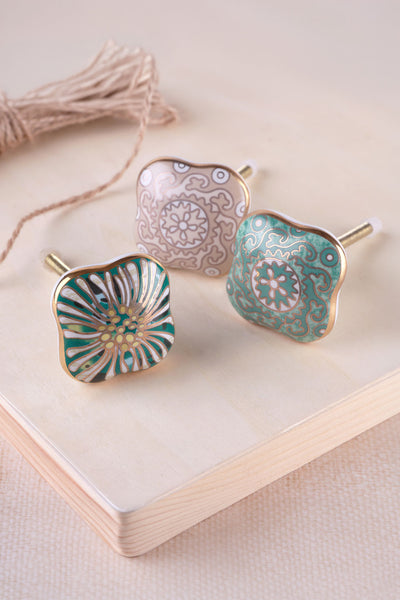
For ceramic knobs specifically, our Chrome Fixing Bolts for Ceramic Cabinet Knobs come in three lengths and cover almost every American application — short for standard ¾" doors, standard for slightly thicker doors, long for applied-panel or inset installations. The set is a small line item that resolves a recurring problem.
The pieces we most often specify
Three knobs cover the majority of the sizing decisions in a typical American kitchen, and are worth naming :
- 1 ⅜" (35 mm) — Milano Signature Ceramic Cabinet Knob. Our best-loved piece and the reliable default for a standard face-frame Shaker kitchen.
- 1 ½" (38 mm) — Elizabeth Mother of Pearl Cabinet Knob in Polished Brass. The considered choice for tall pantry doors and statement built-ins.
- 1 ¼" (32 mm) — Vintage Brass Cabinet Knob. The neat, unhurried default for upper cabinets and lighter joinery.
Each is available singly, so a full kitchen can be specified to the exact door count without leftover boxes.
Frequently asked questions
What size cabinet knob is standard in the US?
1 ⅜" (35 mm) is the reliable default for standard face-frame Shaker and traditional American cabinetry. 1 ¼" (32 mm) sits neatly on smaller upper cabinets ; 1 ½" (38 mm) suits tall pantry doors and larger statement pieces. Undersizing is the more common mistake ; a knob under 1" reads as apologetic on most kitchen doors.
How do I measure centre-to-centre for a drawer pull?
Measure from the middle of one fixing hole to the middle of the other, in inches or millimetres. This is the number that determines fit — the overall length of the pull is always slightly longer than the centre-to-centre, typically by 1" to 2". A pull with the wrong centre-to-centre cannot be made to fit existing holes without visible re-drilling.
What screw length do I need for a US cabinet door?
American cabinet doors and drawer faces are almost universally ¾" (19 mm) thick, and our knobs and pulls ship with fixings suited to that dimension. Order slightly longer screws for doors with applied panels, thicker moulding, or inset construction ; heavier pulls such as marble also benefit from a slightly longer, higher-grade screw.
When should I use a knob versus a pull?
Knobs on doors under 24" wide ; pulls on drawers and any door over 24" wide. Knobs read neatly on a standard cabinet door and give a Shaker face frame the vertical accent it is designed for ; pulls give a drawer the leverage a knob cannot, and a tall pantry door the visual proportion it needs. Most considered American kitchens mix the two — knobs above, pulls below.
A final thought
Hardware is one of the cheapest parts of a kitchen and one of the most felt. Measure twice, order singly, tighten by hand — and the small piece of brass or ceramic in the palm at breakfast will feel right for the twenty years the kitchen serves. It is the smallest specification decision in the room and the one whose regret lasts longest.
✥
Explore the full cabinet knobs and cabinet pull handles collections — every piece sold singly, so a kitchen can be fitted exactly.