

The Journal · British Design
How to Choose Door Knobs for Period Homes (Victorian, Edwardian, Georgian)
A designer's guide to choosing door knobs for period homes — what suits Georgian, Victorian and Edwardian doors, plus the practical questions of mortice fit, finish and keeping the house speaking with one voice.
How do you choose door knobs for a period home without either fighting its history or slavishly copying it? A Georgian townhouse, a Victorian terrace and an Edwardian villa each ask for something slightly different at the door — and the right door knobs are the detail that makes a period home read as cared-for rather than merely old.
Why door knobs matter more in a period home
In a new-build, hardware is a finishing touch. In a period home, it is closer to a signature. Older houses were built with a level of joinery detail — panelled doors, deep architraves, moulded surrounds — that modern hardware can either honour or quietly undermine. A flat, contemporary lever on a four-panel Victorian door looks like a mistake the moment you notice it; the right door knob, by contrast, disappears into the room precisely because it belongs there.
Choosing door knobs for a period home is therefore less about matching a catalogue to a date and more about reading what the house is telling you. The era gives you a starting point; the room, the door, and the light tell you the rest. Our internal door knobs span the styles that suit each period, but the principle below matters more than any single product: choose the knob the door was built to wear.
Georgian homes: restraint and symmetry
Georgian interiors (roughly 1714–1830) were built on proportion and symmetry. Rooms are tall, doors are typically six-panel, and the decorative language is classical and understated. The hardware that suits them is quiet: nothing fussy, nothing overwrought.
What to choose
A plain round knob in brass, or a beehive-shaped knob, sits most comfortably on a Georgian door. Cut glass and mercury-glass knobs also belong to this period and catch the light beautifully in a tall, well-proportioned room. Avoid anything with heavy pattern or a modern silhouette — Georgian restraint is undone by decoration. A pair of faceted glass mortice knobs reads as authentic to the period while bringing a little light to the room, which Georgian houses, with their tall windows, tend to reward.
Finish
Unlacquered or aged brass suits Georgian homes best, developing a patina over time that reads as honest rather than new. Polished brass works in a grander, formal Georgian room; softer aged tones suit the more domestic ones. Our brassworks edit gathers the solid-brass pieces that age this way.
Victorian homes: richness and ornament
Victorian houses (1837–1901) are the opposite of Georgian restraint. This was an age of ornament, colour and confidence — encaustic tiles, deep skirtings, four-panel doors, and a taste for decoration that a good door knob can lean into rather than resist.
What to choose
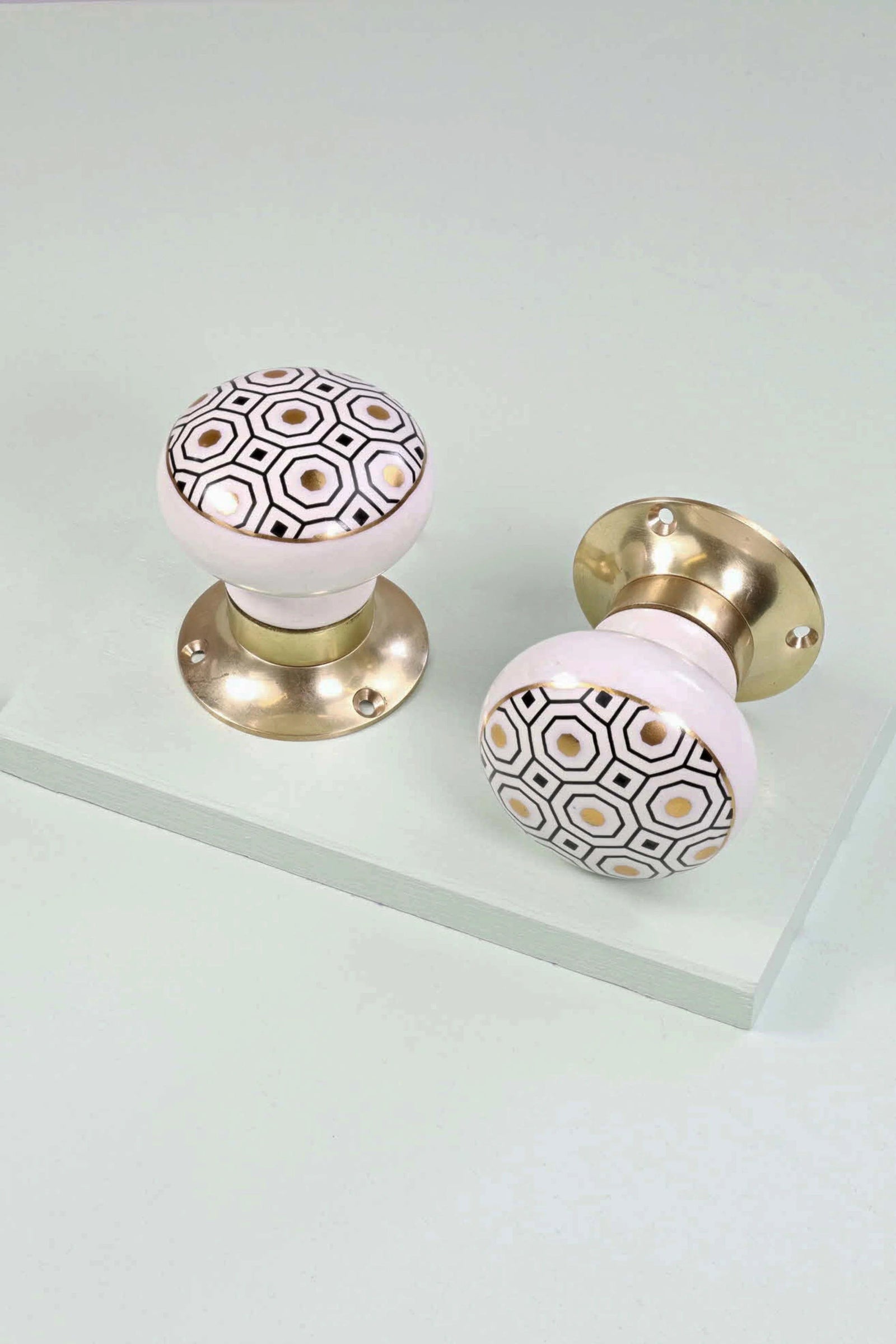
Victorian doors carry pattern well. A hand-painted ceramic knob, a knob with a moulded or honeycomb pattern, or a richly coloured glazed piece all suit the period's love of detail. The Royal Gold honeycomb ceramic knob, with its patterned face and solid brass base, is exactly the kind of ornament a Victorian four-panel door was built to wear. Deep colours — ink, forest green, oxblood — sit beautifully against the darker, richer palettes Victorian rooms favour. Browse our signature pieces for the more decorative knobs that belong to this period.
Finish
Aged and antique brass suit Victorian interiors, as does a ceramic knob on a brass rose. The finish should feel warm and slightly worn — Victorian rooms rarely reward anything that looks freshly minted.
Edwardian homes: lighter, and quietly transitional
Edwardian houses (1901–1910, and the years either side) mark a move away from Victorian heaviness toward something lighter and airier. Rooms are often brighter, ceilings a touch lower, and the decorative mood is softer — think whites and sages rather than oxblood and ink. Arts and Crafts influence is common, with an emphasis on honest materials and hand-work.
What to choose
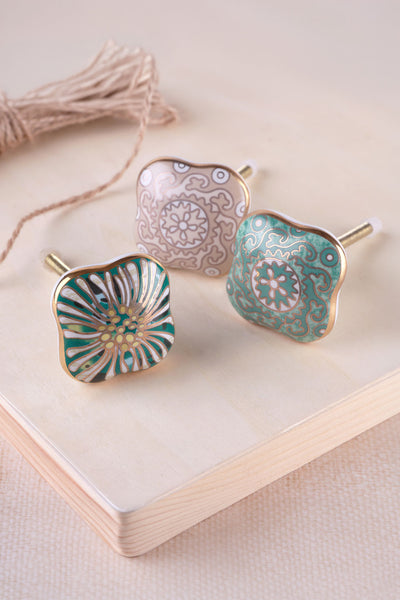
Edwardian doors suit a knob that is decorative but restrained — a hand-painted ceramic in a softer colourway, or a simple faceted glass knob. Pattern is welcome, but the lighter, cleaner Edwardian palette wants pattern in gentler tones than the Victorian one. A hand-painted piece such as the Milano hand-painted ceramic knob bridges the two moods well: enough craft to honour the Arts and Crafts spirit, enough restraint to suit the lighter Edwardian room.
Finish
Aged brass again, or a softer satin brass, works with the lighter Edwardian palette. Chrome and nickel also begin to make sense in Edwardian bathrooms and kitchens, where a cooler finish suits the period's move toward brighter, more hygienic rooms.
The practical question: mortice, rim, and fit
Style aside, a door knob in a period home has to fit a period door — and older doors are rarely standard. Before choosing, it is worth understanding the mechanism the door already has.
Mortice versus rim
Most internal period doors take a mortice knob, where the latch sits inside a housing cut into the door edge and the knobs turn a spindle through it. Some older doors, particularly on the reverse of a Victorian or Georgian house, still carry a rim lock — a box mounted on the surface of the door. Establish which you have before ordering, as the two are not interchangeable. Our door furniture covers the escutcheons, spindles and roses that complete either fitting.
Door thickness and spindle length
Period doors vary in thickness far more than modern ones, and a spindle that is too short simply will not reach. Measure the door before choosing, and check that the knob set allows for a thick, solid door. A well-made mortice knob set accommodates this, so measure carefully and choose a set built for a solid door.
Consistency: let the house speak with one voice
The single most common mistake in a period home is mixing hardware without a plan — a glass knob here, a lever there, three different brass tones down one landing. A period house reads best when the door knobs share a family across the main rooms, even if the exact knob varies from door to door.
This does not mean every knob must be identical. It means the finish should be consistent — one brass tone throughout the principal rooms — and the style should sit within one coherent period language. A run of hand-painted ceramic knobs in different colourways down a Victorian landing reads as considered; the same landing with a random mix of eras and metals reads as unresolved. If you are replacing knobs room by room, keep the finish fixed and let colour or pattern be the only thing that changes. Extending the same finish to cabinet and cupboard hardware keeps the whole house speaking with one voice.
When to honour the period, and when to gently break it
Faithful restoration is not the only honest choice. Many of the loveliest period homes carry a deliberate note of contrast — a run of pattern-cut glass knobs in a Georgian house, or a clean modern knob on a cupboard within an otherwise Victorian room. The trick is that the contrast should feel chosen, not accidental. Keep the door knobs on the principal doors true to the house, and allow yourself a little freedom on cupboards, box rooms and later extensions, where a lighter touch signals that the house has grown over time rather than been frozen.
Frequently asked questions
What door knobs are best for a Victorian house?
Victorian doors suit decorative hardware: hand-painted ceramic knobs, patterned or honeycomb-moulded knobs, and richly coloured glazed pieces on a brass base. Deep colours such as ink, forest green and oxblood sit well against Victorian palettes, and an aged or antique brass finish reads as warm and honest rather than freshly minted.
Are glass door knobs period-appropriate?
Yes — cut glass and mercury-glass knobs are genuinely period pieces, most at home in Georgian and Edwardian interiors, where their light-catching quality suits taller windows and softer palettes. They also work as a considered note of contrast in a Victorian room, provided the finish of the base metal stays consistent with the rest of the house.
How do I know if my period door takes a mortice or rim knob?
Look at the latch. A mortice knob works with a latch housed inside the door edge, so you see only the knob and a keyhole or escutcheon on the face. A rim lock is a box mounted on the surface of the door, usually on the reverse. The two are not interchangeable, so establish which you have before ordering.
Should every door knob in a period home match?
Not identically, but they should share a family. Keep the brass or metal finish consistent through the principal rooms and stay within one coherent period style; let colour or pattern be the only thing that varies from door to door. A consistent finish with varied colourways reads as considered, while a random mix of eras and metals reads as unresolved.
Can I use modern door knobs in a period home?
On the principal doors, a knob true to the house almost always reads better. But cupboards, box rooms and later extensions can carry a lighter or more modern touch, which signals that the house has grown over time. The key is that any contrast should feel deliberate rather than accidental.
A final thought
Choosing door knobs for a period home is one of those small decisions that repays careful attention out of all proportion to its size. Read the era, honour the door, keep the finish consistent, and allow a little considered contrast where the house invites it. Done well, the door knobs are the detail no visitor will remark on and every visitor will feel — the quiet sign of a period home that has been understood rather than merely inherited.
Begin with our internal door knobs, door furniture and signature pieces, and choose the knob your period home was built to wear. With more than 700 verified reviews on Trustpilot and over 2,000 store reviews on Judge.me, our pieces are trusted in homes across the UK, US, Europe and Australia.
Further reading
- How to Choose Door Knobs: A Complete UK Guide — The full guide to shapes, mechanisms and fitting, whatever the age of your home.
- Ceramic vs Brass vs Chrome Door Knobs — Which finish suits which room, and how each ages.
- How to Choose Brass Finishes: A Material Guide — Aged, polished and satin brass, and where each belongs.