

The Journal · Buying Guide
Türklinken auswählen: Ein umfassender Leitfaden für Großbritannien
Türklinken sind die am häufigsten berührten Designelemente in einem Haus – und das kleinste Detail, das sich am meisten verändert. Unser vollständiger UK-Leitfaden behandelt Anatomie, Materialien, Oberflächen, Größen, Installation und Pflege, mit Anleitungen für jede Ära britischer Häuser.
Jedes Mal, wenn Sie zu Hause durch eine Tür gehen, findet Ihre Hand den Knauf, bevor Ihre Augen den Raum finden. Türknäufe sind wohl das am häufigsten berührte Designelement in einem Haus – und das Detail, das die meisten Menschen zuletzt ändern, wenn überhaupt. Wenn Sie sie richtig wählen, hört eine Tür auf, eine funktionale Infrastruktur zu sein, und wird zu einem stillen Stück Persönlichkeit. Wenn Sie sie falsch wählen, fühlt sich selbst das durchdachteste Interieur leicht unpassend an.
Dies ist der praktische Begleiter zu unserem designorientierten Leitfaden So wählen Sie Türknäufe, die einen Raum vollenden. Während sich dieser Artikel auf die Stilseite konzentriert, behandelt dieser die technische Seite – Anatomie, Materialien, Oberflächen, Größen, Installation und Pflege – die Referenz, auf die Sie zurückgreifen werden, wenn Sie tatsächlich bestellen.
Die Anatomie eines Türknaufs
Bevor Sie sich in eine Oberfläche oder eine Farbe verlieben, eine kurze Orientierung. Ein kompletter Türknauf-Satz besteht aus:
- Der Knauf selbst – der Teil, der sich in Ihrer Hand dreht. Rund, oval, facettiert oder skulptural.
- Die Rosette (oder Platte) – die Scheibe hinter dem Knauf, die bündig an der Tür anliegt. Eine kleine Rosette wirkt sauber und modern; eine längere Platte ist eher historisch.
- Der Vierkantstift – die dünne quadratische oder Gewindestange, die die beiden Knäufe durch die Tür verbindet und mit dem Verriegelungsmechanismus im Inneren ineinandergreift.
- Die Befestigungen – kleine Schrauben, Maschinenschrauben oder Bolzen, die alles an Ort und Stelle halten. Bei unseren Knäufen sind diese standardmäßig enthalten.
Für Innentüren, die geschlossen verriegelt werden müssen (die meisten), benötigen Sie auch ein Einsteckschloss oder ein Riegelschloss, das in den Türrand eingebaut wird. Die meisten britischen Türen nehmen ein Standard-2½″- oder 3″-Schloss auf.
Schrank-, Kommoden- und Schubladenknäufe sind einfacher – es handelt sich um einteilige Befestigungselemente mit einer Gewindeschraube, die durch die Schrankfront läuft. Kein Vierkantstift, keine Rosette, kein Schloss.
Materialien – und was jedes aussagt
Das Material ist die größte Entscheidung, die Sie treffen werden. So denken Sie über jedes einzelne nach.
Keramik
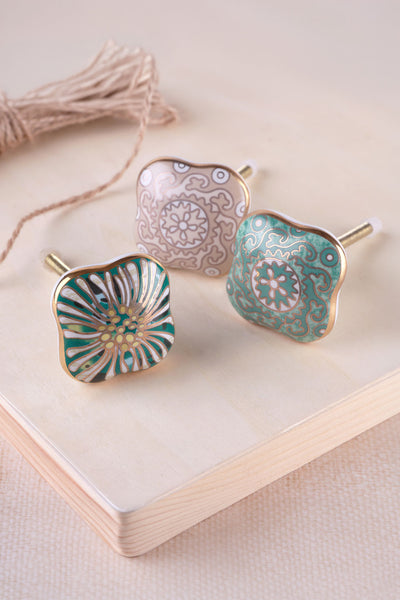
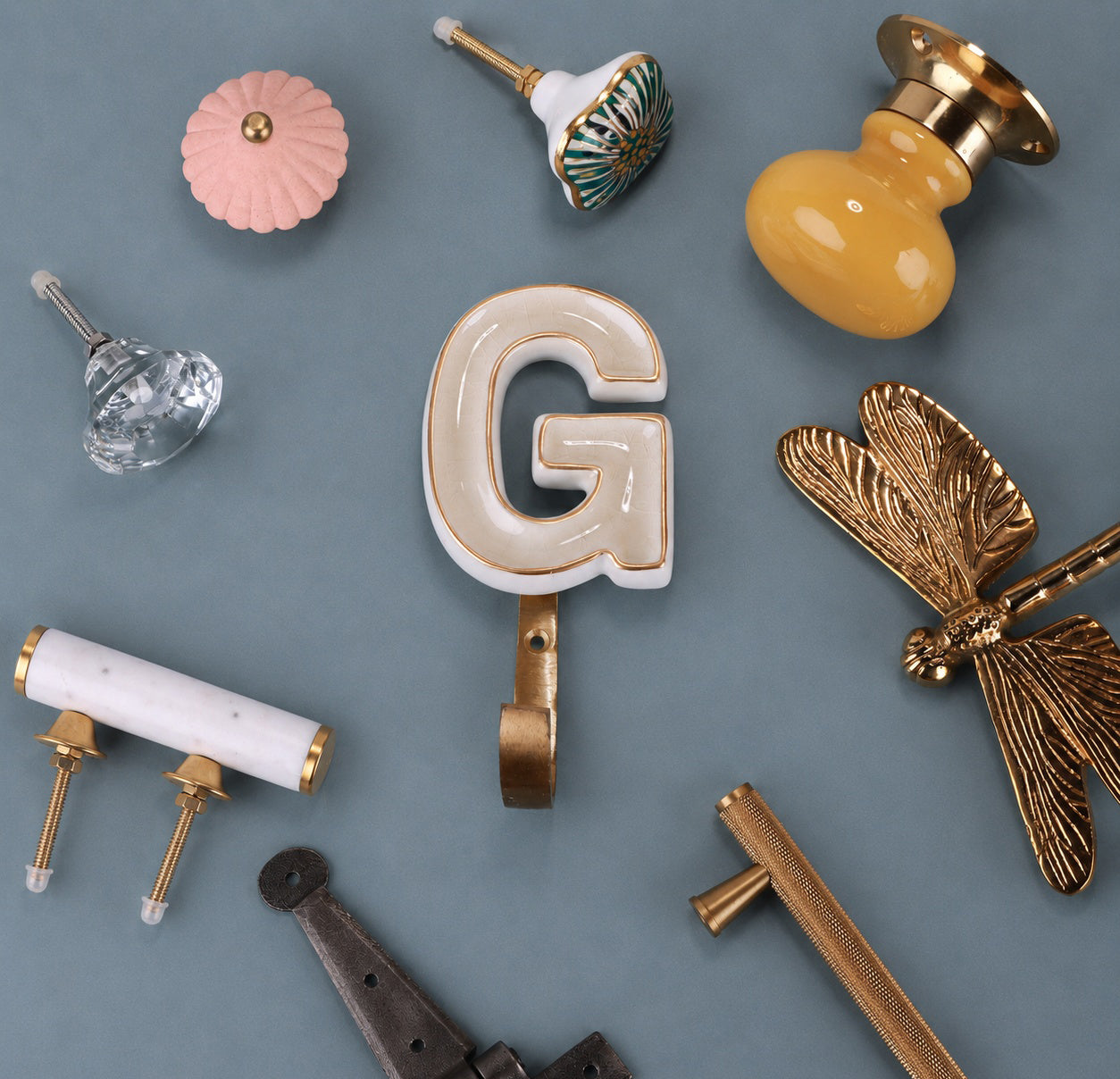
Keramik-Türknäufe und -Schrankknäufe bilden das Herzstück der G Decor Kollektion. Jedes Stück wird von Hand geformt, glasiert und bemalt – so dass keine zwei genau gleich sind. Keramik passt besonders gut zu georgianischen, viktorianischen und edwardianischen Häusern; die malerischen Blumen und traditionellen, von Wedgwood inspirierten Blautöne wirken historisch passend, ohne wörtlich zu sein. In modernen Interieurs fügt handbemalte Keramik Wärme hinzu, wo ein poliertes Metall kalt wirken könnte.
Die Pflege ist unkompliziert – ein weiches, feuchtes Tuch hält die Glasur sauber. Vermeiden Sie scheuernde Reiniger bei handbemalten Designs.
Massives Messing
Messing ist das Arbeitstier unter den Türbeschlägen und altert über Jahrzehnte wunderschön. Wir veredeln Messing auf vier Arten:
- Poliert – hell, reflektierend, golden. Wirkt modern an einer schwarzen oder anthrazitfarbenen Tür, traditionell an einer Paneeltür.
- Gealtertes Messing – weicherer Goldton mit Patina. Vielseitig über alle Epochen hinweg.
- Unlackiertes Messing – blankes Metall, das durch Berührung seine eigene Patina entwickelt. Von Puristen geliebt; es wird im Laufe der Jahre dunkler und heller werden.
- Satin / gebürstetes Messing – matt und warm. Verbirgt Fingerabdrücke; wirkt modern.
Stöbern Sie in unseren Messing-Türknäufen, Messing-Schrankknäufen und Messing-Schrankgriffen.
Glas und Kristall
Facettierte Kristall- und klare Glasknäufe fangen das Licht auf eine Weise ein, wie es kein anderes Material tut. Sie sind elegant, unaufdringlich und passen wunderbar sowohl zu historischem Stuck als auch zu modernen lackierten Schränken. An einer nach Süden ausgerichteten Tür wirft ein Kristallknauf am späten Nachmittag Prismen an die Wände – ein kleines tägliches Vergnügen.
Glasknäufe werden typischerweise auf einem Messing- oder Chromsockel montiert. Die Kombination aus Metallwärme und Glasklarheit verleiht ihnen ihren Charakter.
Perlmutt- und Knochenintarsien
Intarsienknäufe – meist Perlmutt in einen Messingsockel eingelassen, oder handgeschnitzter Hornknochen – sind Statement-Stücke. Sie passen zu durchdachten, bewohnten Interieurs mit kuratierten Objekten: denken Sie an Schlafzimmer, Ankleidezimmer oder die Schränke in einer unaufdringlich opulenten Küche. Intarsienknäufe eignen sich am besten für Schränke und Einbauten und nicht für stark frequentierte Innentüren, einfach weil die Oberfläche feiner ist.
Eisen und geschmiedetes Metall
Handgeschmiedetes Eisen passt zu Landhäusern, Bauernhäusern, umgebauten Scheunen und Arts & Crafts-Interieurs. Wir kombinieren geschmiedetes Eisen mit Bienenwachs oder schwarzen Oberflächen; beide altern anmutig und verleihen massiven Türen ein Gefühl von Gewicht.
Oberflächen – und wie sie sich im Laufe der Zeit verändern
Zwei Türen mit identischen Knäufen in unterschiedlichen Oberflächen werden über Jahre des Gebrauchs völlig unterschiedlich wirken. Ein kurzer Leitfaden:
- Polierte Oberflächen bleiben hell, zeigen aber Fingerabdrücke. Am besten für wenig berührte Türen (formelle Räume, gelegentliche Gästezimmer).
- Gealterte Oberflächen haben eine absichtliche Patina. Sie verzeihen den Gebrauch und werden sich im Laufe der Zeit nicht wesentlich verändern.
- Unlackierte Oberflächen verändern sich bewusst. Neu sind sie hell; nach sechs Monaten Gebrauch sind sie matt und warm; nach fünf Jahren sind sie Objekte mit Geschichte. Wenn Sie Beschläge wünschen, die wie ein Erbstück wirken, wählen Sie unlackiert.
- Satin / gebürstete Oberflächen verbergen alles – Fingerabdrücke, Flecken, leichte Kratzer. Am besten für stark frequentierte Türen: Küchen, Bäder, Kinderzimmer.
Die ehrliche Antwort: Es gibt keine „beste“ Oberfläche. Es gibt die Oberfläche, die Ihrer Toleranz gegenüber Veränderungen entspricht.
Größen – die wirklich wichtigen Zahlen
Für einen Innentürknauf beträgt die Spindelgröße fast immer 8 mm quadratisch (UK-Standard). Die Größe der Rosette ist eine persönliche Präferenz – kleiner (ca. 50 mm Durchmesser) für saubere moderne Türen, größer (60–65 mm oder rechteckig) für historische Einsteckschlösser.
Schrankknäufe verwenden eine Maschinenschraube (typischerweise M4), die durch die Schranktür läuft. Standard-Schranktüren sind 16–18 mm dick; die meisten Knäufe werden mit Schrauben für diese Dicke geliefert, plus einer längeren Schraube für dickere Türen. Messen Sie die Dicke Ihrer Schranktür vor der Bestellung.
Für den Abstand der Türknäufe bei Doppeltüren oder passenden Paaren: Die Standard-Mittelhöhe beträgt 1.000 mm vom Boden (britische Bauvorschriften bevorzugen dies aus Gründen der Barrierefreiheit). Für Einzeltüren sind 1.050 mm traditioneller, aber ein bisschen persönliche Präferenz ist in Ordnung.
So installieren Sie einen Türknauf
Eine Standard-Installation eines Innentürknaufs für jemanden mit einem Schraubenzieher und zwanzig Minuten:
- Prüfen Sie, ob die Tür vorbereitet ist. Sie benötigen eine vorhandene Schlossbohrung (ein Loch, das durch die Türfläche für den Vierkantstift gebohrt wurde) und eine Kantenbohrung (für das Schloss selbst). Die meisten modernen Türen sind vorbereitet; historische Türen müssen oft gebohrt werden.
- Schieben Sie den Vierkantstift durch das Schloss. Der Vierkantstift sollte mit dem Verriegelungsmechanismus im Inneren der Tür ineinandergreifen.
- Positionieren Sie den ersten Knauf und die Rosette. Schieben Sie den Knauf auf ein Ende des Vierkantstifts, halten Sie die Rosette flach an die Türfläche.
- Markieren und bohren Sie Pilotlöcher für die Rosettenschrauben. Verwenden Sie einen 2-mm-Bohrer. Nicht überbohren.
- Wiederholen Sie den Vorgang auf der anderen Seite. Passen Sie die Spindellänge bei Bedarf an – die meisten Spindeln können mit einer Metallsäge auf die richtige Größe zugeschnitten werden. Ziehen Sie die Madenschrauben an jedem Knauf fest, um sie am Vierkantstift zu befestigen.
Testen Sie die Tür, bevor Sie den Schraubenzieher weglegen: Sie sollte beim Schließen einrasten und sich beim Drehen des Knaufs sauber lösen.
Bei Schrankknäufen ist die Installation noch einfacher – eine einzelne Maschinenschraube durch die Schranktür, von hinten handfest angezogen. Kein Bohren, keine Vierkantstifte, keine Beschläge.
Pflege und Reinigung
Für handbemalte Keramik nur ein weiches, feuchtes Tuch. Vermeiden Sie Lösungsmittelreiniger.
Für poliertes Messing sorgt gelegentliches Polieren mit einem nicht scheuernden Metallreiniger für den Glanz. Bei unlackiertem Messing nichts tun – die Patina ist der Sinn der Sache.
Für Glas und Kristall Glasreiniger oder warmes Wasser mit einem Mikrofasertuch.
Für gealtertes Messing, gebürstetes Nickel und pulverbeschichtete Oberflächen reicht ein feuchtes Tuch aus. Vermeiden Sie scheuernde Pads auf jeder Oberfläche.
Schrankknäufe vs. Türknäufe: Der schnelle Unterschied
Eine häufige Frage – ist das dasselbe? Technisch gesehen nein. Türknäufe sind für große Türen und benötigen einen Vierkantstift, ein Schloss und eine Rosette. Schrankknäufe sind für Schränke, Schubladen und Schranktüren und verwenden eine einzelne Maschinenschraube. Schrankknäufe sind einfacher, billiger und werden in viel größeren Mengen verwendet (eine typische Küche hat 20–40 Schrankknäufe im Vergleich zu vielleicht 8–12 Innentürknäufen).
Beide können die gleichen Materialien und Oberflächen verwenden, wodurch Sie ein koordiniertes Erscheinungsbild im Raum erzielen können.
Häufig gestellte Fragen
Welche Spindelgröße benötige ich?
Der britische Standard für Innentüren beträgt 8 mm quadratisch. Dies wird bei jedem Satz Türknäufe mitgeliefert. Für Außentüren oder dickere Türen (über 50 mm dick) kann eine längere Spindel erforderlich sein.
Sind Keramik-Türknäufe langlebig?
Ja – gebrannte Keramik ist härter, als man denkt, und hält bei normalem Gebrauch Jahrzehnte. Die Glasur ist die zu schützende Schicht; vermeiden Sie scheuernde Reiniger, und Sie werden nie ein Problem haben.
Kann ich verschiedene Oberflächen im selben Haus mischen?
Ja, mit einer Regel: Wählen Sie ein primäres Metall und einen Akzent. Poliertes Messing in der Küche + unlackiertes Messing in den Schlafzimmern wirkt durchdacht. Poliertes Messing + Chrom + satiniertes Nickel in drei verschiedenen Räumen wirkt zufällig. Im Zweifelsfall wirken weniger Oberflächen, die konsequenter verwendet werden, teurer.
Sollten Schrankknäufe zu Türknäufen passen?
Das müssen sie nicht, aber sie sollten eine gemeinsame Farb- oder Materialgeschichte teilen. Keramik-Türknäufe und Keramik-Schrankknäufe aus derselben Glasurfamilie funktionieren wunderbar. Poliertes Messing an Türen mit poliertem Messing an Schränken ist die sicherste Kombination.
Versenden Sie international?
Ja – standardmäßig nach Großbritannien, USA, Australien, Deutschland, Frankreich und in die VAE, und auf Anfrage in die meisten Länder. Ausführliche Informationen finden Sie auf unserer Lieferseite.
Werden die Türknäufe von G Decor in Großbritannien hergestellt?
Viele unserer Designs werden in Großbritannien hergestellt, und wir sind ein stolzes Mitglied von Made in Britain. Keramikstücke werden in kleinen Chargen handgefertigt und bemalt; Messingbeschläge werden von britischen Metallhandwerkern veredelt. Die Herkunft wird auf jeder Produktseite angegeben.
Den Rest des Raumes gestalten
Türknäufe sind in der Regel der Ausgangspunkt für eine umfassendere Hardware-Story in einem Zuhause. Sobald Sie Ihre gewählt haben, sind die nächsten natürlichen Schritte:
- Schrankknäufe und Schrankgriffe aus derselben Materialfamilie
- Scharniere für sichtbare Tischlerarbeiten
- Haustürbeschläge – Türklopfer, Briefschlitze, Hausnummern
- Wandhaken und Vorhanghalter, um die Materialgeschichte im Raum fortzusetzen
Stöbern Sie in der gesamten G Decor Beschlagkollektion für das Gesamtbild – jedes Stück wird in England entworfen, von Hand gefertigt und weltweit versendet.
Weiterführende Literatur
- Britisches Handwerk: So entsteht ein handbemalter Knauf – Die Werkstatt, die Hände, der Ofen. Warum handgefertigte Beschläge lebendig wirken.
- Keramik vs. Messing vs. Chrom Türknäufe: Welche Oberfläche passt zu Ihrem Zuhause? – Drei Oberflächen im Vergleich – wann welche gewinnt und wie man sie ohne Showroom-Look kombiniert.
- So wählen Sie Messingoberflächen: Ein Materialleitfaden – Natur, Antik, Poliert und Bienenwachs – ein kurzer Leitfaden zu den Messingoberflächen, mit denen wir arbeiten.