

The Journal · Atelier
The Drinks Tray at Twilight
A small ceremony at the end of the day — building the drinks tray. On glassware, low light, and the cocktail hour at home.
There's an hour around six in the evening — slightly later in summer, much earlier in November — when the daylight stops doing the work. The room dims by half a stop, then another. The kitchen light is too bright for it. The overhead pendant is too cold. You turn on one small lamp on the sideboard, and the whole room rearranges itself around that one warm point.
That hour is the cocktail hour. Or it was, when it was named — somewhere between the wars, by people who'd decided that the move from day into evening deserved a small ceremony. It still does. And the small ceremony, when we observe it at home, has almost always come to centre on a tray.
This is a quiet piece about the drinks tray. Not how to mix a drink, which is its own subject and better-served elsewhere. But what to put on the tray, where it sits, and why the ritual of building one is — we'd argue — one of the most underrated pleasures of a furnished home.
Why a tray
A tray gives the drinks corner an edge. Without it, bottles drift into the rest of the surface — into the post tray, the keys, the books being read. With a tray, the gin is "in the tray," and the tray is in its place, and you don't end up rinsing a glass at half past ten because it was sat next to a houseplant.
The other thing a tray does, almost despite itself, is gather. It collects the small objects — the lemon-zester, the muddler, the soda — that otherwise live in three different drawers. Once everything you need is at hand on a single surface, mixing a drink stops feeling like a project and starts feeling like a pause.
Most drinks trays in our homes live on a sideboard in the sitting room. A few live on a kitchen island, or on a console in a hallway, or — in flats with no obvious place — on the top of a chest of drawers in a corner of the bedroom. None of these is wrong. The tray finds its place.
What goes on it
The honest answer is: less than you'd think. A well-edited drinks tray has perhaps seven objects on it. More than that and it stops looking like a still life and starts looking like a hotel minibar.
Here's what we keep on ours, in the order we'd put them there if starting from nothing.
A decanter. Even for spirits you've not transferred — a decanter just standing in is fine — it gives the tray its vertical anchor. The eye needs something tall to rest on. A 1-litre crystal decanter holds either a bottle of gin or a bottle of whisky with room to spare. We use ours for whatever the season is asking for: gin in summer, brown spirits in winter, sherry between September and November.
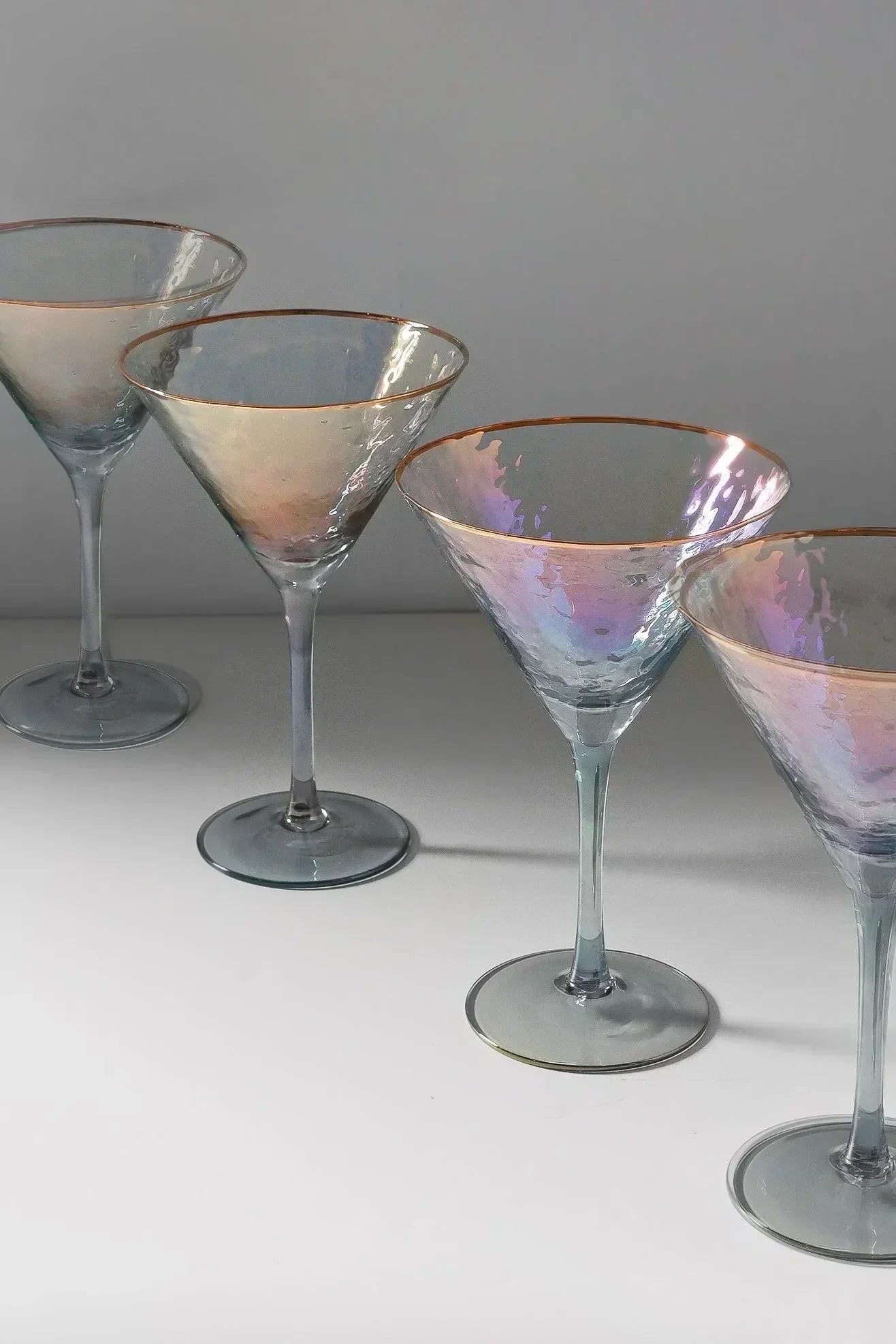
Two glasses, sometimes four. Resist the urge to stack five different glass shapes on the tray. The look that works is repetition — four matching tumblers, or two coupes alongside two tumblers, in the same family. Cut crystal does most of the work; the way it picks up the lamp behind it is half the reason the tray looks good at all. Our Glassware collection covers the standard tumbler, the highball, the coupe; and our Cocktail Glasses sit beside our Wine Glasses if you want both in the same family. Pick the one shape you'll actually use, and buy four.
Something for soda or tonic. A small jug of cold water, a chilled bottle of tonic, a soda siphon if you're feeling continental about it. Don't put the supermarket bottle on the tray; either decant it into something nicer or keep it off-tray and lean on the jug.
A bowl of citrus. Three lemons and two limes will see you through a week. They look like still life and they earn their place every drink. The bowl can be tiny — anything brass, anything ceramic, anything that holds five small green-and-yellow things and looks intentional.
A small dish for olives or salt. Optional, but the kind of thing that nudges a drink from "I had a gin" into "I made a drink." A bowl no bigger than your palm. We use a small hammered brass dish; an antique butter dish from your grandmother does the same job.
One small implement. A jigger, or a bar spoon, or a citrus zester. Pick one — the one you actually use — and let it live on the tray. Three is too many; one is right.
A coaster, or three. Brass, marble, or felted leather. The tray's the parent, the coasters are the children — they spread out around the room when the drinks do, and they come home.
That's the list. Seven items, give or take. If you can't see the tray under what's on it, take something off.
On the tray itself
A drinks tray is bigger than a tea tray. The minimum useful size is about 35cm across; we'd suggest 40–45cm. Smaller than that and you can't get a decanter, two glasses, and a jug onto it without rearrangement.
Brass is the standard, for good reasons. It warms the room at the very moment you most want warmth in the room. It picks up lamp-light and throws it back softly. And it ages — develops a darker patina around the rim where hands hold it, gets a little dimpled in the middle where the decanter sits. After ten years it tells a small story.
Lacquered brass holds its colour and is the sensible choice if you don't want to think about it. Unlacquered brass goes through a stage at about six months in where the colour shifts and you'll panic, briefly, that something's gone wrong; it hasn't. The patina settles by the year mark and from then on it only gets better.
Wood works too — walnut, oak, occasionally olive. A wooden tray reads slightly more relaxed than a brass one, slightly more rustic. Marble is heavy and a touch formal but the right thing for an Art Deco-adjacent flat. Lacquered black or red is right for very particular interiors and wrong for almost everything else.
The lamp
Here is the unspoken rule of the drinks tray, the one that nobody puts in writing and that makes the difference between a tray that looks good and a tray that looks like it's from a photograph.
There must be a small lamp behind it.
Not the room's main light. Not the overhead. A small, dim, warm lamp — preferably with a fabric shade — set behind or just to the side of the tray, throwing about as much light as a single candle. Possibly a candle. The lamp does two things: it gives the glassware something to refract, and it lowers the whole register of the room from "evening" to "after-dark," which is the register in which a drink tastes correct.
Our Lighting collection has small table lamps for exactly this kind of corner — small lamps, low light, warm metal bases. Anything 30–45cm tall, anything with a 5–7 watt warm-white bulb, anything you turn on at five forty-five in November without thinking about it. That's the lamp.
If you don't have a power point near your drinks tray — and not everyone does — a single pillar candle in a glass hurricane lantern does the same job. A pair, if the corner is wide. The point is to find one warm, low source of light that's separate from the room's primary lighting and that lives near the tray. Our Dinner Candles collection covers the standard taper sizes; for ambient light specifically, a low chunky pillar candle in a glass works best.
A small ritual
The reason the cocktail hour persists, in different forms, in nearly every culture that's tried it, is that it's a marker. It says: that part of the day is over, this part is starting. Stop checking the laptop. The kitchen is fine. Sit down.
The drinks tray is the apparatus of that marker. It's the equivalent of a tea set in the morning or a coffee ritual at eleven; the small assembly of objects that says, by being assembled, that you're paying attention to the next thing now.
You don't need to drink to keep one. We know households where the "drinks tray" is a tray of soda waters and bitters, with two beautiful cut tumblers, and the ritual is exactly the same — pour something cold into something pretty, with one small lamp on, and pause for ten minutes. That's the whole point.
Building yours
If you're starting from nothing, the order we'd suggest is:
One brass or walnut tray, about 40cm wide. One crystal decanter. Four matching tumblers — cut crystal if the budget allows, simple thick-walled tumblers if not. A small dish for citrus. A handful of brass coasters. One small table lamp with a fabric shade.
That's the kit. Everything else accumulates — the small dish from a market in Marrakesh, the bar spoon found in an antique market, the second decanter that holds the sherry — over years. The tray gets better the longer you own it. Which, when you think about it, is the right way around for a small daily ceremony to work.
For more on building rituals around the home, read the kitchen at first light, and our short piece on a spring table, set quietly.
Further reading
- A British Summer Table — Long lunches, hand-blown glass, and the way summer asks to be set.
- The Ultimate Guide to Dinner Candles — Types, colour, holders, occasion-by-occasion styling — from tapers to twists to hand-rolled beeswax.
- A spring table, set quietly — A six-person spring lunch laid in fifteen minutes, using only pieces from the Heritage Edit.