

The Journal · Cabinet Knobs
Cabinet Knobs for Shaker Kitchens: A Considered Guide
A considered guide to choosing cabinet knobs for a Shaker kitchen — the history that shaped the style, the materials that suit it best, and the small brass, ceramic and mother-of-pearl details that finish a quiet room.
The Shaker cabinet is one of the few pieces of American furniture that improves the longer it is looked at. It was designed to say very little, and the small piece of metal or ceramic at the corner of its door is the only place it permits itself to speak.
Where Shaker came from — and why the door is so quiet
The Shakers arrived in New York from Manchester in 1774 and, over the next century, built a body of furniture that would eventually be studied as one of the origin points of modern design. Their cabinetry was made for hard use in communal kitchens, laundries and workshops, and shaped by a religious conviction that ornament was a form of dishonesty. What remained, once the ornament was stripped away, was the recessed-panel door — a flat centre held inside a slim frame — and that door is the reason we still say Shaker kitchen two hundred and fifty years later.
The door is quiet on purpose. It leaves the hardware nowhere to hide. A poorly chosen knob on a Shaker cabinet reads immediately as a poorly chosen knob; a well-chosen one reads as the point of the whole thing. This is the great advantage of the style and its one demand — the hardware is not a finishing touch but a headline detail, and it is the only headline the cabinet permits.
The three materials that suit a Shaker kitchen
A Shaker face frame will carry almost any hardware, but three families of material tend to feel native to it. Each brings a different register — one warm, one honest, one iridescent — and each earns its keep in the daily use of the cabinet.
Solid brass — the workhorse
Brass is the finish the Shakers themselves would recognise, cast heavy and left to age. On painted cabinetry — the classic Shaker treatment — a small brass knob glows against the matte paint and softens further as the years pass. Polished brass suits crisp modern paint colours; antique brass is the kinder choice on greens, blues and warm creams. Our brass cabinet knobs are solid throughout — not plated — which is felt the first time you pick one up.
Hand-painted ceramic — the human note
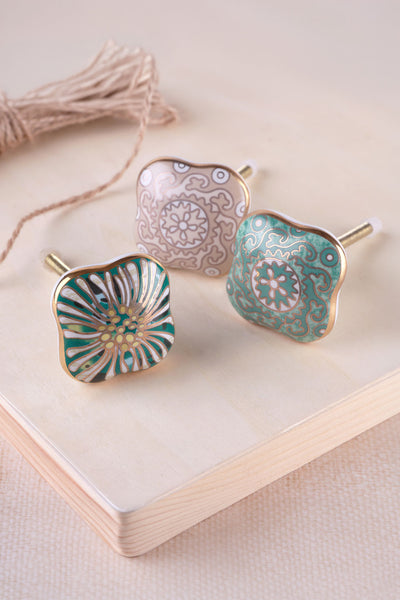
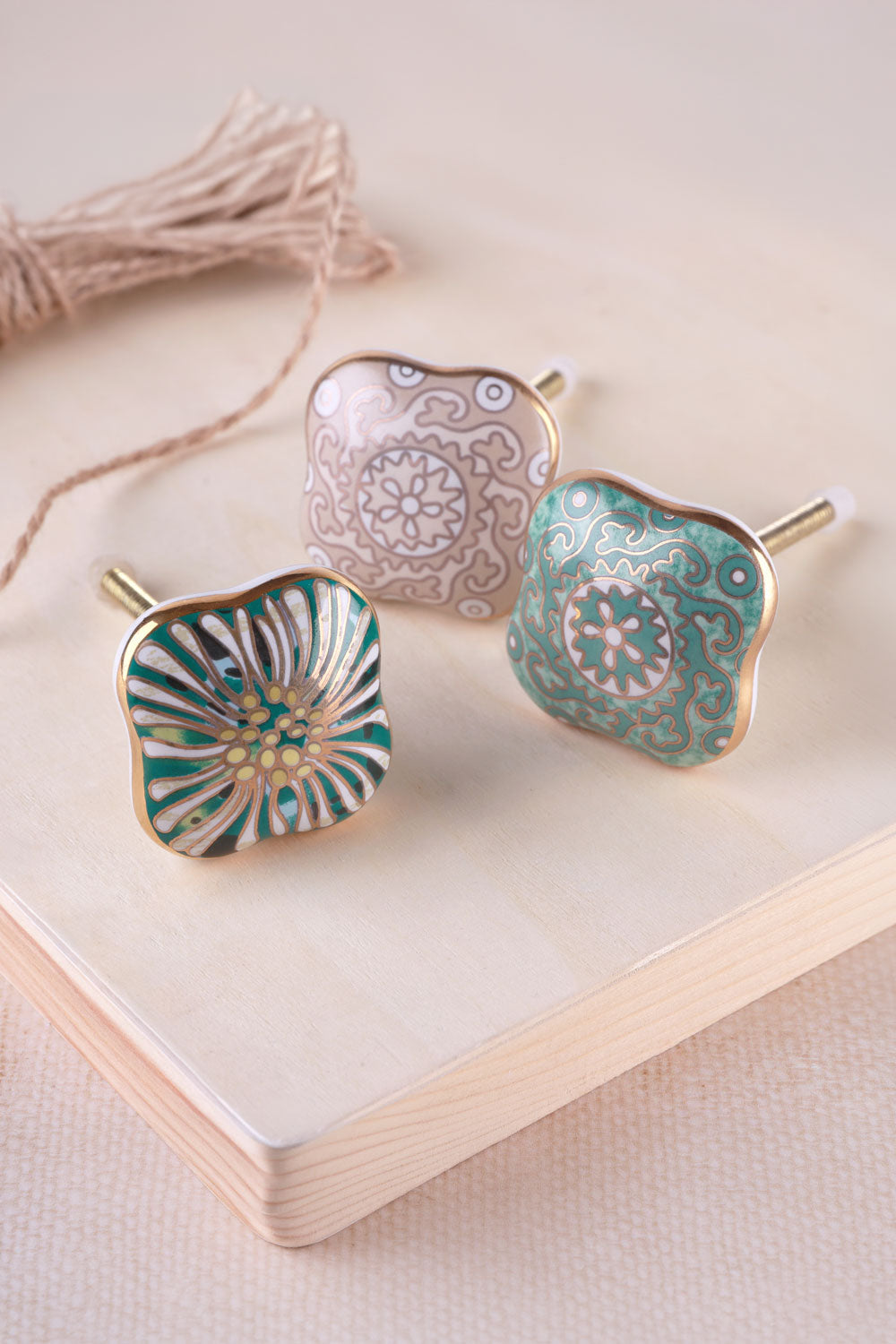
Ceramic is what a Shaker cabinet gains rather than borrows. The Shakers themselves were plain-glazed people, but a hand-painted ceramic knob against a plain painted door reads today the way a quiet detail always does — as the piece that vouches for everything around it. The Milano Signature Ceramic Cabinet Knob, our best-loved piece, is the version we most often specify for Shaker runs — hand-thrown, glazed by hand, and small enough to disappear into the joinery until the hand finds it.
Mother of pearl inlay — the quiet luxury
The Shakers never used it, but a modern Shaker kitchen often can. Mother of pearl inlay set into a polished brass base carries light in a way no painted or plated surface can, and on a run of soft-green Shaker cabinets it reads as the piece that made the cabinets worth painting. The Elizabeth Mother of Pearl Cabinet Knob in Polished Brass is the piece we send to clients who ask for a single considered detail in an otherwise restrained scheme.
Sizing: the small numbers that make it right
The most common mistake on a Shaker kitchen is a knob that is too small for the door. The face frame invites a slightly generous knob — one that reads clearly against the panel — and undersizing looks like an apology.
- Standard Shaker knob diameter: 1 ⅜" (35 mm) is the reliable default. It sits well against the standard 2 ¼" Shaker rail and reads at a normal viewing distance.
- Larger doors (over 24" tall): 1 ½" (38 mm) suits a taller pantry door and doesn't get lost.
- Smaller upper cabinets: 1 ¼" (32 mm) reads neater on 12"–15" upper doors.
- Placement: Knob is set on the stile 2 ½" to 3" from the corner of the door — never on the rail. The eye reads the stile as the vertical accent; the knob completes it.
- One knob per door under 24" wide; a pull, not a knob, on doors wider than that.
For the drawers below the counter, a Shaker kitchen almost always looks best with pulls rather than knobs — the leverage matters, and a small run of cabinet pull handles in the same finish as the knobs above ties the whole room together.
Finish, paint and the pairing that flatters
Shaker cabinetry lives or dies by the paint it is finished in, and the hardware has to speak to the paint. A short pairing guide, drawn from kitchens we have specified over the years :
- Warm white paint — antique brass or hand-painted ceramic with a soft ground.
- Soft sage or olive green — antique brass; mother of pearl for a single accent run.
- Deep forest or hunter green — polished brass; mother of pearl reads as jewellery.
- Moody blue or slate — polished brass or crystal-cut glass; brass warms it, glass cools it further.
- Charcoal or near-black — polished brass for warmth; brushed nickel for a cleaner, more contemporary read.
One finish carries the room; a second, if used, works as a considered accent — never a split. Our full cabinet knobs collection is arranged so a single scheme can be built from it without effort.
Monograms and the personal Shaker touch
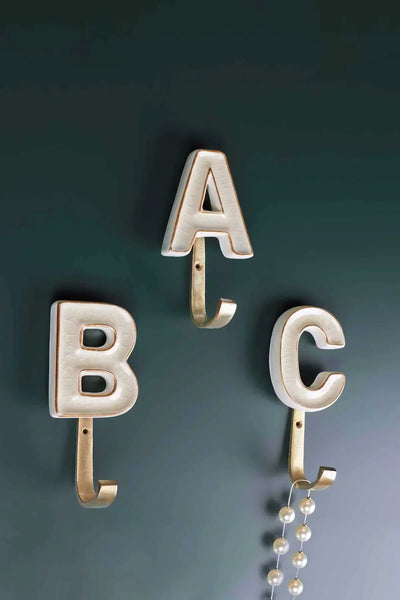
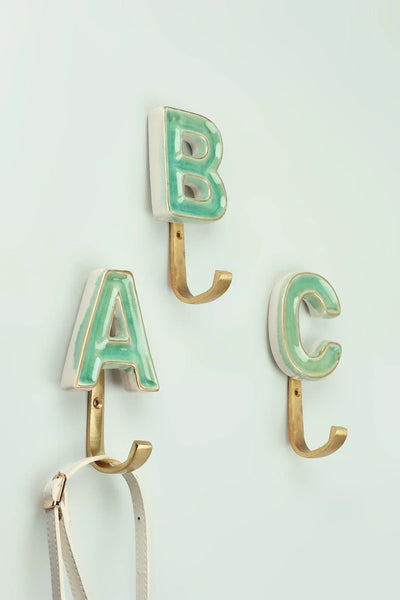
The Shakers would have raised an eyebrow at a monogram, but the modern Shaker kitchen carries them well — a single letter, hand-painted onto a pub-tile ceramic knob, marks a house without shouting about it. The British Pub Tile Monogram Cabinet Knob is a piece often specified for the drinks cabinet or the larder — a house's initial on the door the family reaches for most.
Fitting notes for a US Shaker kitchen
American cabinet doors are almost universally ¾" (19 mm) thick, and our knobs ship with standard threads that suit that dimension. Ceramic knobs are supplied with fixings in the correct length; the separately sold chrome fixing bolts come in three lengths, so a thicker inset or applied panel is easily handled. Tighten by hand to snug, then a quarter turn beyond — no more. Ceramic dislikes compression, and over-tightening is the one avoidable way to shorten the life of a beautiful knob.
Frequently asked questions
What size cabinet knob is best for a Shaker kitchen?
1 ⅜" (35 mm) is the reliable default for Shaker face-frame cabinetry — it reads clearly against a standard 2 ¼" stile without oversizing the door. Move up to 1 ½" for taller pantry doors and down to 1 ¼" for compact upper cabinets. Anything under 1" tends to look apologetic on a Shaker door.
Where should the knob sit on a Shaker cabinet door?
On the stile, 2 ½" to 3" from the corner of the door — never on the rail. The stile is the vertical accent of the Shaker frame, and the knob completes it. Use the corner opposite the hinge; measure from the top corner on lower cabinets and the bottom corner on uppers.
Should I use knobs or pulls in a Shaker kitchen?
Knobs on the doors, pulls on the drawers, is the reliable rule. Knobs sit neatly on a Shaker door and read as native to the style. Drawers ask for the leverage a pull gives, and a run of matching pulls below a run of matching knobs reads as considered rather than uniform.
Do brass knobs suit painted Shaker cabinets?
They are the classic pairing. Antique brass warms soft greens, blues and creams; polished brass sharpens deep greens and moody blues. Solid brass — not plated — will age gently with use, and that gentle patina is part of what makes a painted Shaker kitchen better in year ten than it was in year one.
A final thought
A Shaker kitchen is the rare room that keeps improving as it is used, and the hardware is the piece that carries most of that improvement. Choose knobs and pulls that feel right in the hand, scale to the door, and speak to the paint. The rest of the room was already quiet ; the hardware is what makes the quiet worth listening to.
✥
Explore the Brassworks Edit — our curated range of solid brass cabinet hardware for the considered kitchen.