

The Journal · Brass Hardware
Cabinet Hinges: The Detail No One Notices Until It's Wrong
A guide to choosing cabinet hinges — the quiet detail that decides how a kitchen door swings, wears and reads, from concealed fittings to hand-forged brass, pewter and black iron.
What is it about a cabinet door that either closes with a quiet, satisfying weight or clatters shut like an afterthought? More often than not, the answer isn't the door at all. It's the cabinet hinges holding it — and they are the one piece of kitchen hardware most people never think to choose on purpose.
The detail no one notices until it's wrong
Cabinet knobs get chosen with real care. Pulls get held up against tile samples and debated for weeks. Hinges, meanwhile, tend to arrive as whatever the joiner had on the van — hidden inside the cabinet, doing their job in silence, until one starts to sag, squeak, or let a door swing further than it should. That's usually the first time anyone gives cabinet hinges a second thought.
It's worth giving them a first one. A hinge decides how a door opens, how long it stays properly hung, and — for anyone building a kitchen with visible ironmongery rather than concealed joinery — how the whole run of cabinetry reads. Browse the full range of cabinet hinges and the choice becomes obvious: this is not an afterthought category, it's a design decision with its own materials, finishes and craft traditions.
Concealed, semi-concealed and exposed: the three types
Most modern kitchens use concealed hinges — the spring-loaded, adjustable kind fitted inside the cabinet carcass, invisible when the door is shut. They're practical, self-closing, and disappear entirely into the joinery, which suits a streamlined, handleless scheme.
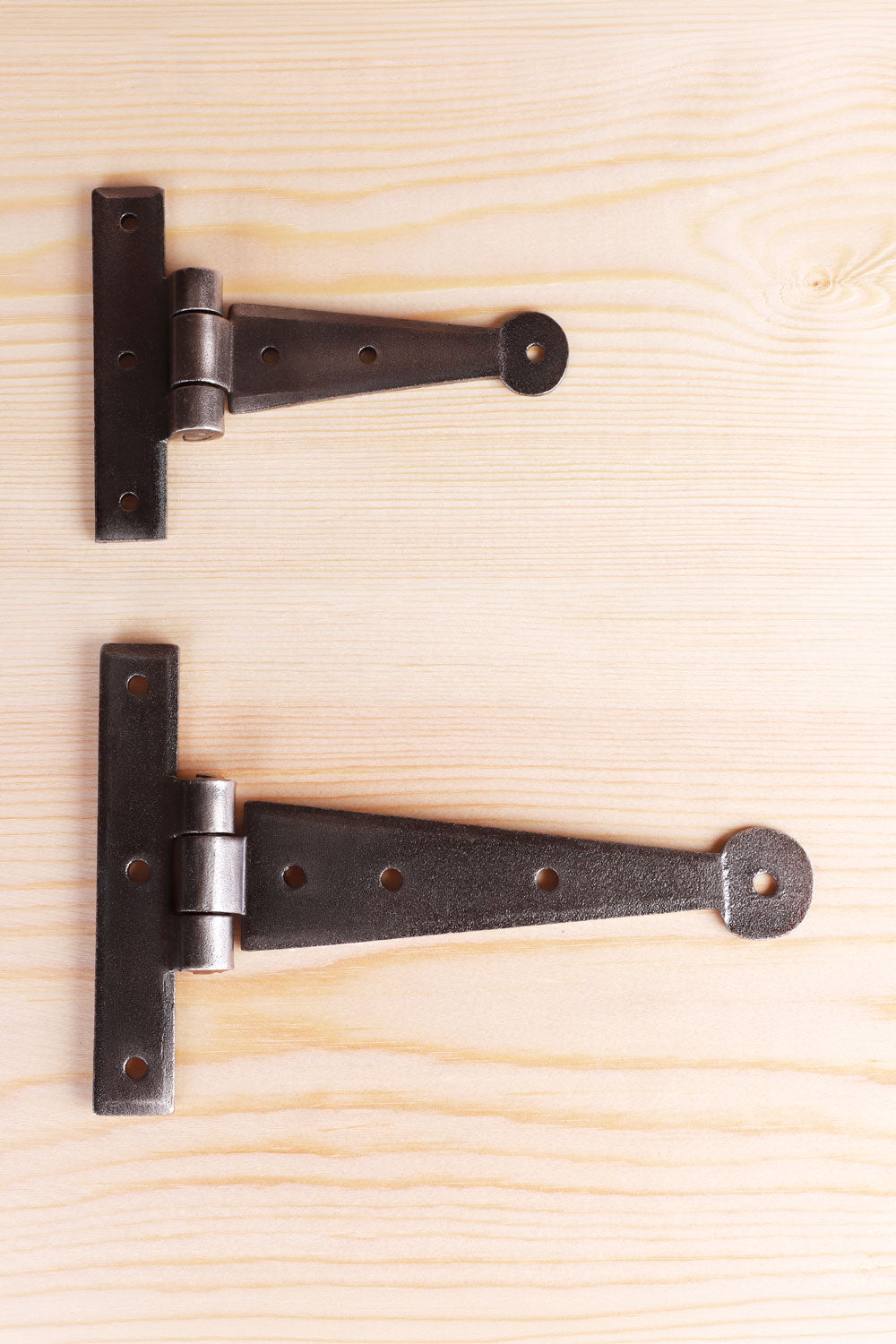
Semi-concealed hinges sit partly on show, usually where a face frame meets the door. But it's the third category — exposed, decorative hinges — that turns hardware into something worth looking at. Strap hinges, H-hinges and penny end T hinges mount directly onto the face of the door and frame, visible every time the cabinet is opened or closed. These are the hinges that belong on a dresser, a larder cupboard, a Shaker-style run of joinery, or anywhere the door itself is part of the room's character rather than something to be hidden.
Material and finish: matching hinges to the room
Once a hinge is visible, it needs to be chosen with the same discipline as a knob or a pull — coordinated with the rest of the cabinet hardware in the room, not selected in isolation.
Brass and pewter
Brass hinges warm a kitchen the way brass knobs and pulls do — they suit painted cabinetry in soft greens, blues and creams, and they age into a gentle patina rather than staying static. Pewter sits a shade cooler and quieter, a considered choice for a scheme built around stone, oak and muted tone rather than gleam.
Black iron and beeswax
A black finish reads as more architectural — sharp against white or pale joinery, and particularly at home in a farmhouse or industrial-leaning kitchen. Beeswax finishes sit somewhere between raw metal and polish: a soft, almost matte warmth that suits reclaimed timber and older properties especially well.
Hand-forged hardware: why the weight matters
There's a reason a hand-forged hinge feels different in the hand before it's even fitted. Pieces like the hand-forged penny end T hinge in pewter finish are shaped individually rather than stamped from sheet metal — each one carries the faint irregularity of having been made by a person, not a machine. That's not a flaw to be engineered out; it's the entire point. A hand-forged hinge holds real weight, swings with real resistance, and doesn't rattle the way a lighter, mass-produced fitting can over time.
The same workshop tradition that shapes a cabinet knob or a cabinet pull applies here — considered materials, finished by hand, made to be used daily rather than admired once and forgotten.
Period kitchens versus modern joinery
In a Georgian, Victorian or Edwardian kitchen, exposed strap and T hinges are historically correct as well as beautiful — the kind of detail that signals a house has been restored with attention rather than simply renovated. A beeswax or black iron finish on a larder door or dresser front sits comfortably alongside period skirting, old stone floors and reclaimed timber.
In a new-build or contemporary kitchen, the choice runs the other way more often: concealed hinges for a flush, handleless run of cabinetry, with decorative hardware reserved for a single feature piece — a drinks cabinet, a pantry door, a run of open shelving with a glazed front. Either approach is legitimate. What matters is that the hinge is chosen to match the door it's hanging, not left to chance.
Getting the fit right
A professional joiner or kitchen fitter will usually have a view on which hinge suits a given door, but it's worth arriving at that conversation with a preference already formed rather than deferring entirely. Bringing a finish sample or a product page to a fitting appointment tends to produce a better result than choosing from whatever's in the trade catalogue on the day.
Cabinet hinges are sold by size and by the weight of door they're built to carry, so it's worth measuring before ordering rather than after. A heavier, solid timber door needs a hinge substantial enough to bear it for years without sagging; a lighter door has more flexibility in finish and scale. Most exposed hinges are sold in pairs, sized for standard cabinet doors, with sizing options for taller or narrower runs.
It's also worth thinking about the hinge alongside the rest of the room's hardware before ordering — door knobs, cupboard pulls and hinges read as a single considered scheme when the finish is consistent, and as three separate decisions when it isn't.
Caring for cabinet hinges over time
A well-made hinge asks very little of a home over the years it's in service. Brass and pewter will develop a soft patina in the same way a knob or pull does, and most owners let that happen naturally rather than polishing it away. Black iron and beeswax finishes need even less attention — an occasional wipe to clear dust from the joint is usually enough to keep a hinge swinging cleanly.
The one thing worth checking periodically is the fixing itself. Screws can work loose on a door that's opened several times a day, and a hinge that's begun to sit slightly proud of the frame is usually a five-minute fix rather than a sign the hardware has failed. Catching it early keeps a heavier door — the kind a hand-forged hinge is built to carry — hanging properly for years.
Frequently asked questions
What's the difference between concealed and exposed cabinet hinges?
Concealed hinges are fitted inside the cabinet carcass and disappear when the door is closed, suiting streamlined, handleless kitchens. Exposed hinges — strap, H-hinge or penny end T styles — mount on the face of the door and frame and stay visible, making them a decorative choice as much as a functional one.
Should cabinet hinges match the knobs and pulls?
They don't need to be identical, but the finish should sit within the same family. A kitchen with brass knobs and a black iron hinge can look unresolved, whereas brass hinges alongside brass or pewter pulls read as a single, considered scheme.
Are hand-forged hinges better than manufactured ones?
Hand-forged hinges are shaped individually rather than stamped, which gives them more substance, a slower swing, and small natural variations that machine-made hardware doesn't have. For a period property or a piece meant to be seen, that character is usually the reason to choose them.
What hinge finish suits a period kitchen?
Beeswax and black iron finishes tend to sit most naturally in Georgian, Victorian and Edwardian properties, echoing the ironmongery those houses were originally fitted with. Brass and pewter work well too, particularly alongside painted cabinetry.
How do I know what size hinge my cabinet needs?
Measure the door's height, width and weight before ordering — a heavier solid timber door needs a more substantial hinge than a lighter panelled one. Most exposed hinges are sold in pairs with a choice of sizes for standard and taller cabinet doors.
A final thought
Cabinet hinges are easy to overlook precisely because they're built to be quiet — but a well-chosen hinge, in the right material and finish, does as much to finish a kitchen as any knob or pull on the front of the door. Fit them with the same care as the rest of the room's hardware and they stop being a functional afterthought and start being part of the design. Explore the full range of cabinet hinges to find the weight, finish and style that suits your own kitchen. With more than 700 verified reviews on Trustpilot and over 2,000 store reviews on Judge.me, our pieces are trusted in homes across the UK, US, Europe and Australia.