

The Journal · Cabinet Knobs
Mother of Pearl Drawer Pulls: The Complete Guide
The complete guide to mother of pearl drawer pulls and cabinet knobs — what nacre is, where it is ethically sourced, how it catches light, which cabinet colours flatter it, and how to care for a piece that will outlast the room it is fitted to.
Mother of pearl is the only material in a kitchen that changes as the light moves across it. A brass pull is warm and consistent ; a glass one is bright and constant. A mother of pearl inlay is different at eleven in the morning than it is at four in the afternoon, and different again by lamplight. Fit one to a drawer you open every day, and the drawer becomes something else.
What mother of pearl actually is
Mother of pearl — nacre, if we are being technical — is the iridescent inner lining of a marine shell. It is what an oyster produces to line its own shell, and what a pearl is made of when the same substance forms in layers around a grain of grit. Nacre is built up from microscopic hexagonal platelets of aragonite, layered like tiny bricks and separated by a protein glue. The result is a surface that is simultaneously very hard (harder than most glass), very tough (it resists fracture in ways single-crystal materials cannot), and optically extraordinary.
The optical extraordinariness is what makes it a hardware material. Because nacre is built of layers of a specific thickness — thinner than the wavelength of visible light — it produces iridescence by interference : light entering the surface bounces between layers, and different colours emerge at different angles. It is the same principle that colours a soap bubble or a butterfly wing, and it is why a mother of pearl knob looks pink from one angle, silver from another and pale gold from a third.
Where the shell comes from
Most decorative mother of pearl in hardware today comes from freshwater mussels farmed in India and Southeast Asia — the same industry that supplies buttons, guitar inlays and fine musical instruments. Farmed nacre is the responsible source ; wild-collected shell from over-exploited species should be avoided, and reputable makers can identify their supply chain if asked. Our own inlay pieces are cut from farmed freshwater shell and set by hand into solid polished-brass bases in workshops we have worked with for many years.
Why mother of pearl reads as jewellery on a cabinet
Cabinet hardware is one of the few categories where the material is the design. The shape of a knob is almost always simple ; the way it catches light and returns it is what carries the piece. Mother of pearl carries light more actively than any other cabinet material, and that is why it reads as jewellery where brass reads as hardware and glass reads as decoration.
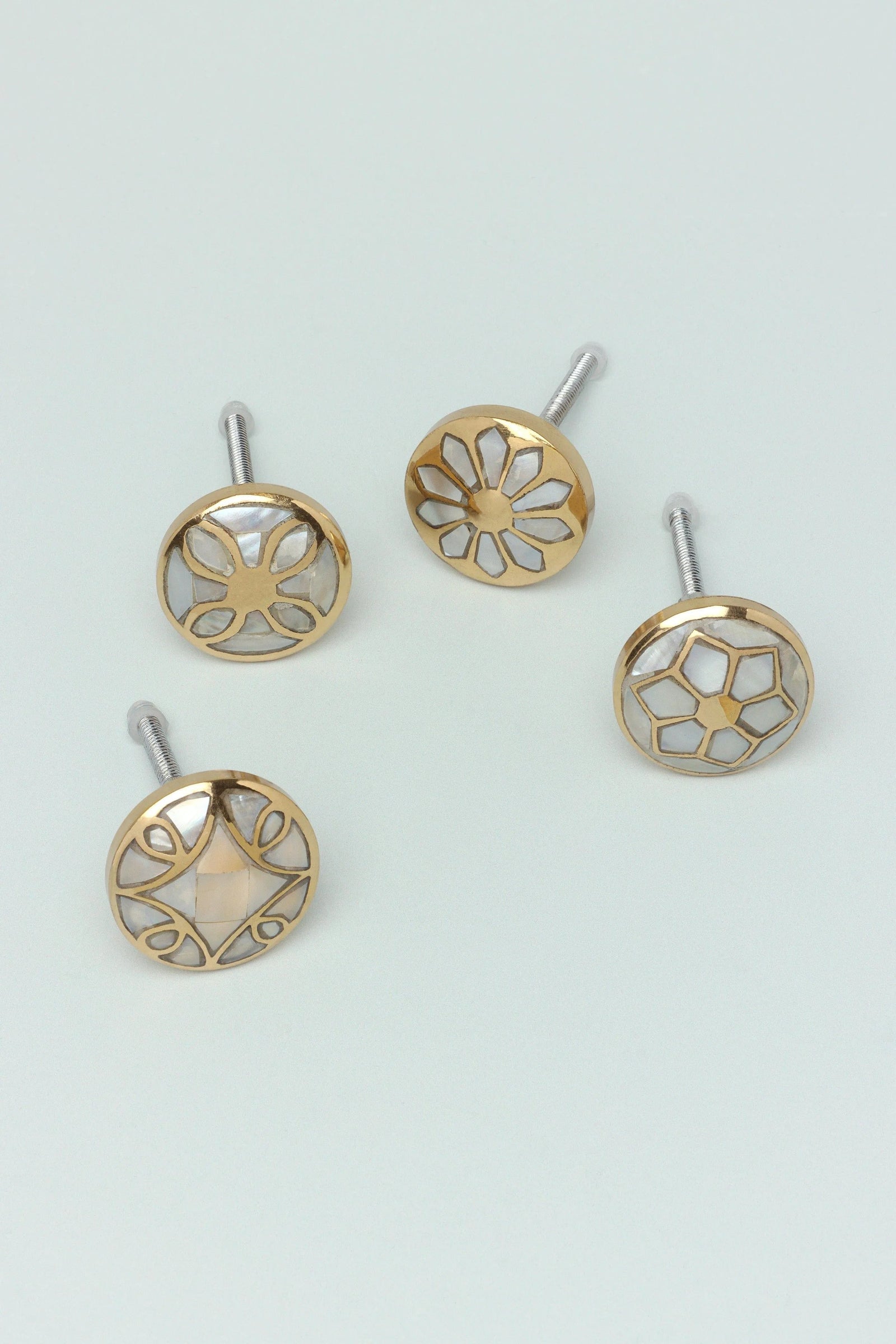
The Elizabeth Mother of Pearl Cabinet Knob in Polished Brass is the piece we most often specify as a first mother-of-pearl introduction to a scheme — a hand-cut inlay pattern set into a solid brass base, at 1 ½" diameter, that reads as a single considered detail on a run of otherwise restrained cabinetry. It is the piece that makes a client understand why the material has been used for cabinetry for two hundred years.
The cabinet colours that flatter mother of pearl
Mother of pearl is not a neutral. It has an iridescent range that runs from pale pink through silver to soft gold, and the cabinet colour behind it decides which of those tones the eye reads first. Four palettes flatter it most :
Deep forest and hunter green
The most reliable pairing. Against a deep green painted cabinet, the pale silvers and pinks of mother of pearl read as jewellery on velvet — cool against warm, iridescent against matte. This is the pairing we specify most often for statement built-ins and dressing-room cabinetry.
Warm white and cream
The quieter reading. On a warm-white kitchen cabinet, mother of pearl and polished brass together warm and lift the cabinetry without introducing colour. The Elizabeth range does its softest work against Alabaster, White Dove or Simply White.
Moody blue and slate
The cooler, more contemplative pairing. Against a deep petrol blue or a slate grey, mother of pearl reads silver-forward, with the pinks receding — a colder, more architectural effect that suits a bedroom or a bathroom cabinet more than a busy kitchen.
Charcoal and near-black
The dressiest pairing. Against very dark cabinetry, mother of pearl reads at its most jewel-like — the iridescence is amplified by the darkness behind it, and the brass base glows against the dark ground. Reserve for statement pieces ; a full run at this contrast can feel overworked.
What mother of pearl does not do : sit comfortably against a heavily patterned or textured cabinet. Its own quiet complexity does its best work against a plain painted or lacquered ground.
The complete-the-room trio
Mother of pearl in one place is a detail ; mother of pearl in three places is a scheme. For clients who want the material to carry a room rather than accent it, we specify three pieces from the same family :
- The knob — the Elizabeth Mother of Pearl Cabinet Knob in Polished Brass, on the doors.
- The pull — the Elizabeth Legacy Mother of Pearl Cabinet Pull Knob, on the drawers.
- The set — the Elizabeth Mother of Pearl and Polished Brass Cabinet Knob Set, for the built-ins.
For a matching hallway or dressing-room hook, the wall hooks collection carries pieces in the same polished-brass finish that read as part of the same family.
Sizing and placement
Mother of pearl is a naturally quiet material, and it earns its keep at 1 ¼" to 1 ½" (32–38 mm) rather than smaller — the iridescence needs surface area to read. Below 1" the piece can look like an inclusion rather than a knob ; above 1 ¾" the brass base begins to dominate. For pulls, the Legacy at its listed centre-to-centre suits standard drawer widths ; two pulls placed at the third points work well on wider drawers, and let the iridescence catch light from two positions rather than one.
Placement follows standard American practice — knob on the stile 2 ½" to 3" from the corner of the door opposite the hinge, pull centred left-to-right and slightly above centre top-to-bottom on deeper drawers. Our full US sizing guide covers the placement conventions in detail.
Care — the small habits that keep it right
Mother of pearl is hard, tough and long-lived, but it is a natural material and it dislikes the same chemicals that any natural surface does. The care regimen is straightforward :
- Dry cloth for dust, barely damp cloth for marks. A soft microfibre works well.
- No abrasives. Even mild kitchen scrub cream will dull the surface over time ; the iridescence lives in the outermost microns.
- No acidic or bleach-based sprays. Citrus cleaners and bleach both etch nacre ; the damage is invisible at first and cumulative.
- Wipe up spills promptly. Standing wine or vinegar left overnight on a mother-of-pearl surface can leave a permanent dulling.
Do this small amount and mother of pearl outlasts almost any other cabinet finish. Some of the most beautiful surviving examples of nacre inlay hardware — on nineteenth-century American dressers, Anglo-Indian writing boxes, Georgian tea caddies — have had two hundred years of daily use and still read exactly as their makers intended.
Frequently asked questions
What is mother of pearl?
Mother of pearl (nacre) is the iridescent inner lining of a marine or freshwater shell. It is built up from microscopic layers of aragonite bonded by protein, and its layered structure produces iridescence by light interference — the same optical effect that colours a soap bubble or a butterfly wing. It is one of the oldest decorative materials in furniture and hardware.
Is mother of pearl hardware durable?
Yes — nacre is harder than most glass and tougher (more fracture-resistant) than a single-crystal material of comparable hardness, and mother of pearl inlay hardware from the nineteenth century regularly survives in daily use today. Modern pieces set into solid polished brass bases carry the same longevity, provided they are cleaned gently and kept away from acidic or abrasive chemicals.
What cabinet colours look best with mother of pearl?
Deep forest green is the most reliable — the iridescence reads as jewellery on velvet. Warm white and cream give the softest, quietest reading. Moody blues and slate greys push the tone toward silver ; charcoal and near-black amplify the iridescence at its most jewel-like. Mother of pearl does its best work against plain painted or lacquered cabinetry rather than heavily patterned or textured surfaces.
How do I clean a mother of pearl knob or pull?
Dust with a soft dry cloth ; lift marks with a barely damp one. Avoid all abrasive cleaners, citrus-based sprays and bleach — nacre lives in the outermost microns of the piece and these chemicals will dull it over time. Wipe up spills promptly. With this small care, a mother of pearl piece will outlast the cabinet it is fitted to.
Is the mother of pearl in G Decor hardware ethically sourced?
Yes. Our inlay is cut from farmed freshwater shell — the responsibly farmed source that also supplies fine buttons, guitar inlays and musical instruments — and set by hand into solid polished-brass bases in workshops we have worked with for many years. No wild-collected shell from over-exploited species is used.
A final thought
Mother of pearl is the material that quietly rewards attention — different at every angle, different at every hour of the day, different every year as the room around it changes. Fit a single Elizabeth knob to a considered cabinet and the cabinet becomes the piece the eye returns to. Fit a matched trio and the whole room reorganises itself around them.
✥
Explore the Mother of Pearl Cabinet Knobs collection — inlay set into solid polished brass, designed in England.