

The Journal · Buying Guide
How to Choose Glassware for the Home: A British Guide
A British guide to choosing glassware that works for everyday and occasion — the seven shapes worth owning, what to look for in quality, and how to build a collection that earns its place.
There's a particular pleasure in drinking from a properly weighted glass. You only notice it when it's missing — when the wine you've poured into a thin, cheap thing tastes thinner than it should, when the gin and tonic at the second pub of the evening lands differently because the glass was right. Most people never put it into words, but glassware shapes the experience of the drink. The shape matters. The weight matters. The way the rim sits against the lip matters.
This is a guide to choosing glassware for the home. Not a complete oenophile's bible — just a practical short read on the shapes worth owning, what makes a good glass good, and how to build a collection that doesn't feel like the bits-and-pieces accident of fifteen years of half-remembered gifts.
The seven shapes worth owning
You don't need fifteen different shapes of glass to live a glassware-considered life. You need seven. Three for wine, three for spirits and water, and one for champagne. The rest are nice to have. These seven cover almost everything.
1. The everyday wine glass. A single shape that handles both red and white. The Italians call this an universale — a balanced bowl, neither too narrow nor too wide, that lets red breathe enough and keeps white cold enough. Around 350–450ml capacity. If you only want one wine glass, this is it. Buy six.
2. The red-wine glass. When you've moved past one-size-fits-all. Slightly larger bowl, more rounded, opens up the nose of heavier reds (Bordeaux, Rhône, Barolo). 500–700ml. Buy four if you regularly drink red with company.
3. The white-wine glass. Smaller, more elongated bowl that holds white wine at temperature longer. Tighter rim concentrates the more delicate aromatics. 300–400ml. Buy four.
4. The tumbler. The hardest-working glass in the house. Spirits on the rocks, water at lunch, soft drinks, juice, the late-night glass of milk. A weighty crystal or hammered-glass tumbler is what gives a small everyday drink a sense of occasion. 250–350ml. Buy six.
5. The highball. Tall, slim, for long drinks — gin and tonic, vodka soda, whisky highball, iced coffee in summer. 350–450ml. Buy four.
6. The coupe (or martini). The cocktail glass. The coupe is having its moment because it's prettier than the martini glass and more stable. Either works. For the occasional negroni, manhattan, or any drink that should be served up rather than over ice. Buy four.
7. The champagne flute (or coupe again). Tall, narrow, holds the bubbles. Four is enough for most households — you can stretch to six if you host New Year's Eve regularly.
That's it. Twenty-eight glasses across seven shapes covers wine, water, spirits, cocktails, and celebrations. Anything beyond is a luxury, not a necessity.
What makes a good glass good
Two things, mostly: the weight, and the rim.
Weight tells you about the glass itself. A heavier glass feels substantial in the hand and sits steadily on a soft tablecloth. A glass that's too light feels cheap. A glass that's too heavy is tiring at a long lunch. The sweet spot for an everyday tumbler is around 200–250g; for a wine glass, 150–200g.
The rim is the single most underrated quality in a glass. A thin, smooth rim feels almost invisible against the lip; a thick, rolled rim breaks the experience of the drink. This is the thing that separates a hand-blown wine glass from a supermarket one in the same shape. If you can only invest in one thing, invest in glasses with a thin, polished rim. You'll feel it every time.
Beyond those two: clarity (the glass should be optically clear, not slightly cloudy), stability (the base should feel planted, not tippy), and the join between bowl and stem (it should feel like one continuous form, not glued together). Hand-blown glasses fail none of these tests. Mass-produced glasses sometimes fail all four.
Crystal, hand-blown, or pressed?
Three broad categories of glassware quality. Worth knowing the difference.
Crystal contains a small percentage of lead oxide or barium oxide, which gives the glass extra weight, extra clarity, and the ringing sound when you tap a rim. Modern crystal is almost always lead-free; the optical qualities come from barium or potassium oxide instead. Crystal catches light beautifully — the way a tumbler glints under a lamp at dusk is half the reason you put a tray together in the first place.
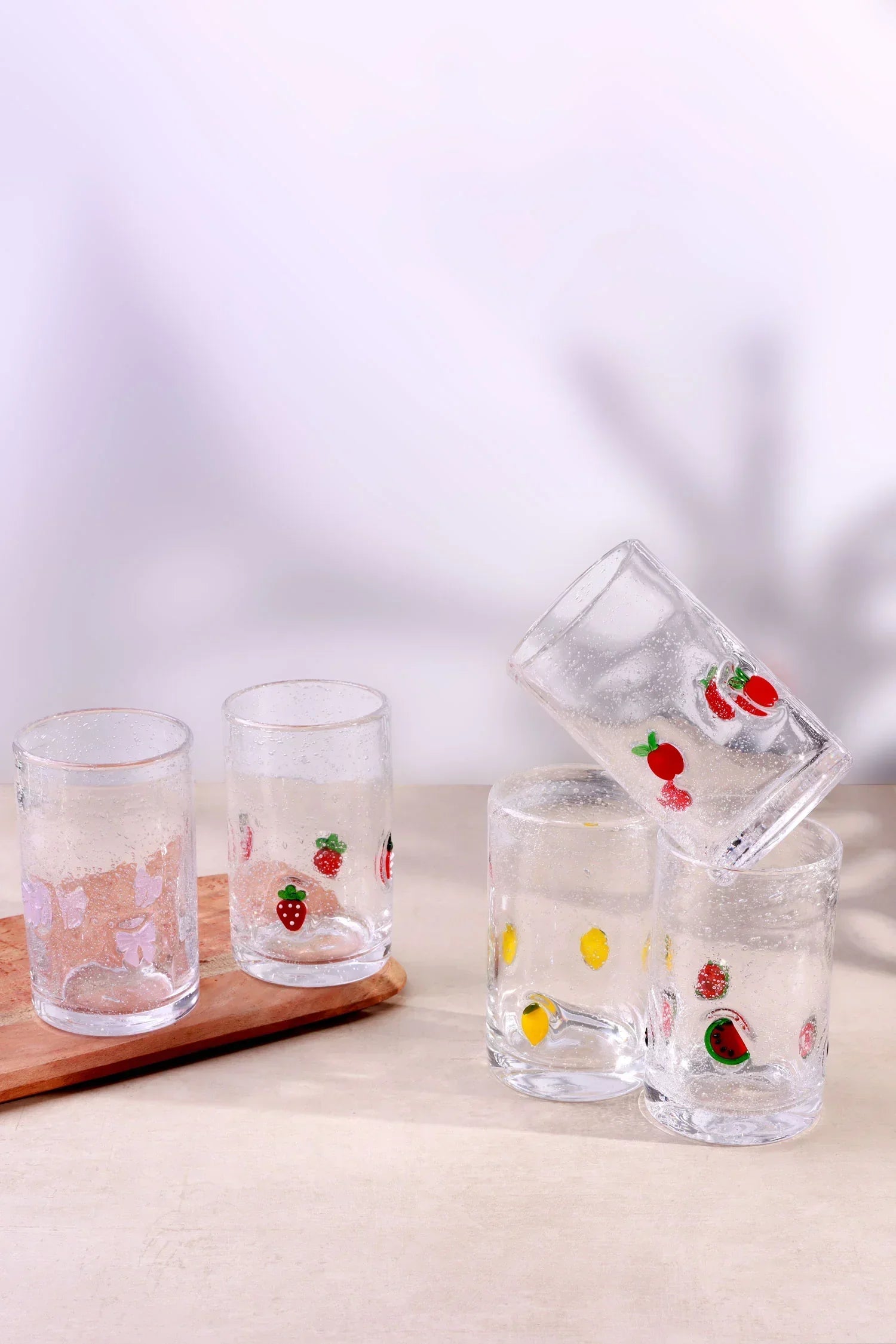
Hand-blown glass is shaped by hand from molten glass — you'll see slight variations in form, sometimes tiny bubbles caught in the glass, asymmetries that tell you it was made by a person. The texture varies from piece to piece. Most of the glassware worth owning is hand-blown.
Pressed glass is moulded — cheaper, more uniform, less interesting. Fine for picnic glasses, the kids' tumblers, water glasses for everyday. Not what you want for the wine you opened on a Friday.
A reasonable home collection mixes all three. Crystal tumblers and wine glasses for the dining table. Hand-blown glasses for the special pieces. Pressed glass for the garden and the picnic basket.
The drinks tray and the cupboard — two storage philosophies
If you want your glassware to be used and enjoyed, store it where you can see it. A few wine glasses upside-down on a kitchen shelf. Four tumblers on the drinks tray. A pair of coupes set out on the sideboard. The pieces in a cupboard get used for special occasions; the pieces on display get used every day.
The exception is fragile crystal and the second set of champagne flutes, which can live behind a closed door. Everything else — use it weekly or store it in the loft.
For more on the drinks corner specifically, our editorial on the drinks tray at twilight covers what to put on a tray, where it sits, and the lamp that makes the whole thing work.
Four common mistakes
Buying twelve when you need six. A set of twelve looks generous on the shelf and sad in the cupboard when half of them break in the first three years. Buy six, replace as needed. The set will evolve.
Skipping the everyday tumbler. Most people overspend on wine glasses and underspend on tumblers. The tumbler gets used three times more often. Spend the money there.
Choosing complicated shapes for everyday. The Riedel-style varietal-specific glasses (Pinot Noir glass, Sauvignon Blanc glass, etc.) are wonderful for tasting and impractical for everyday. They take up cupboard space, break easily, and don't add much for the average bottle. Save them for the dedicated wine collection. For everyday, the universal shape wins.
Buying all clear. A coloured or textured glass — amber, smoke, hammered finish, gold rim — lifts a table out of clinical neutrality. Don't fill the entire collection with colour, but a single set of four iridescent or coloured glasses gives the drinks tray its character.
Building a collection from scratch — the order
If you're starting fresh and don't have any glassware to speak of, here's the order we'd buy in. Each line is one purchase, and you don't need the next until you've used the previous for a few months.
Round one: six everyday wine glasses + six tumblers. The two shapes that handle 80% of all drinks. Get these in good crystal or hand-blown form. Buy them together so they look related.
Round two: four champagne flutes + four highballs. Special occasions and long drinks. The flutes don't need to match the wine glasses, but should match each other.
Round three: four coupes (or martinis) + a pair of decanters. Now you're cocktail-ready. A decanter for spirits (gin in summer, whisky in winter) and a smaller one for water at the table.
Round four: red and white wine glasses, four each. The dedicated varietal shapes. By the time you're at this stage you know what you drink most.
A note on care
Hand-wash anything you care about. Dishwashers etch the surface of crystal over time, leaving microscopic scratches that dull the clarity. The hand-blown pieces, the ones with gold rims, the heirloom crystal — always hand-wash, in warm soapy water, rinsed in clean water, dried immediately with a soft linen cloth.
The pressed water tumblers can go in the dishwasher. Everything else, no.
Store wine glasses right-way-up if they're on a shelf (the rims are the most fragile part — don't rest them on the rim). Store tumblers upside-down only if the shelf is dust-free.
The pleasure of getting it right
A well-considered set of glassware is one of the small pieces of furnishing that pays back every day. You'll pour a glass of water from the tap on a Tuesday afternoon and notice that the tumbler in your hand feels right. You'll set a Sunday lunch with matching wine glasses and the table will look intentional without your having to do anything else.
None of this needs to be expensive. A set of six universal wine glasses, six tumblers, and a pair of coupes — chosen properly, kept properly — will outlast a decade of dinner parties and feel better than any luxury kitchen gadget you could buy in their place.
Browse our Glassware collection, Wine Glasses, Tumblers, Cocktail Glasses, and Carafes & Jugs. For evening styling, read our editorial on the drinks tray at twilight.