


The Journal · Drawer Pulls
Farmhouse Drawer Pulls: A Design Guide for the American Kitchen
A design guide to farmhouse drawer pulls for the American kitchen — aged brass, forged iron and hammered finishes, correct sizing for pan drawers, and the warm-white palette that lets the hardware carry the room.
The American farmhouse kitchen is one of the great modern rooms — familiar, generous, and quietly precise about the details that make it work. The drawer pull is the detail that most often decides whether the room reads as heritage or as pastiche.
American farmhouse, British country — the distinction that matters
The two traditions get conflated, and they shouldn't. A British country kitchen carries the weight of a very old cottage — flagged floors, deep Belfast sink, ranges built into inglenooks, and a lineage of paints in soft, dust-fatigued colours. The American farmhouse kitchen, as we have come to know it in the last decade, is a modern room drawing on nineteenth-century Midwestern and Southern vernacular — the wide plank floor, the apron-front sink, the tall pantry cabinet, the mix of painted lower cabinetry with open shelving above.
The style that lit up American kitchens through the mid-2010s — the Chip & Jo era, the Fixer Upper period — took that vernacular and made it a design vocabulary. Shiplap walls. Exposed shelving. White cabinets over deep wood counters. And, at the drawer, a substantial cast pull in aged brass or forged iron that gave the whole room its centre of gravity. The pull is what keeps the modern farmhouse kitchen from tipping into farmhouse chic ; it is the one place the room lets a craftsman speak.
The three finishes that read as farmhouse — and one that doesn't
Aged and antique brass — the softest read
Aged brass is the modern farmhouse's most versatile finish. Warm, slightly bronzed, and chemically softened rather than mirror-bright, it sits handsomely against a warm-white cabinet and picks up the tone of walnut or oak counters. On drawer pulls it does the great trick of the American vernacular kitchen — it looks as if it has always been there. Our Vintage Brass Cabinet Knob is the small end of the same family, and pairs naturally with a brass bar pull across the drawers.
Hand-forged iron — the honest read
Iron, hand-forged and finished in wax or matte black, is the farmhouse's older grandfather finish. On a wide pan drawer, a forged pull in beeswax or black reads as the piece the local smith might have made, and pairs beautifully with a range cooker, a butcher-block counter or a farmhouse sink. The Penny End Hand-Forged Iron Pull Handle in Beeswax Finish is the piece we most often specify — supplied in three lengths, so a full kitchen can be fitted from a single family. Its matte-black sibling reads a shade more graphic, and suits a moody-charcoal or deep-green lower run.
Hammered and beaten brass — the tactile read
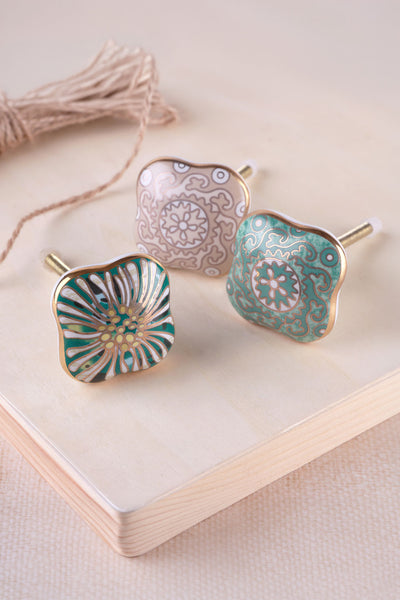
Where a smooth finish is too polite, a hammered surface gives the hand something to notice. The Hand Forged Hammered Beaten Cupboard Door Knob is the piece for the sink cabinet, the spice drawer or the range hood plinth — the small places in a farmhouse kitchen where the eye lands often and the finish should reward the second look.
What doesn't work — polished chrome
Polished chrome is a fine finish in a great many kitchens, but the modern farmhouse is not one of them. Chrome reads as bathroom, or as commercial, and pulls the room in a direction its cabinetry cannot follow. The rule is warm, aged, or forged ; the exception is unlacquered nickel on a specifically antique-leaning scheme.
Sizing farmhouse pulls: the numbers that matter
Farmhouse cabinetry runs to generous drawers — deep pan drawers under the cooktop, tall pantry pull-outs, wide utensil drawers — and the pulls should be sized for the load and the eye at once. Pull sizes are quoted by centre-to-centre — the distance between the fixing holes, not the overall length of the pull.
- 3" (76 mm) c-to-c — narrow cutlery drawers under 12" wide. Overall length around 4".
- 3 ¾" (96 mm) c-to-c — standard drawers 12"–18" wide. The reliable American default.
- 5" (128 mm) c-to-c — drawers 18"–24" wide. The workhorse pull for most farmhouse kitchens.
- 6 ¼" (160 mm) c-to-c — pan drawers 24"–30" wide, and pantry pull-outs.
- 8" (203 mm) c-to-c and up — appliance drawers, wide pan drawers 30"+, integrated fridge fronts.
The reliable rule is that a pull should be roughly one-third the width of the drawer it is fitted to. On drawers wider than 36", two pulls placed at the third points look more considered than a single long pull. Always confirm the centre-to-centre measurement before ordering ; a pull with the wrong c-to-c will not fit the holes already drilled in the drawer face.
The warm-white palette that lets the hardware do the work
The American farmhouse kitchen is built on a warm-white lower and upper run — Alabaster, White Dove, Simply White, Swiss Coffee — with a wood counter or a marble-look quartz above. Against that ground, aged brass reads as jewellery ; against a cool white (bright white, pure white), the same brass can read yellow. The paint decides the pull as much as the pull decides the paint.
For a farmhouse scheme moving in a moodier direction — deep forest green lowers, warm white uppers — forged iron and aged brass both look right, and mixing them by zone works well : iron on the deep drawers below the cooktop, brass on the wall cabinets. Our writing on cabinet pulls, materials and mixed metals covers the mixing principles in more detail.
Cup pulls and the farmhouse drawer
No shape reads as farmhouse more immediately than the cup pull — a shell of brass or iron grasped from below, the working piece of a nineteenth-century apothecary drawer. Cup pulls suit a Shaker or beaded-face-frame drawer in soft green, cream or blue paint, and are almost the only pull that improves with a slight patina. They are the kinder choice for the traditional farmhouse ; the bar pull is the modern read.
Fitting notes
American drawer faces are typically ¾" (19 mm) thick and take standard-thread machine screws. Order slightly longer screws for pan drawers with applied panels or thick moulding — the small extra purchase matters over a decade of use. Tighten by hand to snug, then a quarter turn ; never with a driver on high torque, which strips the drawer face and, over time, loosens the pull.
Order one or two spare pulls with the initial run. A dropped pull during fitting is easily replaced from stock ; six months on, matching a discontinued finish is a small ordeal. The cabinet pull handles collection is deliberately deep in the finishes that anchor a farmhouse kitchen, and every piece is sold singly so a full room can be fitted precisely.
Frequently asked questions
What size drawer pull is best for a farmhouse kitchen?
The reliable default is 5" (128 mm) centre-to-centre for standard 18"–24" drawers ; step up to 6 ¼" (160 mm) for pan drawers up to 30", and 8" (203 mm) or greater for pantry pull-outs and appliance drawers. The pull should be roughly one-third the width of the drawer ; below 12", a 3" cup pull or a knob is often the kinder choice.
What finish should I choose for a modern farmhouse kitchen?
Aged or antique brass is the most versatile — warm, slightly bronzed, and flattering against a warm-white cabinet. Hand-forged iron in beeswax or matte black reads as the honest, older-farmhouse choice, particularly against dark greens or deep charcoals. Polished chrome is the finish to avoid ; it reads as bathroom on a farmhouse cabinet.
Can I mix brass and iron in a farmhouse kitchen?
Yes — and the best modern farmhouse kitchens do. Iron on the deep pan drawers below the cooktop, brass on the wall cabinets and pantry, is a common scheme that reads as collected rather than confused. Keep one finish dominant at roughly 70% of the visible hardware ; distribute the second across the room rather than zoning it.
Do farmhouse drawer pulls need special installation?
Standard-thread machine screws in a length matched to your drawer face — typically ¾" (19 mm) — will fit almost any American cabinet. Order slightly longer screws for pan drawers with applied panels. Confirm the centre-to-centre measurement carefully before drilling ; changing a pull to a different c-to-c leaves visible holes in the drawer front.
A final thought
The farmhouse kitchen is a room that is used hard, and the pull in the palm at six in the morning is the piece that decides whether the room feels considered or merely styled. Choose finishes that will age with the house rather than against it, and the room will look better in year ten than it did in year one.
✥
Explore the Brassworks Edit — solid brass and forged iron for the American farmhouse kitchen.