


The Journal · British Design
A Reading Corner You'll Actually Use
A designer's guide to building a reading corner you'll actually use — the chair, the light, the surface within reach and the quiet details that make a corner one you return to each evening.
What separates a reading corner you actually use from one that quietly becomes a place to drop the laundry? Not the square footage, nor the price of the chair. A reading corner that earns its keep is one that has been arranged around a single honest question: would you genuinely want to sit here, at the end of a long day, with a book and nothing else?
What makes a reading corner you'll actually use
Most reading corners fail for the same reason. They are designed to look like reading corners rather than to be sat in. The chair is handsome but shallow. The lamp is decorative but throws light at the ceiling rather than the page. The little table is too far to reach without leaning. Everything photographs beautifully and no one ever sits there.
A reading corner that works is built from the body outward. It begins with how you actually read — slumped, curled, one leg tucked under, a cup of something within reach — and arranges the furniture and light to serve that, rather than to impress a visitor who will never use it. Get the comfort right and the corner will be used every evening. Get only the look right and it becomes, within a fortnight, a very elegant shelf for folded washing.
The chair comes first
Everything else in a reading corner is in service of the chair, so the chair is the one decision worth taking slowly.
Sit before you choose
The test is simple and uncompromising: can you sit in it for an hour without shifting? A reading chair needs depth enough to tuck your legs, a back high enough to rest your head against, and arms at a height that supports a book without hunching the shoulders. A dining chair, however lovely, will never do this. Nor will a chair chosen only for its silhouette.
Wing-backs, club chairs and the honest armchair
The classic reading chair is enclosing — a wing-back that shields you from the draught and the room, or a deep club chair you sink into rather than perch on. In a country house, a generous armchair with a loose linen cover reads as the obvious choice. In a city flat, something tighter and more upholstered keeps the corner from feeling bulky. Either way, choose the chair for the way it holds you, not for the way it sits empty.
Light you can read by
A reading corner lives or dies by its light. Overhead lighting alone is hopeless — it throws shadow onto the page and floods the room with the wrong mood for an evening with a book. What the corner needs is its own dedicated source, low and warm, placed so the light falls over the shoulder and onto the page rather than into the eyes.
A table lamp does this best. Browse our lighting for a piece with a shade that directs light downward — a fabric or pleated shade softens the glow in a way a bare bulb never will. Something like the Ananas Doré table lamp earns its place twice over: it casts a warm pool of reading light by night and stands as a considered object by day. Set it on the table beside the chair, at roughly shoulder height when seated, and the corner will pull you in after dark.
If you can, put the lamp on a switch or a plug you can reach without standing — the small friction of crossing the room to turn off a light is enough to stop a corner being used last thing at night.
The surface beside the chair
A reading corner needs somewhere to put things down. Not a coffee table marooned in the middle of the room, but a small surface within arm's reach of the seated hand — close enough that a cup of tea, a book laid face-down, and a pair of glasses can all live there without a stretch.
A side table, a stool, or even a stack of large books will do the job, provided it sits at the right height: roughly level with the arm of the chair. Too low and you reach down for everything; too high and the surface dominates. On it, keep only what the corner needs — the lamp, a coaster, a candle, perhaps a single small object that pleases you each time you glance at it.
Warmth, texture and the things worth glancing at
A reading corner should feel softer than the rest of the room. This is partly texture — a wool throw over the arm, a cushion at the small of the back, a rug underfoot so the first step out of the chair lands somewhere warm — and partly the small, personal objects that make a corner feel like yours rather than a showroom's.
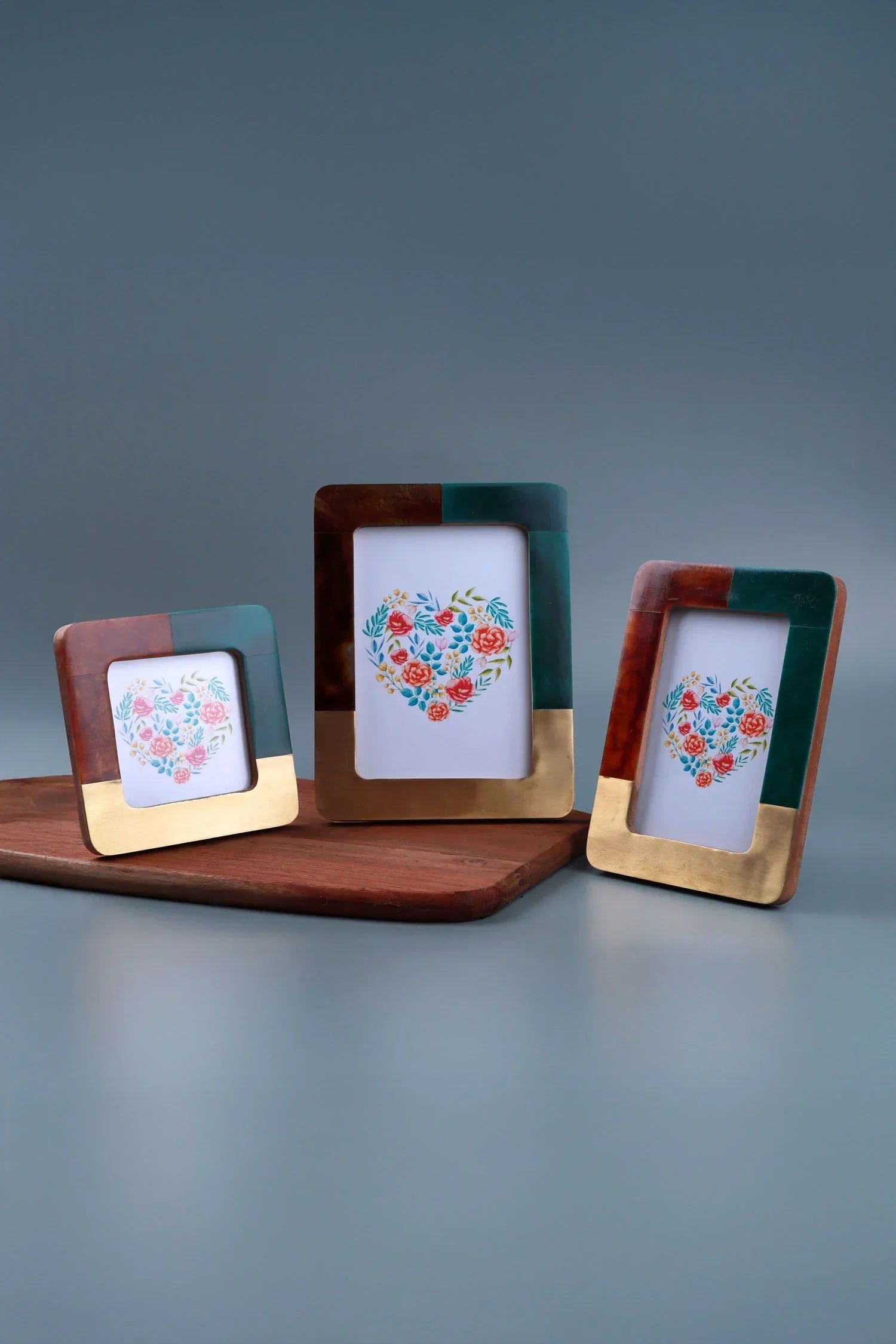
A framed photograph on the side table is one of the quietest of these. A piece like the Lucca bone-inlay frame, in vintage green and aged brass, holds a single picture in a way that rewards a second look — exactly the kind of object that belongs within glancing distance of a reading chair. Browse our home décor and signature pieces for the one or two objects that make the corner personal, and resist the urge to add a third. A reading corner is a place of few things, well chosen.
A single stem or a small plant softens the corner further. A low planter or vase on the windowsill or the side table brings a note of green that a corner built for stillness particularly wants. One is enough.
Atmosphere: the candle and the quiet
The last layer is the one that turns a well-furnished corner into a place you look forward to. A candle, lit ten minutes before you sit, does more for the mood of a reading corner than any amount of furniture. Choose a fragrance from a quiet family — woody, green, or lightly spiced — rather than anything sweet enough to compete with your concentration. A scented candle such as the Rasa Aranya patchouli and citrus candle settles a room without demanding attention.
For the evenings you'd rather not have a flame burning, a piece of home fragrance — a diffuser, a quiet reed — keeps the corner smelling cared-for between candles. Pick one fragrance and let it own the corner, rather than layering competing scents that pull the mind in three directions.
Where to put a reading corner
The best spot for a reading corner is usually one a room offers up rather than one you impose. A bay window, the wall beside a fireplace, the quiet end of a bedroom, the turn of a landing wide enough for a chair. Look for somewhere a little out of the through-traffic, where the chair can face into the room or out of a window, and where there is a wall behind to give a feeling of enclosure.
Natural light matters less than you might think — a reading corner is most used after dark, which is why the lamp earns its keep. What matters more is a sense of being slightly apart: a corner that feels like a small room within a larger one. Even a single chair, a lamp, and a side table, arranged with care in an overlooked spot, will outperform a grander attempt marooned in the middle of the floor.
Frequently asked questions
What is the most important element of a reading corner?
The chair, without question. A reading corner you'll actually use begins with a chair you can sit in comfortably for an hour — deep enough to tuck your legs, high enough to rest your head, with arms that support a book. Everything else, from the lamp to the side table, is arranged in service of the chair.
What kind of lamp is best for reading?
A table lamp with a shade that directs light downward, placed at roughly shoulder height beside the chair so the light falls over the shoulder onto the page. Avoid relying on overhead lighting alone, which casts shadow onto the book and sets the wrong mood for an evening of reading.
How much space do I need for a reading corner?
Less than most people assume. A single chair, a small side table within arm's reach, and a lamp will fit into a bay window, the corner of a bedroom, or a wide landing. The feeling of being slightly apart from the room matters far more than the floor area.
Where should I put a reading corner in my home?
Look for a spot a little out of the household's through-traffic, ideally with a wall behind the chair for a sense of enclosure — beside a fireplace, in a bay window, or at the quiet end of a bedroom. A corner that feels like a small room within a larger one will always be used more than one in the middle of the floor.
How do I stop my reading corner becoming a dumping ground?
Keep the surface beside the chair almost empty — the lamp, a coaster, a candle, and one object you like. Give everything else, particularly the things that tend to migrate to a quiet chair, a proper home elsewhere. A corner with little on it stays a reading corner; a corner with somewhere to pile things becomes a shelf.
A final thought
A reading corner you'll actually use is never the grandest corner in the house. It is the most honest one: a comfortable chair, a warm lamp, a surface within reach, a candle, and one or two objects worth glancing at. Arranged with care in an overlooked spot, it becomes the place you drift to without thinking — which is the only real measure of whether a reading corner works.
Begin with our lighting, home décor and scented candles, and build the corner one considered piece at a time. With more than 700 verified reviews on Trustpilot and over 2,000 store reviews on Judge.me, our pieces are trusted in homes across the UK, US, Europe and Australia.
Further reading
- How to Arrange the Perfect Bedroom — Layout, light and the quiet decisions that make a bedroom rest you.
- How to Choose Table Lamps for the Home — A designer's guide to light, scale and atmosphere, lamp by lamp.
- The Mantelpiece: How to Style One Without Cluttering It — The art of arranging a surface so it reads as considered, not crowded.