

The Journal · Brass Hardware
The Front-Door Hardware Edit: Brass, Iron and Considered Detail
A British designer's edit of front-door hardware — knockers, knobs, letterplates and the brass details that make a house feel arrived at.
What is the first thing a guest touches when they reach your house? A front door is the introduction — long before the room behind it. The hardware on it does quiet, important work: a brass knocker, a heavy knob, a letterplate that closes with the right small clack. Considered front-door hardware is what turns a painted door into a welcome.
Why the front door deserves its own conversation
Inside the house, hardware is part of a wider scheme — cabinet knobs talk to the worktop, door knobs talk to the joinery. The front door is different. It stands alone, framed by brick or stone, and its hardware is the only ornament it gets. A handsome painted door let down by a thin, plated knocker reads as half-finished. The same door with a piece of solid brass front-door hardware on it reads as a house someone cares about.
This is the part of the house that meets the street, the postman, the neighbours and every guest. It is also the part that ages most visibly, exposed to the weather and used several times a day. The pieces that go on it should be made for that life: cast brass, solid iron, hand-finished, weighty in the hand.
The pieces that make up a front door
Most British front doors carry four or five pieces of hardware, and the relationship between them is what separates a considered door from a hastily fitted one.
The knocker
The knocker is the focal point. It sits at eye level, it is the piece that catches the light, and it is the one detail a guest sees from the path. A heavy cast-brass knocker — a Woodpecker, an Owl, a Windsor, a Lion — carries character that a generic ring or modern doorbell never quite manages.
The knob or handle
Front-door knobs are heavier and broader than internal ones, designed to be pulled rather than turned. They sit lower than internal knobs — usually centred about a metre from the floor — and their finish should agree with the knocker above.
The letterplate
A horizontal letterplate is the more traditional choice for British homes; vertical letterplates suit Edwardian and Arts-and-Crafts doors. Either way, weight matters: a heavy hinged plate that closes with a soft clack is the small acoustic detail that signals quality.
The escutcheon and the numbers
The keyhole escutcheon and the house numbers are the supporting cast. They are small, but if they don't match the rest of the family, the eye notices. Buy them as a set, in the same finish, at the same time.
The bell push
If a doorbell is fitted, a brass bell-push is the considered version. It sits beside the door rather than competing with the knocker, and it ages alongside the rest of the hardware.
Brass: the language of welcome
Polished brass is the historical material of British front-door hardware, and it remains the most flattering choice on almost every paint colour. On a black door it reads sharp and confident; on a navy door it reads classical; on a deep green door it reads country house; on a Georgian off-white it reads quietly grand.
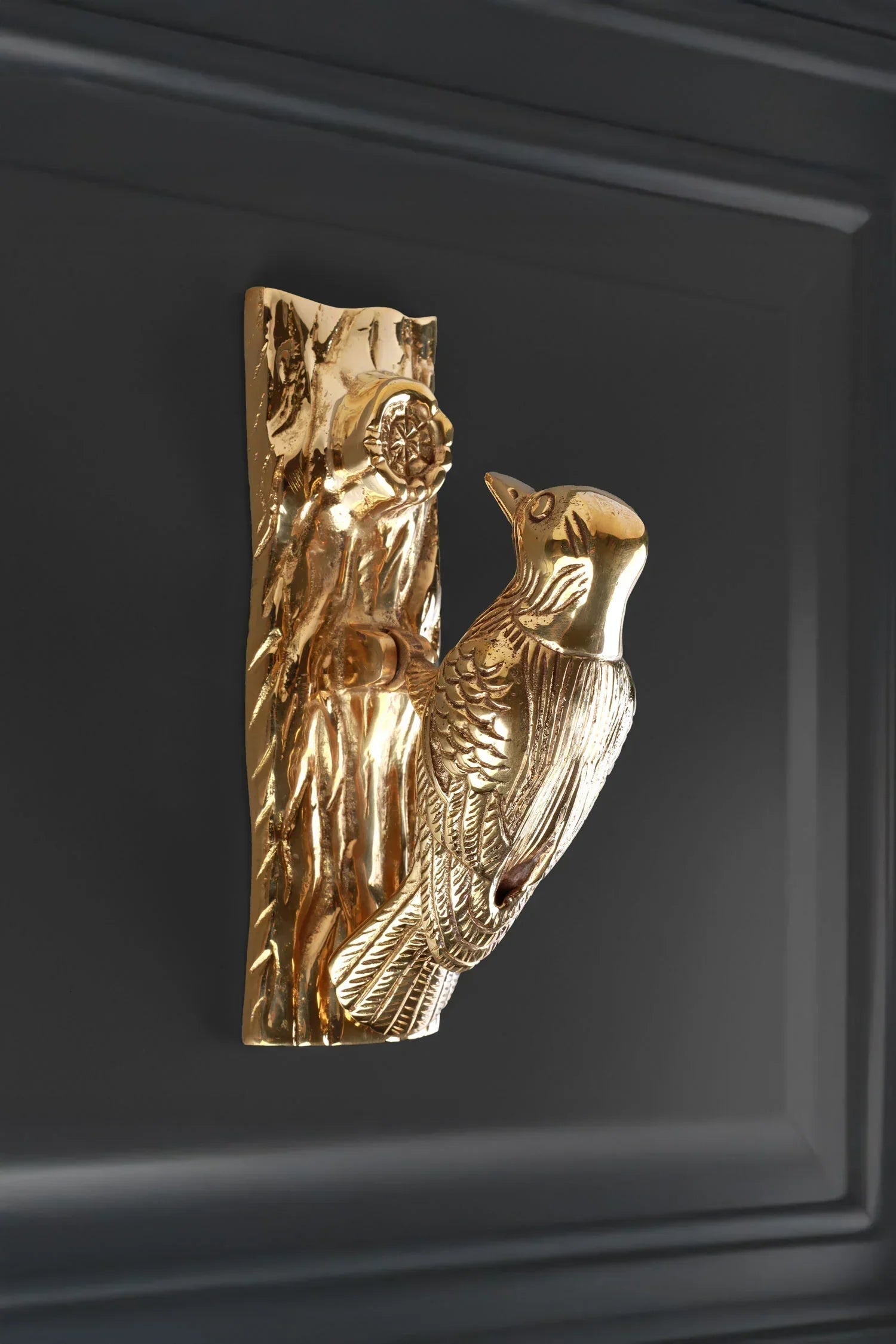
What makes a brass piece read as considered rather than ornamental is the casting. Solid cast brass has weight in the hand, sharp definition in the modelling, and a depth of colour that plated brass cannot match. A Woodpecker polished brass knocker is a useful example — the cast detail in the feathers and the heft of the bird in the hand is the difference between a piece of hardware and a piece of small sculpture.
Brass also ages well. Left untreated, it develops a soft patina that deepens the warmth of the finish. Polished back to its bright tone, it returns to the sharper, more formal look it had on the day it was fitted. Either reading is correct; the choice depends on the door.
Iron and the older British vocabulary
Iron is the older language of British ironmongery and it suits a different kind of house — cottages, farm doors, stone-fronted Georgian houses in market towns, anywhere with a heavier door. Black-painted iron carries a quieter authority than brass. It is also the right choice for a door that gets full weather: rain, sun, frost.
The trick with iron is to commit. A door that mixes a thin iron knocker with a brass letterplate and chrome numbers reads as unsure. Choose iron, choose it for every piece, and let the door speak in one register.
Choosing a knocker: a quick designer's edit
The knocker is the piece that does most of the work, so it deserves the most thought. The full front-door furniture collection covers most of the options, but the choice usually narrows down to a few families.
The figurative knocker
A figurative cast — a Woodpecker, an Owl, a Bee, a Dragonfly, a Lion — carries personality. It says something about the household. An Owl knocker suits an older house, particularly one set back behind a planted front garden. A Woodpecker suits a townhouse where the door faces the street directly and the cast detail will be read at close range.
The architectural knocker
A Windsor-style knocker — plain, columnar, restrained — is the right answer when the door wants its colour and the brickwork around it to do the talking. It works particularly well on Georgian and early-Victorian frontages.
The ring knocker
The simple brass ring is the oldest and quietest form. It suits cottages, rectories, and any door where the rest of the elevation is doing the architectural work. The ring is also the easiest piece to live with in a busy household: nothing to catch, nothing to dust.
Period homes: what suits which front door
Different periods of British house ask for different things from the front door. Get the period right and the door looks correct; get it wrong and it always looks slightly off.
Georgian (c.1714–1830)
Georgian doors are panelled, painted, and sit behind a fanlight. They suit polished brass in restrained forms — a plain knob, a ring or columnar knocker, a horizontal letterplate, plain numbers. Symmetry matters. The fewer competing shapes, the better.
Victorian (c.1837–1901)
Victorian doors are more decorative — stained-glass panels, deeper mouldings, sometimes tiled porches. They will carry a more figurative knocker, a heavier knob and a substantial letterplate. Polished brass is the traditional choice; aged brass works equally well on a darker painted door.
Edwardian (c.1901–1910)
Edwardian frontages are softer, often with leaded glass and a deeper porch. A vertical letterplate, a slim columnar knocker and a brass knob work harmoniously here. The lighter touch suits the period.
Arts and Crafts, cottage and rural
Older rural doors carry iron more comfortably than brass. A black iron ring knocker, a hand-forged thumb latch, iron numbers — the whole door speaks of an older craft tradition. This is the only context where iron is almost always the right answer.
Mid-century and modern
Modern doors prefer simpler forms. A plain brass ring knocker, slim sans-serif numbers and a brushed-brass or matte-black letterplate sit comfortably on a flush painted door. Restraint is the rule.
Maintenance, patina and the long view
Brass front-door hardware develops a patina within a few months, particularly in coastal and damp British climates. Most owners come to prefer this softer tone; if you want to hold the brighter finish, a soft polish once or twice a year is enough. Avoid abrasive cleaners and avoid harsh metal polishes — a microfibre cloth and a gentle brass cream is the considered approach.
Lacquered brass holds its bright finish for longer but eventually wears at the touch points — around the knocker, the knob, the letterplate edge — and these wear marks read as part of the door's history rather than a defect. Iron asks less of you: a wax once a year keeps it from rusting and that is essentially the whole maintenance schedule.
For the wider hardware family across the house, the Brassworks edit and the broader hardware collection are built to age in the same key.
Putting it together: the considered front door
A finished front door is the sum of small agreements. The knocker and the knob share a finish. The letterplate sits horizontally on a Victorian or Georgian door, vertically on an Edwardian one. The escutcheon is the same brass as everything else. The numbers are the same family of font and finish. The bell push, if there is one, agrees with the knocker. None of these decisions are loud on their own. Together they read as a household that has thought about its threshold.
The same logic carries inside. The brass on the front door can echo the internal door knobs in the hall, the door furniture on the rooms beyond, and the wider tone of the house. The threshold becomes the first note in a longer chord.
Frequently asked questions
What is the right height for a door knocker?
A door knocker sits at roughly head height — around 1.5 to 1.6 metres from the floor for most British doors. It should be high enough that a guest's hand falls to it naturally, and low enough that it is clearly visible from the path.
Polished brass or aged brass for a front door?
Polished brass reads as classical and rewards doors in deep, saturated colours — navy, forest green, glossy black. Aged or antique brass carries warmth and pairs comfortably with paler doors and weathered frontages. Both are correct; the door tells you which.
Will brass front-door hardware tarnish in the British climate?
Solid brass will develop a patina, particularly within a mile or two of the coast. Most owners come to prefer this. A soft polish once or twice a year holds the brighter tone if you prefer it; lacquered brass slows the process down further.
Should the front-door knob and knocker match?
Yes — they should share a finish and ideally come from the same family. The eye reads matched hardware as deliberate and mixed hardware as accidental. Do the knocker first and bring the knob and letterplate in over the following months if needed.
Can I fit a knocker to a uPVC or composite door?
Yes, but it needs care. Composite doors will take a knocker, but the fixings should be appropriate for the door's construction — a long bolt with a backing plate is usually the right approach. Avoid drilling into the visible glazed panel of any door.
A final thought
Front-door hardware is the smallest investment in the elevation of a house and the most visible. Choose solid pieces, cast rather than stamped, in a finish that suits the door and the period of the house. Buy the set as a family, fit them together, and let them age into the door. Browse the full front-door furniture collection when you are ready to give your threshold the welcome it deserves. With more than 700 verified reviews on Trustpilot and over 2,000 store reviews on Judge.me, our pieces are trusted in homes across the UK, US, Europe and Australia.
Further reading
- British Craft: How a Hand-Painted Knob Gets Made — The workshop, the hands, the kiln. Why hand-finished hardware looks alive.
- Ceramic vs Brass vs Chrome Door Knobs: Which Finish Suits Your Home? — Three finishes, side by side — when each one wins and how to combine them without a showroom look.
- How to Choose Brass Finishes: A Material Guide — Natural, antique, polished and beeswax — a short guide to the brass finishes we work with.