


The Journal · behind the brand
British Craft: How a Hand-Painted Knob Gets Made
Behind every G Decor ceramic knob is a specific human — someone who shapes it, glazes it, paints it, fires it. A look inside the process: the workshop, the materials, the hands, and why hand-finished hardware looks alive in a way machine-made pieces never can.
G · Stories · No. X · Craft & Makers
A G Decor Guide
Question: why does a hand-painted ceramic knob look alive in a way a mass-produced one doesn't? Because every step of its making was done by a person. Someone shaped it, glazed it, painted it, fired it. Held it twice, looked at it three times, set it aside if it wasn't right. The thing carries the marks of every hand that touched it.
This is a short look inside how a G Decor ceramic knob actually gets made. The workshop, the steps, the hands, and what each stage adds to a piece you'll touch a thousand times before you stop noticing it.
The starting material: clay, water, time
It begins with porcelain clay — a fine white clay that fires hard, smooth, and almost translucent. The clay arrives at the workshop in damp blocks, ready to be wedged (kneaded by hand) to remove air bubbles. An air bubble in clay becomes a crack in the kiln, so this step matters.
The wedged clay is then shaped — either pressed into moulds for consistent forms or thrown on a wheel for one-off pieces. Most G Decor knobs are pressed in plaster moulds, then trimmed and finished by hand once the clay is leather-hard (firm enough to handle but still soft enough to carve).
The first firing: bisque
The shaped clay piece is left to dry slowly — usually for several days — until all the water has evaporated. A piece that's still damp will explode in the kiln. Once dry, the piece goes through its first firing at around 980°C. This is the bisque firing.
Bisque firing turns soft clay into a hard but porous ceramic. The piece is now stable, can be handled, and is ready to take glaze. It looks chalky and matte at this stage — nothing like the finished knob.
Glazing and painting
This is the stage that gives the knob its colour and character. The bisque piece is dipped or brushed with liquid glaze — a fine suspension of glass particles in water. The glaze sits on the surface of the clay until it's fired again.
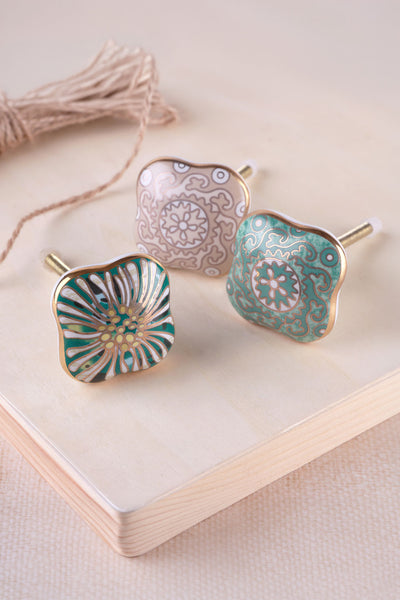
For our hand-painted knobs, this is also where the design is added. A skilled painter sits at a bench with a small brush and paints the pattern directly onto the glazed surface — the dots, the stripes, the floral motifs, the gold accents. Each piece is painted individually, by hand, which is why no two are identical.
This is the stage that takes the longest and the stage where craft most clearly shows. The painter's hand wobbles slightly. The brush carries more glaze on some strokes than others. The pattern is consistent in feeling but not in detail. These are the marks of human work, and they're what make a hand-painted knob feel different from one printed by a machine.
The second firing: glaze
The glazed and painted piece goes through a second firing — this time hotter, around 1220°C. At this temperature, the glaze melts into a smooth glassy surface, fusing to the ceramic underneath. The painted pattern becomes permanent.
This is where the colour develops too. Many ceramic colours look one shade before firing and finish completely different after. The painter has to know what each colour will become — the green that's grey before firing, the blue that's almost white, the gold that's brown until the heat brings out its true colour.
The kiln runs for a full day for this firing. The pieces are loaded carefully so they don't touch each other (the molten glaze would fuse them together), and unloaded only when fully cooled the next day.
The brass base
Most G Decor mortice door knobs and many cabinet knobs sit on a solid brass base. The brass is cast separately in a foundry — molten brass poured into sand moulds, cooled, removed, and finished. The base is then turned on a lathe to give it the precise threading needed to hold the spindle and screws.
Brass casting is its own craft. The brass-worker decides the alloy, monitors the temperature, removes imperfections by hand. A poor casting has voids or cracks; a good one is solid and weighs more than you'd expect.
Assembly
Ceramic top, brass base, and the small hardware that joins them — spindle, screws, washers — come together at the assembly bench. Each finished piece is checked: the ceramic for chips or cracks, the painting for consistency, the brass for proper threading, the assembly for fit.
Pieces that don't meet the standard go back. The seconds market exists because not every piece comes out perfect, but the pieces that ship are the ones that did.
Why this process matters
The whole sequence — clay to bisque to glaze to firing to brass to assembly — takes about three weeks per batch. A mass-produced plastic knob takes about three minutes.
The difference shows up in three ways:
- Visual character. The hand-painted pattern, the slight glaze variation, the weight of brass — these read as craft rather than product. People notice without being able to say why.
- Tactile feel. Ceramic and brass weigh more than plastic. They feel cool to the touch, then warm to body temperature. They feel substantial in a way machine-made hardware doesn't.
- How they age. A hand-painted knob softens beautifully over years of use. The brass develops a patina. The ceramic stays exactly as it was. A plastic knob fades, scratches, and starts looking old within a year.
The economics of craft
A hand-painted ceramic knob from G Decor costs roughly five to fifteen times what a mass-produced plastic equivalent costs. Most of that difference is human time — the painter, the kiln operator, the brass-worker, the assembler. The clay and glaze themselves cost very little.
Which is why hand-finished hardware will always cost more than the alternative, and always be worth it for the people who care. The price is paying for the time of the people who made it.
Frequently asked questions
Are all G Decor ceramic knobs hand-painted?
Most are. Some patterns are screen-printed for consistency, then finished by hand. The product description on each piece notes whether it's fully hand-painted or hand-finished.
Why do hand-painted knobs vary slightly between pieces?
Because they're made by people, not machines. Slight variation is part of the appeal. Customers who want absolute uniformity should choose machine-finished pieces; customers who want character should embrace the variation.
How long do hand-painted ceramic knobs last?
Decades. The glaze is fired at 1220°C and is essentially permanent. With normal household use, a hand-painted knob will outlast the door it's mounted on.
What's the difference between bisque and glaze firing?
Bisque is the first firing at around 980°C, which hardens the clay. Glaze is the second firing at around 1220°C, which melts the glaze into a smooth permanent surface and locks in the painted pattern.
Where are G Decor ceramic knobs made?
G Decor is designed in England, with manufacturing through small-batch craft workshops. We're a Proud Member of Made in Britain, and our craft and sourcing is documented on our Responsibility page.
A final note
Every hand-painted knob carries the marks of the people who made it. The clay shaped by one hand, the glaze applied by another, the pattern painted by a third, the brass cast by a fourth. The piece you mount on a door is the result of dozens of small human decisions made over three weeks — which is why it looks alive in a way nothing made in three minutes ever can.
Browse G Decor's hand-finished door knobs and cabinet knobs. With more than 700 verified reviews on Trustpilot and over 2,000 store reviews on Judge.me, our pieces are trusted in homes across the UK, US, Europe and Australia.
Further reading
- How We Make a Hand-Painted Monogram — A letter, painted by hand, fired into glaze. The five-step process behind every monogram piece.
- Ceramic vs Brass vs Chrome Door Knobs: Which Finish Suits Your Home? — Three finishes, side by side — when each one wins and how to combine them without a showroom look.
- How to Choose Brass Finishes: A Material Guide — Natural, antique, polished and beeswax — a short guide to the brass finishes we work with.