

The Journal · British Design
A Guide to Cabinet Pulls: Materials, Sizing and Choosing for Your Kitchen
A designer's guide to cabinet pulls — when to choose a pull over a knob, how to size them, the materials worth specifying, and how mixed finishes work in a considered kitchen.
Hardware is the jewellery of a room — noticed first by the hand, then by the eye. A cabinet pull says more about a kitchen than the paint colour, the worktop or the splashback.
Why a cabinet pull matters as much as the cabinet
Pull a kitchen drawer twenty times a day for ten years and the small piece of metal in your hand has done as much work as the floor beneath your feet. Cabinet hardware is the most touched part of any kitchen, and the part most easily got wrong — a thin pressed-steel pull on an otherwise beautiful Shaker run, an oversized cup on a slim drawer, a colour temperature that fights the lighting overhead. The hardware is the detail that finishes a kitchen, and the one most often left until last.
Done well, a considered range of cabinet pulls turns a kitchen from joinery into design. The hand reaches for a substantial piece of cast brass that has the right weight, the right warmth, the right small shape, and the experience of opening a drawer becomes a quiet pleasure rather than an afterthought. The cost of the hardware against the cost of the kitchen is almost negligible; the difference it makes is anything but.
This guide sets out the small set of principles that separate the hardware that earns its keep from the hardware that merely closes the cupboards. Pull versus knob. Centre-to-centre measurement. Material and finish. Mixed metals. And the rule of thirds that quietly governs the whole.
Pull or knob? The first decision, and how to make it
Before any question of material or finish, decide between pull and knob. Both are valid; both have their places. The rule, drawn from cabinetmakers who have done a thousand kitchens, is simple enough :
Use knobs on doors — the wall cabinets, the larder cupboards, the single doors below a worktop. A knob is grasped with the fingertips, suits a smaller pulling force, and reads neat on a vertical face. A run of cabinet knobs across upper cabinets is one of the kindest looks in a traditional kitchen.
Use pulls on drawers — deep pan drawers, cutlery drawers, larder pull-outs. A drawer needs leverage that a knob cannot provide; pull a heavy pan drawer with a knob and the fingers tire by the second week. A pull, grasped with the whole hand, distributes the load and feels right.
Use pulls on oversized doors — the tall larder, the fridge integration, the appliance garage door. Anything over about 600 mm of height or 500 mm of width benefits from a pull, both for the leverage and for the visual proportion. A small knob on a tall door looks lost.
Many of the best modern kitchens mix the two — knobs on the wall cabinets and pulls on the drawers and tall units below. This is not a compromise; it is the correct answer. The eye reads it as considered. A uniform run of knobs through both upper and lower cabinets is also fine, particularly in a smaller kitchen, but in a generous run, the mix is more interesting.
How to measure: centre-to-centre, and what the numbers mean
Cabinet pull sizes are quoted as centre-to-centre measurements — the distance from the centre of one fixing hole to the centre of the other. This number, not the overall length, is what matters when ordering; it is what determines whether the pull will line up with the holes drilled in the drawer.
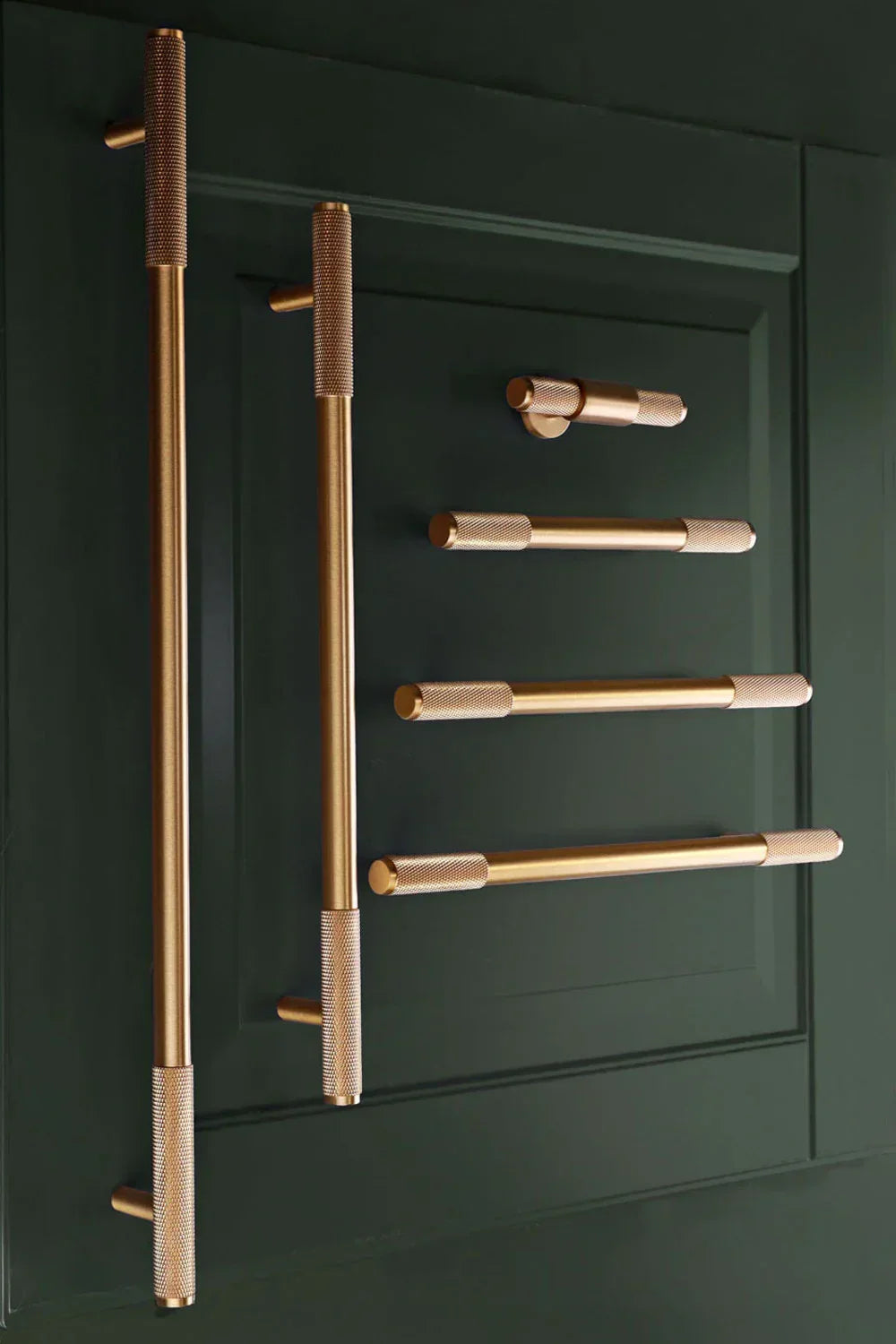
Common centre-to-centre measurements : 96 mm, 128 mm, 160 mm, 192 mm, 224 mm, 256 mm, 320 mm. Most pulls also come in 320 mm and above for very wide drawers, oversized larders, and fridges. The overall length of the pull (sometimes called the "length overall" or LOA) is always slightly longer than the centre-to-centre measurement — typically by 20 to 50 mm depending on the design.
For a new kitchen, agree the centre-to-centre measurement with the cabinet maker before the drilling is done. For a refresh of an existing kitchen, measure the existing holes carefully — some online retailers will accept a stated centre-to-centre measurement only, others will let you filter by it. A pull with the wrong centre-to-centre cannot be made to fit without re-drilling, which leaves visible holes in the drawer front.
The rule of thirds: scaling pulls to the drawer
A pull that is too small for its drawer looks apologetic; a pull that is too large for it looks comic. The same rule of proportion that governs almost every other design decision applies here, neatly summarised :
The pull should be roughly one-third the width of the drawer. A 600 mm drawer carries a pull of around 200 mm; a 900 mm drawer carries one of around 300 mm; a 1200 mm pan drawer can carry a single pull of around 400 mm, or two smaller pulls placed at the third points. Below 400 mm of drawer width, a knob is often the kinder choice.
For very wide drawers — the deep pan drawers at the base of a long kitchen run — a single, generous pull is almost always better than two smaller pulls. The exception is the appliance drawer or the fridge drawer, where a structurally heavy front sometimes requires two fixing points for the user to grasp.
Vertical proportion matters too. A bar pull is typically centred vertically on a drawer of less than 200 mm depth; on deeper drawers, it sits slightly above centre. Cup pulls always sit on the upper half of the drawer (they are pulled from below, so the cup needs space beneath the hand). The cabinetmaker will know all of this; the rule of thirds is the rule that tells you whether the cabinetmaker has done it well.
Materials: solid brass, antique brass, nickel, marble, mother of pearl
Cabinet hardware is one of the few categories where the material is the design. The shape is often simple; the way it ages, the way it catches light, the weight in the hand — that is where the hardware earns its keep.
Solid brass is the workhorse of considered kitchens. Cast or machined from a single piece, polished or brushed, it has weight in the hand and a warmth that no plated finish can mimic. The brass cabinet knobs and pulls that we offer are solid brass throughout, not plated — the difference is felt the moment you pick one up. Solid brass develops a patina over years that becomes part of the character of the kitchen.
Antique brass is solid brass that has been chemically aged to a deeper, warmer tone — less golden, more bronzed. It suits traditional and country kitchens beautifully, sits well against painted Shaker cabinets in soft greens, blues and creams, and pairs effortlessly with unlacquered taps. Antique brass continues to age gently with use, particularly around the most-touched areas where the patina lifts a little to show the warmer tone beneath.
Polished nickel is the cooler classical choice — silver-toned, mirror-finished, deeply traditional. Polished nickel suits monochrome kitchens, marble worktops, and the kind of kitchen that takes its cue from the great houses. It pairs particularly well with chrome or polished nickel taps and stainless steel appliances. Brushed nickel — the softer matte version — is the more contemporary cousin.
Marble and stone pulls are the sculptural choice — Carrara, Verde, onyx, travertine. They are not for every kitchen, but on a single statement run — the island drawers, the larder doors — a set of marble pulls reads as architecture rather than hardware. They are inevitably heavier than brass and require slightly stronger fixings, but the impact is significant.
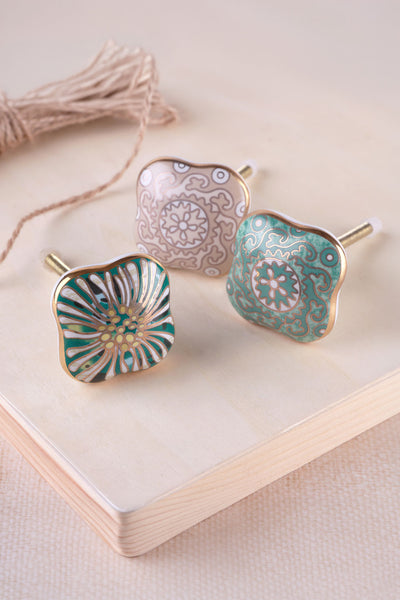
Mother of pearl and inlaid pulls bring a different register entirely — the considered, slightly bohemian kitchens that draw from Moorish and Indian design traditions. A small handful on the island drawers gives a kitchen a sense of having been collected rather than fitted.
The brass-based finishes — polished, antique, brushed, blackened — are the most versatile and the most widely specified. Most considered kitchens use one of these as the principal finish, with one or two other materials introduced as accents. The Brassworks Edit is a curated range built around this principle.
The question of mixed metals
The old rule — that all hardware in a kitchen must match — has not been the rule for a long time. The best contemporary kitchens deliberately mix metals, and the mixing is part of what makes them feel collected rather than bought. The principles, briefly :
Pick two, not three. A kitchen with brass cabinet hardware and brushed nickel taps reads as considered. A kitchen with brass, nickel and black hardware reads as undecided. Two metals, balanced — one warm, one cool, or one bright, one dark — is the rule that works.
Distribute, don't cluster. If brass is on the cabinets, let nickel appear at the taps, the lighting, the appliance handles. If the two metals are both used in the cabinetry, distribute them — brass on the lower drawers and antique brass on the larder, say — rather than splitting the room in half. Mixed metals look natural when they are sprinkled; awkward when they are zoned.
Let one metal dominate. One of the two should be the principal finish, used at perhaps 70% of the visible hardware. The other is the accent. A kitchen that is half and half reads as a tie; one that is two-thirds and one-third reads as a decision.
Within a single finish, the matching can also be loosened — polished brass pulls with antique brass knobs, brushed nickel pulls with polished nickel taps. As long as the tone family is consistent, the variation reads as depth rather than disorder.
Cup pulls, bar pulls, ring pulls: the four shapes worth knowing
Within the broad category of pull, four shapes account for almost everything worth specifying. Each has a place, and the differences are worth knowing before ordering.
The bar pull is the modern standard — a straight cylinder of metal, often with slightly tapered ends, fixed by two screws. Bar pulls suit contemporary kitchens, slab-front cabinets, and any kitchen that wants its hardware to read as clean and uncluttered. They are the most versatile pull and the right default in most modern schemes.
The cup pull is the traditional drawer pull — a curved cup of metal grasped from below, sometimes called a "shell" pull. Cup pulls suit Shaker kitchens, country kitchens, English and American traditional styles, and any kitchen with painted cabinets. They are particularly handsome in antique brass on a soft green or cream painted drawer.
The ring pull is the third great traditional shape — a circular metal ring on a backplate, pulled forward and released to fall flush. Ring pulls are the most decorative and the most classical, suiting period kitchens and dressers. They are often combined with knobs on the upper cabinets of a Georgian or Edwardian house.
The recessed or finger pull is the most minimal — a small notch cut into the drawer, sometimes lined in metal, sometimes simply routed into the timber. Recessed pulls suit very contemporary kitchens, particularly handleless designs, and read as architecture rather than hardware. They demand precise joinery and are usually specified at the design stage of a new kitchen.
Fitting, fixings and the small details that show
The fixings that come with cabinet hardware are often the cheapest part of the package, and the part most likely to fail under load. Replace the supplied machine screws with quality steel screws of the same gauge if the heads look thin or the threads slack. For heavier pulls — marble, large brass — specify slightly longer screws to ensure full purchase through the drawer front.
The screw head matters too. A flat, polished screw head finished to match the pull reads as intentional; a Phillips head in zinc plate is the giveaway of a hurried fit. Many of the better hardware suppliers, including the Brassworks Edit, supply matched screws as standard.
Tighten screws by hand to the point at which the pull no longer rotates, then a quarter turn beyond. Over-tightening cracks the pull's casting; under-tightening lets the pull turn over time and works the screw loose. A cabinet pull, properly fitted, should outlast the kitchen it is attached to.
Care, longevity and the patina that comes with time
Solid brass hardware wants very little. Wipe with a soft, dry cloth occasionally to remove fingerprints and the small smears of cooking that gather around the most-used drawers. Avoid abrasive cleaners on lacquered finishes, which will dull the surface, and avoid acidic cleaners on unlacquered brass, which can spot the patina.
Unlacquered brass and antique brass develop their character over years — lighter around the touched edges, darker in the recesses — and this is the patina that distinguishes them from plated alternatives. Many of the more beautiful kitchens of British design history have unlacquered brass hardware that has been gently aged by twenty years of family life. Resist the temptation to polish them back; the patina is part of the design.
Nickel and chrome respond to a soft microfibre cloth and warm water. Marble pulls want the same gentle treatment as marble worktops — a non-acidic cleaner, a soft cloth, and an occasional sealing treatment if the marble has become matte.
Building a hardware scheme that lasts
A considered kitchen does not need a vast collection of hardware; it needs a coherent, well-chosen one. Begin with the finish — brass, nickel, or one of the contemporary blackened alternatives — and let one finish anchor the whole. Choose pulls for the drawers, knobs for the doors, and an oversized pull for the larder. Add an accent finish only if the kitchen is generous enough to carry it.
Order generously. Drop one pull during fitting and the kitchen waits while a replacement is shipped; keep one or two spare in the drawer of every kitchen, alongside spare screws, for the long life of the kitchen ahead. Hardware is one of the few investments in a kitchen that pays back every day, and a small budget here — perhaps two to three percent of the total kitchen cost — carries weight beyond its share of the spend.
Begin with our cabinet pull handles edit and the wider cabinet knobs range, alongside the brass cabinet knobs and the curated Brassworks Edit. The right hardware on the right kitchen makes the rest of the room look better than it did before.
Frequently asked questions
What size cabinet pull do I need for a drawer?
The reliable rule is that a pull should be roughly one-third the width of the drawer it is fitted to. A 600 mm drawer carries a pull of around 200 mm overall, a 900 mm drawer one of around 300 mm, and a 1200 mm pan drawer either a single pull of around 400 mm or two smaller pulls placed at the third points. Below 400 mm of drawer width, a knob is often a kinder choice. Always confirm the centre-to-centre measurement — the distance between the fixing holes — before ordering, since this, not the overall length, determines fit.
Should I use pulls or knobs in my kitchen?
Use knobs on doors, pulls on drawers, and pulls on any oversized door such as the tall larder, the fridge integration or the appliance garage. Pulls give the leverage a heavier drawer needs and read as proportionate on a large door, while knobs sit neatly on a standard cabinet door and are the kinder traditional choice on upper cabinets. Most considered contemporary kitchens mix the two — knobs above, pulls below — which the eye reads as considered rather than uniform.
Can I mix metals in cabinet hardware?
Yes, and the best contemporary kitchens deliberately mix them. The rule is to pick two metals, not three, and let one dominate at perhaps 70% of the visible hardware. Brass and nickel, brass and black, or polished nickel and antique brass all work; the principle is one warm and one cool tone, or one bright and one dark. Distribute the metals across the kitchen rather than zoning them, and the result reads as collected and considered rather than indecisive.
What is the difference between solid brass and brass-plated hardware?
Solid brass hardware is cast or machined from a single piece of brass throughout; brass-plated hardware is a base metal (usually zinc or steel) electroplated with a thin layer of brass. The difference is felt immediately in the weight — solid brass has substance in the hand — and seen over time, since plated finishes can chip, peel and corrode at the edges, while solid brass develops a patina that becomes part of its character. For pieces touched every day, solid brass is the investment that pays back.
How do I clean and care for brass cabinet pulls?
Wipe with a soft, dry cloth occasionally to remove fingerprints and the small smears that gather around the most-used drawers. Avoid abrasive cleaners and avoid acidic cleaners on unlacquered brass, which can spot the patina. Lacquered brass keeps its colour and asks for nothing more than gentle dusting; unlacquered brass develops its character over years, lighter around the touched edges and darker in the recesses. Resist the temptation to polish unlacquered brass back to bright; the patina is part of the design.
A final thought
Cabinet hardware is the smallest investment in a kitchen and one of the most felt. The hand reaches for the same drawer twenty times a day for twenty years, and the small piece of brass in the palm becomes part of the daily texture of the house. Choose pulls and knobs that feel right in the hand, scale to the drawer, and speak to the room. The kitchen will be better for it every morning.
Begin with our cabinet pull handles edit and the wider cabinet knobs range. With more than 700 verified reviews on Trustpilot and over 2,000 store reviews on Judge.me, our pieces are trusted in homes across the UK, US, Europe and Australia.
Further reading
- Cabinet Pulls vs Cabinet Knobs — The full case for each, drawer by drawer.
- How to Choose Brass Finishes: A Material Guide — Polished, antique, brushed, blackened — which suits which room.