

G Decor
Historic Home Hardware — Period-Correct Cabinet Knobs & Door Hardware
A period-correct home doesn't want a shiny reproduction — it wants hardware that looks, feels and ages the way the originals did. Here's what we've learned specifying cabinet knobs and door hardware for Victorian, Craftsman, Colonial, and Georgian restorations across the US.
The American historic zones — the single-house terraces of Charleston, the federal rowhouses of Georgetown, the red-brick Beacon Hill blocks, the Brooklyn brownstones — were built in a period when hardware was cast, chased, and finished by hand. A Victorian pantry door in 1885 carried an unlacquered brass knob that had already begun to darken by its second winter. A 1910 Craftsman kitchen used hand-painted ceramic on six-panel cupboards. A Colonial dressing-room drawer carried polished brass that was expected to patina — never polished back.
Restoration hardware fails when it looks new — when the brass is lacquered to stay bright, when the ceramic is decal-printed instead of hand-painted, when the finish is engineered to resist the very oxidation that gives the piece its character. The better answer is hardware that behaves the old way: unlacquered brass that will darken, ceramic that carries the brush-mark of the painter, solid pieces with real weight in the hand. That's what this page collects.
Our pieces for historic homes
Every knob and pull below is designed in England and handcrafted in small batches. The brass comes polished, satin or aged, and the unlacquered pieces keep deepening in tone with age; the ceramics are glazed and painted by hand, so no two are quite alike.
Three period-correct designs to start with:
- Milano Handmade Ceramic Cabinet Knob — 38 mm hand-thrown ceramic in a soft-white glaze on a polished-brass base. The correct answer for a six-panel Craftsman cupboard, a Colonial pantry door, or any painted-cabinet install where the original hardware was plain white ceramic. Reads exactly as the 1910 pieces it replaces.
- Versailles Vintage Polished Brass Cabinet Knob — cast in solid brass with an engraved decorative face. Sold without lacquer — it will begin to patina in months and deepen for decades. The correct choice for a Federal or Georgian restoration where the original hardware was cast brass with a decorative face.
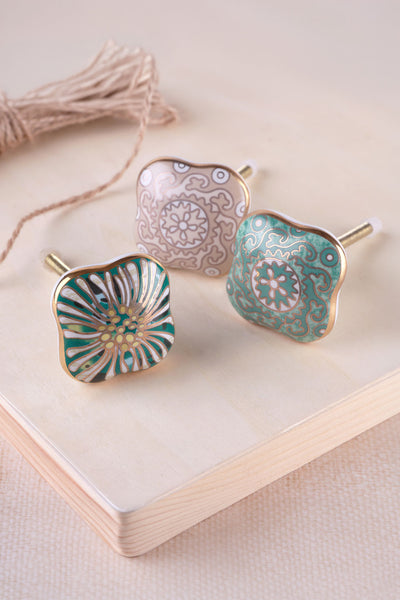
- Silver Applique II Elegant Lace Ceramic Cabinet Knob — hand-painted botanical lacework in fine silver line over a soft-white glaze. Reads high Victorian — the piece you'd find on a dressing-table drawer in an 1880s Beacon Hill townhouse. Best used where the historic room can carry ornament without noise.
Browse the full range of cabinet knobs or the internal door knobs collection for full-sized door hardware.
Sizing — a quick reference for historic US cabinets and doors
Pre-war US cabinets and interior doors are smaller and taller-proportioned than modern builds. A well-proportioned knob for a historic install sits in this range:
- Cabinet doors under 15 inches wide (butler's pantry, china cupboard uppers): 30–38 mm knob (1¼–1½ in). Twin knobs on wider Victorian pantry doors — spaced one third and two thirds across — read more period-correct than a single centred knob.
- Standard cabinet doors 15–24 inches wide: 38 mm knob (1½ in). Ceramic on painted cupboards; polished-brass cast on stained or shellacked woodwork.
- Interior six-panel doors: 55–60 mm knob (2¼ in) on a matching rose or backplate. Ceramic and polished-brass both correct depending on the room's period.
- Drawer fronts: 30–38 mm knob for standard drawers; twin knobs on wider drawers, never a bar pull — bar pulls are a 1960s idiom and read wrong in a pre-war room.
The full sizing guide covers screw specs, backplate options, and installation offsets in detail.
Finish choices for historic restorations
Period-correctness is a matter of finish more than shape. Four finishes cover the great majority of US historic installs:
- Polished brass (unlacquered) — the historically correct default. Starts bright and darkens for decades. The finish every original brass knob in a Charleston single-house, a Georgetown federal, or a Brooklyn brownstone was made in.
- Aged brass — supplied already darkened, for the patinated look on day one. The right choice for a restoration where the surrounding original hardware has already darkened and the new pieces need to match.
- Hand-painted ceramic — soft white, botanical, or lacework. Correct for Craftsman, Colonial Revival, and high-Victorian dressing rooms and pantries.
- Polished nickel — cool, bright, mirror-clean. Correct for Edwardian and early-20th-century bathrooms and butler's pantries where the original spec called for nickel over brass.
Shipping to the US
Every US order ships tracked from the UK, with duties and taxes included in the price you pay at checkout. US shipping is priced by order value, from £17.95 (shown in US dollars at checkout), and delivery takes 5–10 business days. Nothing to pay on delivery.
Read further
Our editorial guide to period-correct hardware for historic home restoration walks through real installs in Charleston, Georgetown, Beacon Hill, and Brooklyn — with the correct hardware called out room by room.
✦