

The Journal · bedroom design
How to Arrange the Perfect Bedroom
Question: what makes a bedroom feel like a retreat? Not the bed, exactly. Not the wallpaper. A British designer's guide to bedrooms that feel personal rather than performative — light, hardware, texture, bedside styling, and the small finishing touches that change everything.
G · Stories · No. III · Room by Room
A G Decor Guide
Question: what makes a bedroom feel like a retreat? Not the bed, exactly. Not the wallpaper. It's the smaller, quieter things — soft light at the right hour, a wardrobe knob that catches the eye, a candle on the nightstand, the texture of linen against bare wood. The bedrooms that work hardest at making you want to stay are usually the ones that look like they were considered slowly.
This is a designer's guide to arranging a bedroom that feels personal rather than performative. Not an Instagram bedroom. A bedroom you actually want to wake up in.
Start with what you keep, not what you buy
The first move in arranging a good bedroom is editing, not adding. Take everything off the surfaces. Open the wardrobe and look at it. Notice what's been there a while because you love it, and what's there because you bought it once and never got around to moving it.
Most bedrooms feel cluttered not because there's too much furniture, but because there are too many small items competing for attention. A nightstand with three candles, a stack of unread books, a phone charger, a glass of water, and a piece of jewellery is a tray's worth of stuff in a single square foot. Half that, and the room calms down.
Designers call this negative space. You don't need to call it anything. You just need to put fewer things on flat surfaces.
The light decides the mood
Before you change anything else in the bedroom, change the light. The strongest, fastest way to make a room feel like a retreat is to lower the colour temperature and add layers.
- One warm bedside lamp with a soft 2700K bulb — never a cool white. The bulb is more important than the lamp.
- One overhead fixture on a dimmer — even an inexpensive plug-in dimmer for the existing fixture works. Most bedroom ceiling lights are too bright and too cold; the dimmer fixes both.
- One candle at the lowest layer — lit in the evening, before bed, at the moment you want the room to feel like sleep, not work.
The candle isn't decoration. It's a cue. Bedrooms that have a wind-down candle ritual feel different than bedrooms that don't. Our pillar and dinner candles are made for exactly this — designed to be the last thing burning at the end of the day.
The hardware nobody notices, except they do
Bedroom hardware is the most under-loved finishing touch in most homes. The wardrobe still has the builder's cheap chrome handles. The bedroom door uses the same plain knob as the bathroom and hallway. The chest of drawers came with whatever the manufacturer included.
Change three pieces of hardware and the room changes:
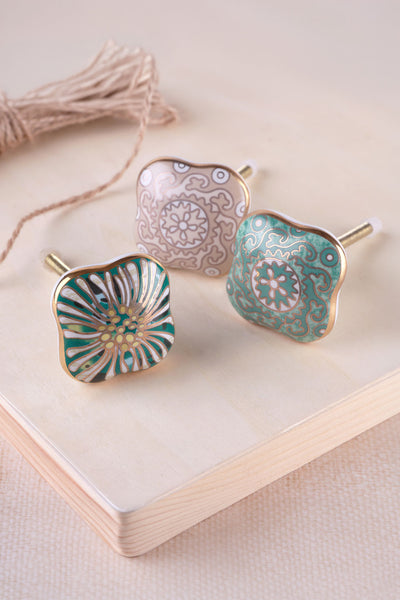
- The wardrobe knobs. A pair of hand-painted ceramic knobs on a brass base turns a plain Ikea wardrobe into something that looks intentional. Pick a colour that picks up something else in the room — bedlinen, the lamp, a piece of art.
- The bedroom door knob. Replace the builder's chrome with a ceramic mortice set. Even a quiet sea-blue or soft pink knob makes the door feel like part of the design rather than something that came with the house.
- The chest of drawers. If you have a vintage or charity-shop chest, the existing drawer pulls are usually the giveaway. New ceramic or brass knobs change everything.
Browse our internal door knobs and cabinet knobs — most are hand-finished in small batches, designed for exactly the kind of small upgrades that change a bedroom.
Layer the textures, not just the colours
Most bedroom design advice talks about colour. The more useful advice is about texture. A monochrome bedroom in cream, beige, and taupe can feel rich and considered if the textures vary — a linen duvet cover, a wool throw, a ceramic lamp base, a wooden nightstand, a brass picture frame, a hand-blown glass beside the bed.
The trick is contrast in feel rather than contrast in colour. The eye doesn't need ten different colours to find the room interesting. It needs different things to look at and touch.
A few easy texture additions for a flat-feeling bedroom:
- A linen pillow case (any colour) on top of plain cotton bedding
- A wool or cashmere throw at the foot of the bed
- A small ceramic vessel on the nightstand for everyday earrings or rings
- One framed photograph or print in a brass or wood frame, on the wall above the chest
- A hand-painted ceramic knob on the wardrobe to bring colour and pattern in small doses
The bedside table is the most important surface in the room
If a bedroom has one zone that gets used every day, it's the bedside table. A well-arranged bedside makes the whole room feel cared-for; a messy one undoes the rest of the room's work.
What belongs on a good bedside table:
- A lamp — warm-toned, dimmable if possible, with a base you don't mind looking at
- A current book — one, not the stack of seven you mean to read
- A candle or small fragrance object
- A glass of water in a piece you like (cut glass, hand-blown, anything that isn't a plastic bottle)
- One personal object — a photo frame, a small ceramic dish for jewellery, a vintage clock
That's it. Five things. The discipline isn't fashionable, it's relaxing. A clean bedside table makes the whole room feel calmer in the morning.
The one piece of art that does most of the work
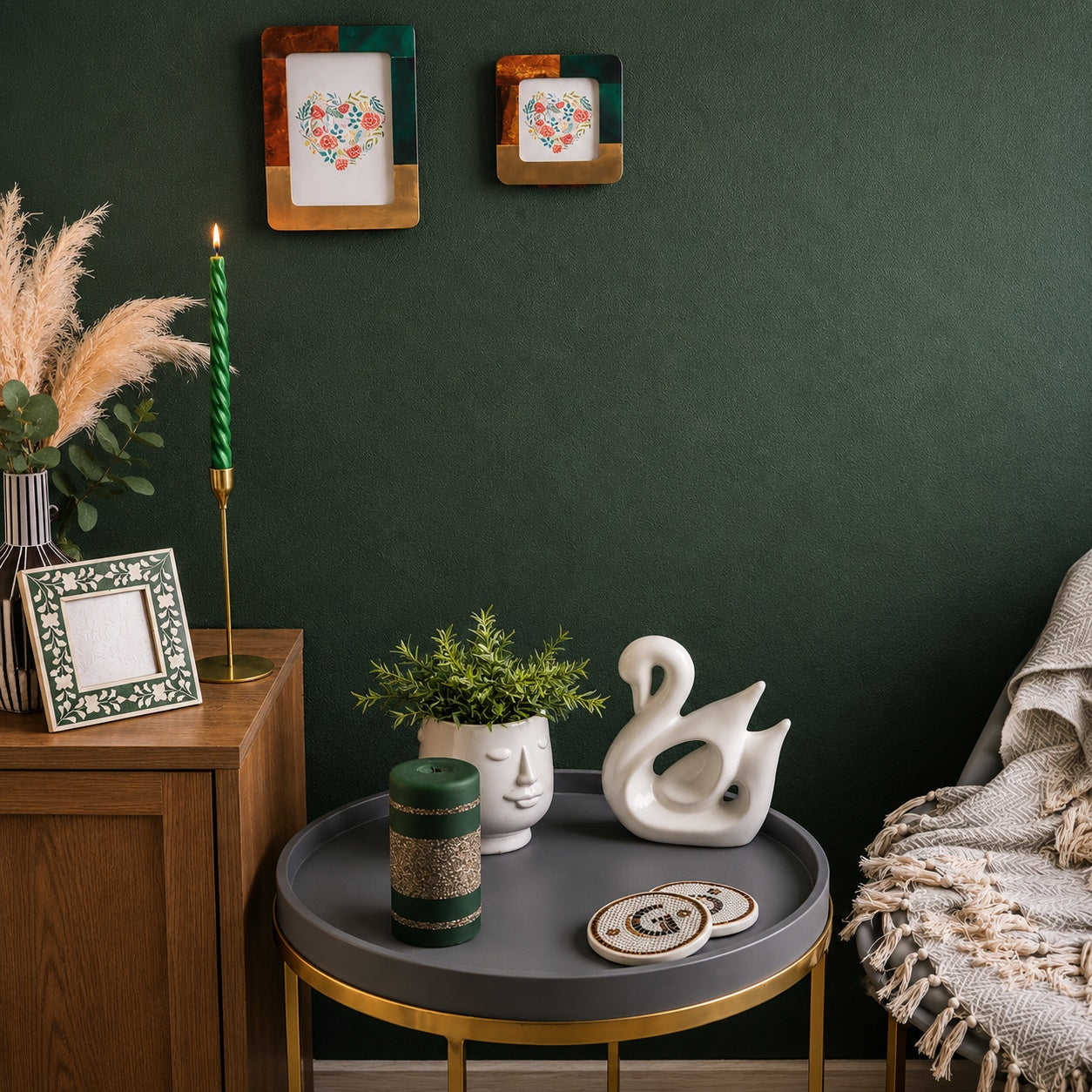
Bedrooms benefit from one strong piece of art on the wall opposite the bed — large enough to anchor the room, framed properly so it feels intentional. Our Lucca Bone Inlay frames in vintage green and aged brass are made for exactly this — a frame that adds depth without competing with what's inside it.
Don't overthink the subject. A black-and-white photograph from a holiday, a botanical print, a small painting from a local artist, a charcoal sketch — anything personal will outperform anything generic from a chain. The frame is what makes it feel finished.
The wardrobe as a feature, not just storage
If your wardrobe is built-in or a freestanding piece worth looking at, treat it as part of the room's design. If it's a basic Ikea PAX or similar, the easiest upgrade is the hardware.
Replace plain pulls with hand-painted ceramic knobs. Choose one colour that ties into the rest of the room — a sage green, a powder pink, a deep blue. The wardrobe stops being a storage box and starts being a feature wall. It costs less than a duvet set.
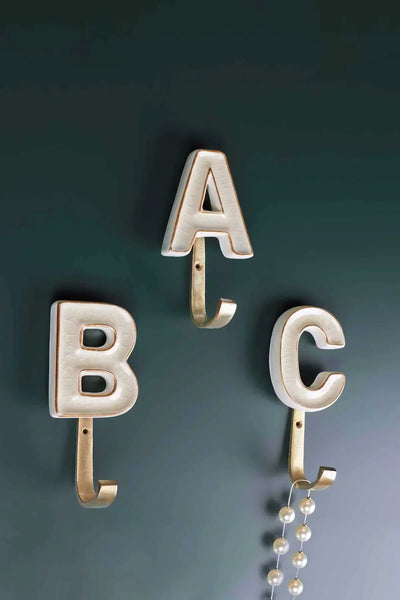
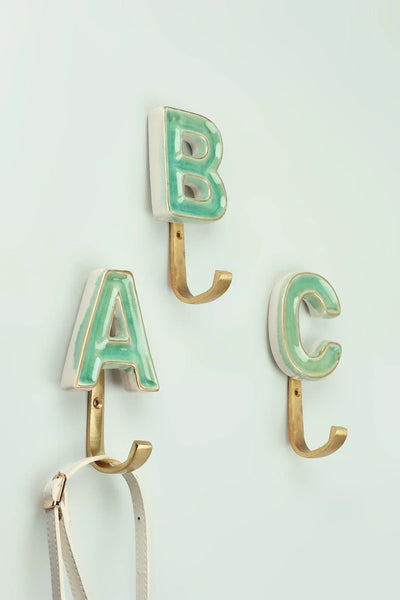
For a more personal feel, a row of monogrammed coat hooks on the back of the bedroom door can carry the same idea — small hardware, big personality. Our hooks and wall hardware include hand-finished options in ceramic, brass and pub-tile styles.
What to avoid
A few moves that consistently make bedrooms feel less considered, not more:
- Too many cushions. A bed that takes ten minutes to assemble and disassemble each day is a bed nobody actually makes. Two pillows, one accent cushion, one throw. That's a bed.
- Statement wallpaper everywhere. One wall, possibly. All four walls, almost never. Wallpaper that's beautiful in small doses becomes overwhelming when you're trying to sleep.
- Cool-white LEDs in the bedside lamp. The single most damaging design choice in modern bedrooms. Replace with warm 2700K bulbs immediately.
- “Bedroom-themed” art. Anything that says “Sleep” in cursive script, a sign saying “Mr & Mrs”, or anything else that announces what the room is for. The room already knows.
- Matching bedroom suites. The bed, two nightstands, the dresser, and the wardrobe all from the same collection in the same finish reads as a hotel room. Mix the finishes — a wooden bed with a painted nightstand, an antique chest with a modern wardrobe.
A small order of operations for arranging the bedroom
If you're starting fresh or refreshing what's there, do it in this order:
- Clear the surfaces first. Take everything off the nightstands, the chest, the windowsill. Put it all on the bed. Now decide what goes back.
- Fix the light. Warm bulbs in the lamps. Dimmer on the ceiling fixture. A candle for the evening.
- Change three bits of hardware. Wardrobe, bedroom door, chest of drawers. Same finish or one repeated colour.
- Add one piece of art. Above the chest, opposite the bed. Properly framed.
- Layer the textures. Linen, wool, ceramic, wood. Less colour, more material.
- Style the bedside. Five things. Lamp, book, candle, glass, one personal object.
That's the whole guide. The bedroom doesn't need a renovation. It needs the small finishing touches that make every surface look like it was chosen, not assembled.
Frequently asked questions
What's the easiest bedroom upgrade?
Switching the bedside lamp bulb to a warm 2700K bulb. Total cost under £5, takes thirty seconds, changes the whole feel of the room.
How do I make a small bedroom feel bigger?
Reduce the number of items on flat surfaces, swap heavy curtains for lighter ones, and use mirrors to bounce light. Hardware in lighter or polished finishes (chrome, polished brass) can also make a small bedroom feel less heavy.
What hardware finish works best in a bedroom?
Brass for warm, heritage bedrooms. Chrome for cool, modern bedrooms. Ceramic on either base for personality. The finish should match the rest of the room's metal accents — picture frames, lamp bases, light switches.
Should the bedroom door knob match the rest of the house?
Not necessarily. The bedroom can have its own treatment — softer, more personal — than hallway and front-door hardware. A patterned ceramic knob on the bedroom door makes the room feel like a destination.
How many candles should be in a bedroom?
One or two, maximum. Bedrooms are for winding down, not for stockpiling fragrance. A single pillar candle on the bedside or a small scented candle on the chest is enough.
A final note
The best bedrooms aren't the most decorated. They're the most edited. A few good textures, warm light, hardware that's been considered, one strong piece of art, and the discipline to leave space around what's there. That's the whole formula.
Browse G Decor's bedroom hardware, candles, and lamps — designed for the small finishing touches that make a bedroom feel considered. With more than 700 verified reviews on Trustpilot and over 2,000 store reviews on Judge.me, our pieces are trusted in homes across the UK, US, Europe and Australia.
Further reading
- Cabinet Hardware: The Detail That Defines a Kitchen — Why designers spec the cabinet hardware before the cabinetry itself.
- How to Style a Sideboard: A Designer's Guide — The rule of three, the four-layer system, room-by-room ideas — a sideboard that lasts seasons not weeks.
- The kitchen at first light — On the half-hour after dawn — the objects that earn their place at that hour.