


The Journal · Atmosphere
Layered Lighting: A Designer's Guide to Lamps, Wall Lights and Atmosphere
A designer's guide to layered lighting — the three layers of ambient, task and accent light, where to place lamps and wall lights, how colour temperature and dimmers shape a room, and how to light a home beautifully from morning to midnight.
Why is it that two rooms with identical furniture can feel so utterly different after dark? The answer, almost always, is the lighting. A room lit from a single point overhead feels flat and institutional; the same room lit in layers feels considered, intimate, alive. Layered lighting is the quiet discipline behind every interior that looks designed rather than merely furnished.
What layered lighting actually means
Layered lighting is the practice of lighting a room from several sources at several heights, rather than from one bright fixture in the centre of the ceiling. A well-lit room draws on three kinds of light working together: ambient light that fills the space, task light that serves a particular job, and accent light that flatters and shapes. Good lighting is rarely about one beautiful fixture; it is about how the sources speak to one another once the sun has gone.
The single overhead pendant — the default of most rooms in most houses — is the enemy of atmosphere. It casts light downward and evenly, flattening faces, erasing shadow, and giving a room the character of a waiting room. The remedy is not a brighter bulb. It is more sources, each doing less. This guide sets out how to build that layered scheme, room by room, and the pieces that make it work.
The three layers, and what each one does
Ambient light: the wash
Ambient light is the base layer — the general illumination that lets you move through a room safely. Traditionally this came from the central pendant, and in many homes it still does. But ambient light need not come from above. A pair of wall lights, an uplighter in a corner, or several lamps working together can provide the same base wash with infinitely more warmth. The aim of ambient light is presence without glare: you should feel lit, not spotlit.
Task light: the working layer
Task light serves a specific activity — reading, cooking, working, applying make-up. It is brighter and more directional than ambient light, and it belongs exactly where the task happens: beside the armchair, over the worktop, on the desk, at the mirror. The mistake most rooms make is asking the ambient layer to do the task layer's job, flooding the whole room with brightness to light one corner where someone wants to read.
Accent light: the flattery
Accent light is the layer that does the emotional work. It is the candle on the mantel, the small lamp on a stack of books, the picture light, the glow that has no practical purpose beyond making the room feel cared for. Accent light is where atmosphere lives, and it is the layer most rooms neglect entirely. A single low lighting source at the right height will do more for an evening than any amount of overhead brightness.
Why the central pendant fails a room
It is worth dwelling on why the overhead light disappoints, because understanding the fault is half the cure. Light from a single high point casts hard shadows downward — under the brow, under the nose, under every object — and renders a room evenly bright but emotionally empty. It is the lighting of utility: useful for finding a dropped earring, useless for an evening.
The fix is to demote the pendant. In a layered scheme the overhead light becomes one option among several, on its own switch or dimmer, used for cleaning and searching rather than for living. The evening belongs to the lower layers — the lamps, the wall lights, the candles — which sit at the height of a seated person and light the room the way firelight once did.
The case for lamps, and where to place them
If you change one thing about how your home is lit, add lamps. Table and floor lamps bring light down from the ceiling to the level where life actually happens, and they let you switch a room on in pieces rather than all at once.
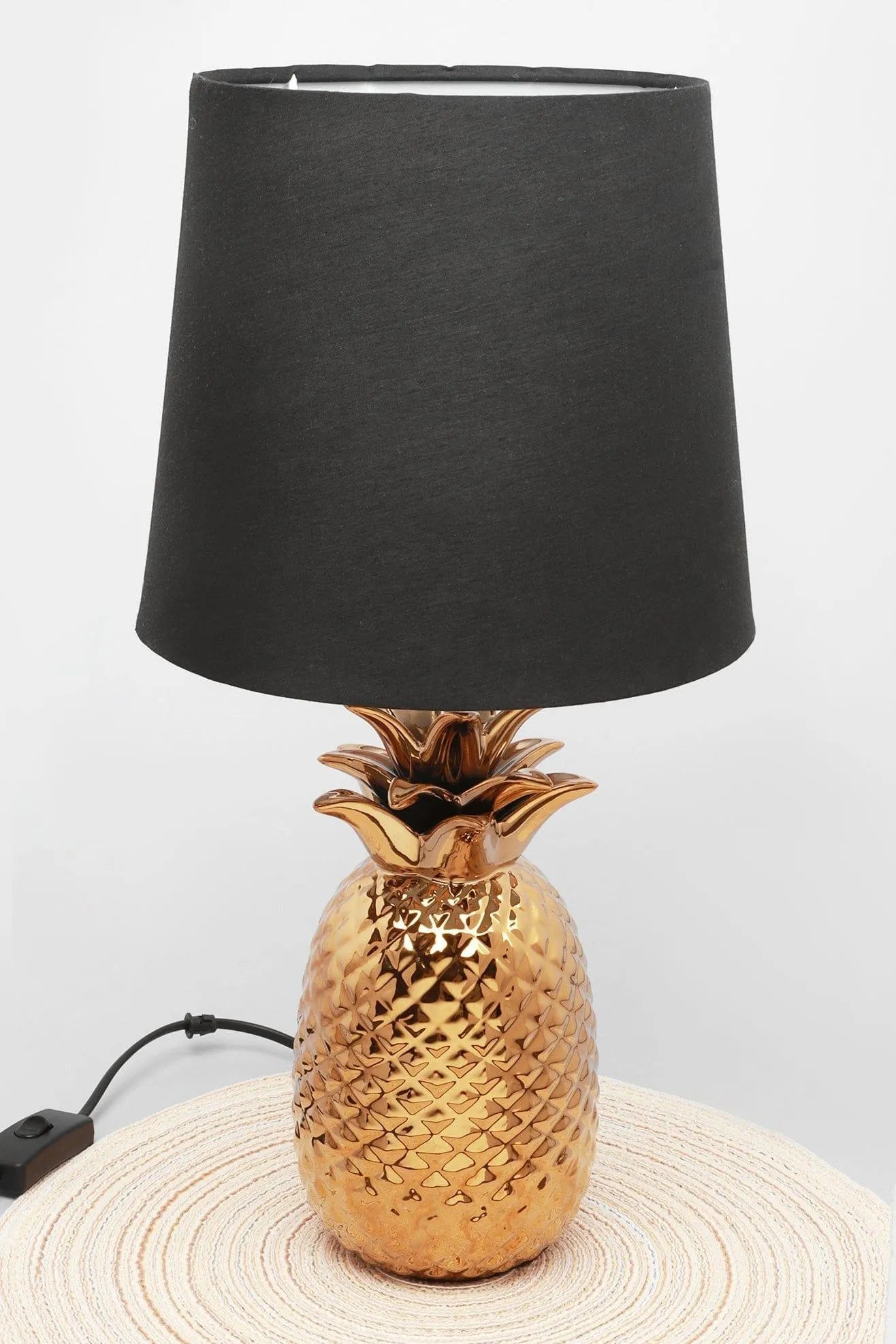
The rule designers follow is to aim for several pools of light rather than one. Three lamps in a sitting room — one beside each seat, one on a console or sideboard — will light the room more beautifully than the brightest pendant ever could. A statement piece such as our Ananas Doré gold pineapple lamp earns its place twice over: lit, it casts a warm pool through its shade; unlit, it reads as sculpture. A lamp is one of the few lighting pieces that works as hard by day, switched off, as it does by night.
Placing a table lamp
A table lamp should sit so that the bottom of the shade is roughly at eye level when you are seated beside it — high enough to light a page, low enough to hide the bulb. On a bedside table, the switch should fall to hand without reaching; on a console, the lamp should be tall enough to balance the wall above it. When the proportions are right, a lamp feels inevitable; when they are wrong, it feels perched.
Wall lights and the value of light at the edges
Wall lights are the most underused layer in the British home, and among the most rewarding. Set at the perimeter of a room, they push light outward to the walls — which bounces it back softly — rather than down into the middle. The effect is to make a room feel larger and calmer, its corners resolved rather than lost in shadow.
Wall lights are particularly useful in rooms where surfaces for lamps are scarce: hallways, stairwells, narrow studies, the awkward wall beside a bed. Mounted in pairs and put on a dimmer, they give a room a sense of architecture it may not actually possess. Where wiring a wall light is not practical, a pair of tall lamps or a well-placed grouping of candles from the candle holders edit can stand in for the same edge-lit effect.
The smallest layer: candlelight
No discussion of layered lighting is complete without candlelight, because it is the warmest and lowest layer available and the one that does most for atmosphere for the least effort. A candle flame sits far down the colour temperature scale — warmer than any bulb — and it moves, which is precisely why a room with candles in it feels alive in a way a room of fixed light never does.
Dinner candles in holders down the centre of a table, a cluster of pillar candles on a hearth, a single scented candle on a side table — these are the finishing layer of a lit room. A set of dinner-candle holders such as the Halo hand-blown glass holders turns a table into an occasion, and the wider candles range gives you the flame to fill them. Candlelight is the layer guests feel without ever naming.
Colour temperature: the warmth that makes or breaks a room
If your rooms feel cold no matter how many lamps you add, the culprit is almost certainly colour temperature — the warmth or coolness of the light itself, measured in kelvin. Lower numbers are warm and golden; higher numbers are cool and blue-white. For a home, warm is almost always right. The cool, bright light of an office or a supermarket has no place in a sitting room after dark, however energy-efficient the bulb.
Choose warm bulbs throughout your living spaces and reserve cooler, brighter light only for genuine task areas where you need to see clearly — a kitchen worktop, a bathroom mirror, a desk. And keep the temperature consistent within a room: mixing a warm lamp with a cool overhead is as jarring to the eye as mixing metals is to a scheme. One temperature, warmly chosen, holds a room together.
Dimmers: the simplest upgrade with the largest effect
The most useful thing you can do for the lighting in your home requires no new fixture at all: put your lights on dimmers. A dimmer turns a single fixture into many, letting one lamp serve as bright task light at the desk and low accent light at the close of the evening. Light, more than almost anything, sets the hour — and a room that can be dimmed is a room that can change with the day.
Dimmers also let the layers cooperate. As the evening draws in, the overhead drops away, the lamps come down to a glow, and the candles take over — a gradual handover from bright to intimate that a fixed scheme can never manage. A room you can dim is a room you can live in from morning to midnight.
Lighting room by room
The sitting room
The sitting room rewards layered lighting more than any room in the house, because it is where the day ends. Aim for at least three lamps, a pair of wall lights if you can wire them, and candlelight for the evening. Keep the overhead on a dimmer and reach for it rarely. The goal is a room you can light at four different levels, from bright enough to find a book to low enough to fall asleep by.
The bedroom
A bedroom wants the gentlest scheme in the house. Bedside lamps with switches to hand, a low ambient source for dressing, and as little overhead light as you can manage. A pair of characterful table lamps — our Aviary Doré parrot lamp makes a fine bedside companion — gives a bedroom both function and personality at the hour it matters most. Warm bulbs only; nothing cool belongs where you sleep.
The kitchen and dining room
The kitchen is the one room where bright, cooler task light genuinely earns its place — over the worktop, where you need to see what you are doing. But the dining end of the room should switch registers entirely: a low pendant over the table, dimmed, with candles down its length. The contrast between a brightly lit working kitchen and a softly lit table is part of what makes a kitchen-diner feel generous rather than utilitarian.
The hallway
A hallway is where a home introduces itself, and it is almost always lit badly — one harsh fixture, on or off. Wall lights, a lamp on a console, and a warm bulb will turn a corridor into a welcome. Because a hall is passed through rather than lingered in, it is the ideal place for a piece of lighting that makes a statement: a sculptural lamp, a pair of bracketed wall lights, something that signals the character of the rooms beyond.
Building a lighting scheme that lasts
A considered scheme is assembled slowly, not bought in a single afternoon. Begin by demoting the overhead light to a dimmer and adding lamps where you sit. Add a low accent source — a small lamp, a cluster of candles — for the evening. Bring in wall lights where surfaces are scarce. Standardise on warm bulbs throughout, and put as much as you can on dimmers. Each step is small; together they remake how a home feels after dark.
Choose pieces that hold their own switched off as well as on, since a lamp spends much of its life unlit. The lighting edit, alongside the candle holders and home décor ranges, is designed to be collected this way — each piece hand-finished to sit as comfortably in daylight as it does in the glow it casts at night. Good lighting, in the end, is not a purchase but a habit: the habit of lighting a room in layers.
Frequently asked questions
What are the three layers of lighting?
The three layers are ambient, task, and accent. Ambient light fills the room and lets you move through it safely; task light is brighter and directional, serving a specific activity such as reading or cooking; and accent light is the low, atmospheric layer — lamps, candles, picture lights — that flatters a room and gives it mood. A well-lit space uses all three together.
Why does my room feel cold even with plenty of light?
The most common cause is colour temperature. Cool, blue-white bulbs make a room feel clinical no matter how many you add. Switch to warm bulbs throughout your living spaces, keep the temperature consistent within each room, and reserve cooler light only for genuine task areas like a kitchen worktop or a bathroom mirror. Warmth, not brightness, is what makes a room feel welcoming.
How many lamps should a sitting room have?
Aim for at least three pools of light — typically one beside each main seat and one on a console or sideboard. Several lamps at the level where you sit will light a room far more beautifully than a single bright pendant overhead. The point is to light the room in pieces, so you can switch on as much or as little as the evening asks for.
Are wall lights worth the wiring?
For most rooms, yes. Wall lights push light outward to the walls, which bounce it back softly, making a room feel larger and its corners resolved. They are especially valuable where surfaces for lamps are scarce — hallways, stairwells, beside a bed. Where wiring is impractical, a pair of tall lamps or a grouping of candles can stand in for the same edge-lit effect.
What is the easiest way to improve a room's lighting?
Put your existing lights on dimmers and add a lamp or two at seated height. A dimmer turns one fixture into many, letting a light serve as bright task lighting and low evening glow from the same switch, while lamps bring the light down from the ceiling to where life happens. Neither requires rewiring the room, and together they remake how it feels after dark.
A final thought
Layered lighting is the difference between a room that switches on and a room that comes to life. Demote the overhead, light from several sources at several heights, keep the bulbs warm, and let the candles finish what the lamps begin. Done well, lighting is the most powerful thing in a room and the least noticed — felt by everyone who walks in, named by almost no one.
Begin with our lighting edit and the candle holders that complete it. With more than 700 verified reviews on Trustpilot and over 2,000 store reviews on Judge.me, our pieces are trusted in homes across the UK, US, Europe and Australia.
Further reading
- How to Arrange the Perfect Bedroom — Where lamps, layout and calm meet.
- Candle Care: How to Burn a Pillar Properly — The lowest, warmest layer, looked after.
- A Hallway with Character — On lighting the room that introduces a home.