

The Journal · British design
Setting a Table That Looks Considered, Not Cluttered
The most considered tables aren't the most decorated. A designer's guide to setting a table that looks like someone thought about it without looking like they tried too hard. Restrained, beautiful, the kind of table that makes a long lunch feel like an event.
G · Stories · No. VI · Hosting & Tables
A G Decor Guide
Question: when does a table stop looking like a meal and start looking like an occasion? Not when there's more on it. Almost always, when there's less. The most considered tables in the world — the ones at houses you remember leaving — usually have fewer items, placed with more care, than the ones at houses you don't.
This is a designer's guide to setting a table that looks like someone thought about it without looking like they tried too hard. Restrained, beautiful, the kind of table that makes a long lunch feel like an event without anything announcing itself.
Why most tables look cluttered
The well-meaning host puts everything on the table because they want guests to feel looked-after. Two wine glasses, a water glass, three pieces of cutlery on each side, a napkin, a charger, a plate, a side plate, a butter knife, salt and pepper, a candle, flowers, the bread basket, the carafe, a serving dish.
Eleven things per place setting. Times eight people. Eighty-eight items on a table designed for eight. The eye doesn't know where to land.
The fix isn't subtraction for its own sake. It's deciding what's actually used and removing the rest. A side plate that nobody touches is just clutter. A butter knife at every place when there's no butter is decorative theatre. A second wine glass before the second wine is poured is hopeful at best.
The frame: plate, bowl, charger
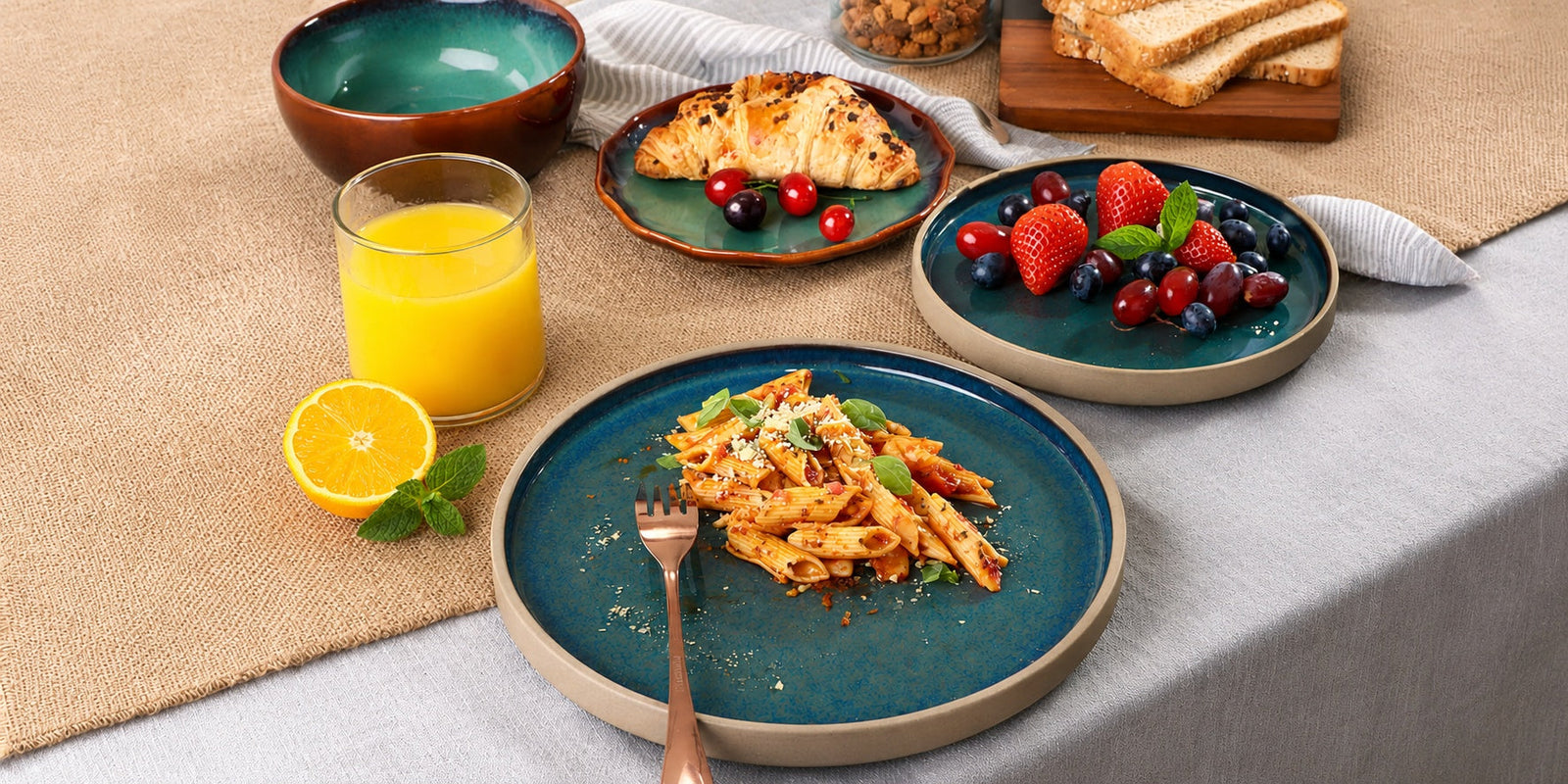
Start with what sits where each guest sits. In the most restrained version, that's just one plate. In a more layered version, it's a charger underneath a plate, with a bowl on top.
The charger is the layer that does the heavy decorative work. It's a large flat plate that stays under the meal — guests' actual plates and bowls sit on top of it. A wooden, ceramic, or rattan charger gives the place setting weight without adding to the wash-up. Remove it before dessert.
The plate sits on the charger. Match the plates to each other; don't try to match the plates to the charger. Mismatched plates and charger looks designed; matched looks like a wedding registry.
If the meal is a soup, stew, or pasta, swap the flat plate for a shallow bowl. One vessel per guest, not two.
Glassware: stems, height, layering
Most tables have too many glasses. The default — water, white wine, red wine — assumes everyone will drink in the same order. Almost no one does.
A simpler approach for a relaxed dinner:
- One water glass per guest, set at the top of the place setting
- One wine glass per guest, the right shape for whatever wine you're pouring first
- Add a second glass only when the second wine arrives
For a more formal occasion, two wine glasses on the day, but with the same restraint elsewhere. Our Laurent Fluted Wine Glasses in pink and green, or the Blush Bow Pink Wine Glasses with their delicate bow stems, are made for exactly this — handblown pieces designed to do the design work without you adding more to the table.
Layer height matters. The water glass tallest, the wine glass shorter, the candle lower still. The eye reads the place setting in heights, not just colours.
Cutlery: outside in, but only what you need
The traditional rule — cutlery laid out from the outside in, in the order it'll be used — still works. The shorter rule that matters more: only put out what's actually being used.
If the meal is one course, that's a knife and a fork. A spoon if there's soup. A dessert spoon if there's pudding. Five pieces of cutlery for a one-course dinner is hospitality for the look of it, not for the meal.
Polished cutlery matters more than expensive cutlery. A mid-priced set polished to actually shine looks better than a heritage set tarnished.
Linen, runner, or bare wood
Three table treatments, in order of formality:
- Bare wood with linen napkins. Casual, modern, lets the table itself become a design feature. Best for solid wood tables with a finish you don't mind getting hot dishes on.
- A linen runner down the centre, plates set onto bare wood on either side. The runner gives a band of texture without covering the table. Good middle ground.
- A linen tablecloth over the whole table. Most formal, most laundry. Reserve for the occasions where it actually matters.
Whichever you choose, real linen ages better than poly-cotton. The wrinkles are part of the look.
The centrepiece, or no centrepiece at all
Most centrepieces are too tall. The table goes silent because no one can see across. The single best centrepiece for a dinner party is something low — a long shallow bowl of fruit, a row of small candles in dinner-candle holders, a flat dish of single stems in water.
If using flowers, low and many small vessels rather than one tall vase. Three small ceramic pots of single garden roses down the centre of the table, no taller than a wine glass. People can talk over them.
If skipping flowers entirely, a row of three pillar candles down the centre — same height, same colour — does more for the atmosphere than a flower arrangement. Our pillar candles are made in heights that work as centrepieces without becoming centrepieces.
Light at the table
The most under-considered element of a dinner. Most tables are lit by overhead pendants that are either too bright (looks clinical) or too dim (no one can see the food). The fix:
- A pendant on a dimmer, lowered to roughly 80–90 cm above the table
- Two or three candles on the table itself for the warm secondary layer
- Warm 2700K bulbs in the pendant — never cool white over food
Candle types: dinner candles in low brass holders for a traditional setting, or short pillar candles for modern. Avoid heavily scented candles at the table — they fight the food.
Browse our dinner candles and candle holders for table-appropriate options.
The small rituals
The host's small actions are often the most beautiful part of a meal. Things that take seconds and signal that the table was prepared with thought:
- Napkins folded simply (rectangular fold, set under the fork or to the left of the plate). Avoid origami swans.
- Bread placed in a basket lined with linen, on the table at the start, not announced
- Water carafe filled and on the table before guests sit down
- Salt and pepper in small ceramic bowls or grinders, not branded shakers
- A butter dish only if butter is being served — and a butter knife only if it is
These are details that take the table from “set” to “considered.”
Setting for daily, not just occasions
The mistake is to save the good plates, glasses, and linens for occasions. The Tuesday-night table benefits from the same care: plate, glass, napkin, candle. It takes thirty seconds longer than throwing the meal at the kitchen counter, and it changes the meal.
Half the value of beautiful glassware is using it on a Tuesday. The hand-blown wine glass for a glass of water. A real linen napkin for a quick supper. The hand-painted bowl for the salad. The point of nice things is to use them.
What to skip
A few things consistently don't earn their place on a table:
- Plastic placemats. Buy linen ones, or just go bare wood.
- Decorative napkin rings. Add no function, take away surface area.
- Branded coasters. Mark the table no better than a fabric one and look hospitality-bought.
- Large floral arrangements that block the line of sight. The table is for talking.
- Anything that says “EAT” or “DINE” on it. The table already knows.
- Folding the napkin into a rose. Has never made anyone enjoy a meal more.
Frequently asked questions
How many glasses should I put at each place setting?
For a relaxed dinner, two: one water glass and one wine glass. Add a second wine glass when the second wine arrives, not before. For a more formal occasion, water plus two wine glasses on the day is the maximum that doesn't crowd the place setting.
Charger or no charger?
Charger if the meal is a sit-down occasion of two or more courses; skip for a one-course casual dinner. The charger does decorative work but adds to the wash-up; trade off accordingly.
Do candles on the table need to be unscented?
Yes — at least the ones close to the food. Heavily scented candles fight the meal's aromas. If you want fragrance in the room, light a scented candle on a side table or sideboard, away from the food.
What's the easiest way to make a Tuesday-night table feel like an occasion?
A linen napkin and a single dinner candle. Total time: under a minute. Total cost: a few pounds. The change in feel: significant.
Should the table match the dining room?
The table should connect — through metals, colours, or materials — to one or two elements in the room (lamp, picture frame, hardware on the sideboard). It doesn't need to match every element.
A final note
The most considered tables aren't the most decorated. They're the ones with the fewest items, placed with care, in glassware and on plates worth using. Restraint reads as luxury at a table the same way it reads as luxury anywhere else.
Browse G Decor's glassware, tableware, and dinner candles — designed for the Tuesday and the dinner party. With more than 700 verified reviews on Trustpilot and over 2,000 store reviews on Judge.me, our pieces are trusted in homes across the UK, US, Europe and Australia.
Further reading
- A British Summer Table — Long lunches, hand-blown glass, and the way summer asks to be set.
- The Ultimate Guide to Dinner Candles — Types, colour, holders, occasion-by-occasion styling — from tapers to twists to hand-rolled beeswax.
- The Drinks Tray at Twilight — A small ceremony at the end of the day — on glassware, low light, and the cocktail hour at home.