

The Journal · Brass Knobs
How to Choose Cabinet Knobs: A Complete UK Guide
A British designer's guide to choosing cabinet knobs — material, finish, sizing, placement and the small details that turn a kitchen from installed into designed.
How do you choose a cabinet knob in a way that finishes a kitchen rather than just fills the hole? It is a small piece of hardware that gets touched more often than any other detail in the house, and yet most people inherit whatever was there when they moved in. The right cabinet knobs do something quieter and more useful — they tell you the room has been considered.
Why cabinet knobs matter more than people think
A kitchen is made of large decisions — cabinetry, worktops, splashbacks — and then a few small ones that carry an enormous amount of visual weight. Cabinet knobs are the smallest. They are also the most touched, the most photographed, and the most likely to either pull a scheme together or quietly let it down. Walk into a kitchen with handsome doors and dull, generic cabinet knobs, and the room reads as installed. Walk into the same kitchen with hand-finished knobs in the right material, and the room reads as designed.
Cabinet knobs are one of the rare pieces of hardware where the difference between a generic choice and a considered one is visible from across the room. They are also one of the easiest places to start if you are reworking a room from the inside out — a single afternoon's work, and the kitchen reads differently.
Cabinet knob or cabinet pull: a quick first question
Before any conversation about material or finish, decide whether the door wants a knob or a pull. The general principle is this: knobs work on doors with a small footprint and on drawers up to about forty centimetres wide. Cabinet pulls are the better choice for wide drawers, deep larder cupboards and anything that needs two hands to open.
Many kitchens use both — knobs on the upper cabinets and pulls on the deeper lower drawers — and the contrast between the two adds a small layer of rhythm to the run. If you are working through this for the first time, our companion piece on cabinet pulls versus cabinet knobs covers the decision in more detail.
Materials, and what each one says about a kitchen
The material of a cabinet knob carries more meaning than the colour. Ceramic reads as crafted and quiet, brass reads as warm and traditional, glass reads as clean and light-catching, wood and resin together read as relaxed and contemporary. A single material can hold a whole kitchen; a careful mix of two can do the same.
Hand-painted ceramic
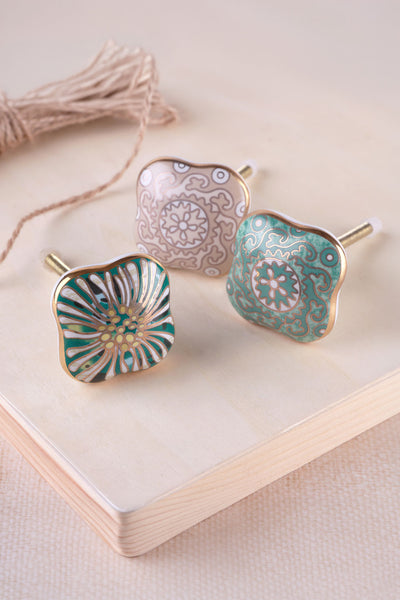
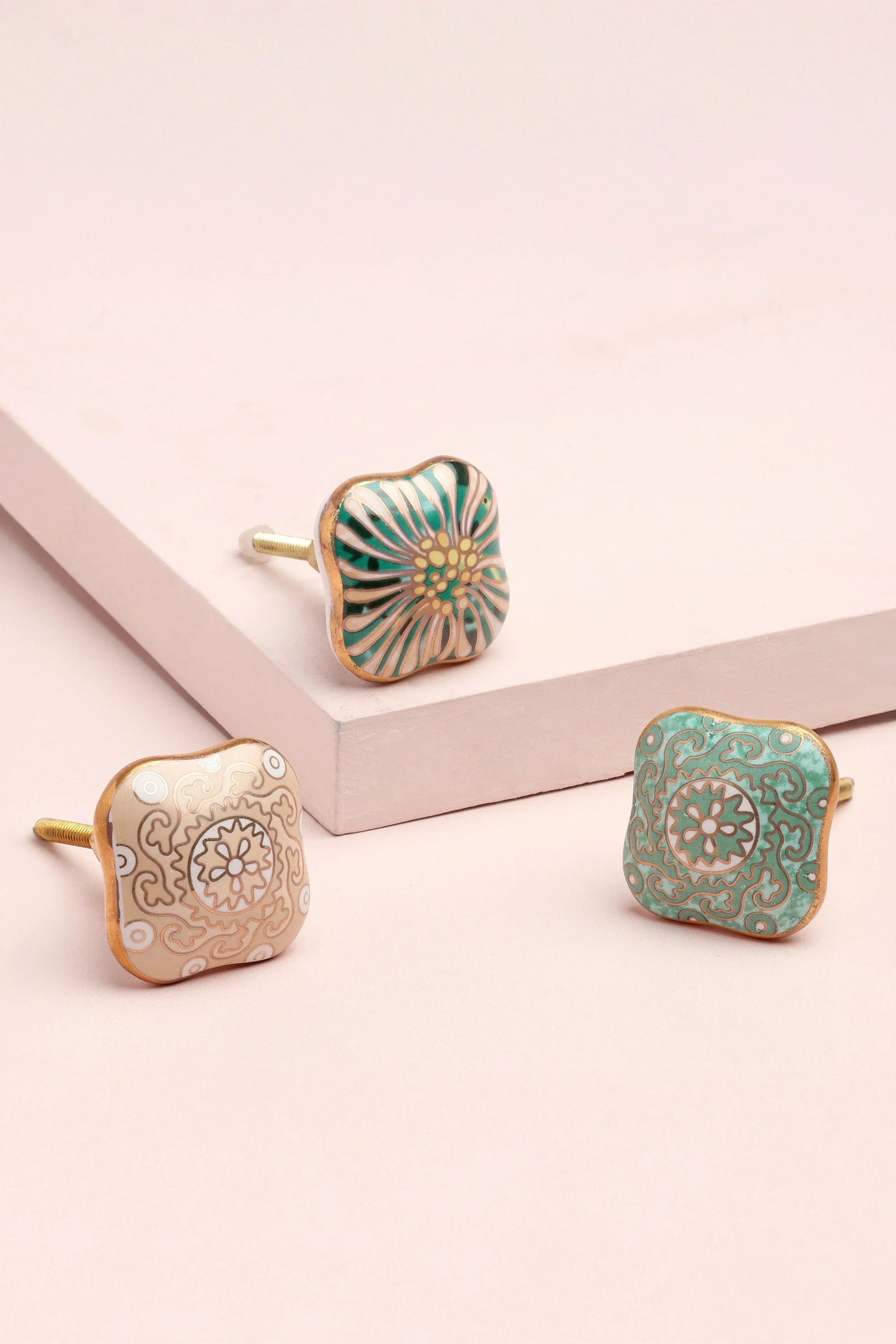
Ceramic is the workhorse of British cabinet hardware and, when hand-painted, the most quietly luxurious. The pattern is laid by brush, the glaze is fired in small batches, and no two knobs are identical. A Milano cabinet knob in a creamy hand-painted finish does the work of softening a painted shaker run; a deeper, patterned ceramic does the same job in a country kitchen with darker cabinetry. The thing to look for is the brass base — a heavy, solid base separates an heirloom-grade ceramic knob from a thin, hollow one.
Solid brass
Brass is the most forgiving material in cabinet hardware because it ages with the room. A brushed brass knob in a dark green kitchen will deepen over five years; an aged brass knob in a paler scheme will hold its tone almost indefinitely. Brass is the right choice when the rest of the room is doing the colour work and the hardware is meant to support it rather than lead. Look across the wider Brassworks edit for the full range of finishes.
Cut glass and crystal
Glass knobs are often overlooked for cabinets and they shouldn't be. A faceted crystal knob on a pale-painted dresser, or on the front of a bathroom vanity, throws small fractures of light back into the room. They suit Georgian and Edwardian rooms particularly well, but they also work in newer schemes where the rest of the cabinetry is quiet and a single sparkle of detail is welcome.
Wood, resin and mixed materials
For more contemporary kitchens, a three-tone wood, resin and brass cabinet knob brings warmth without weight. Wood reads as soft, resin reads as quiet sculpture, and the brass detail keeps the piece from drifting into rustic. These work especially well in kitchens with pale stone worktops, where a touch of warmth at hand-height makes the room feel lived in.
Finishes: which one for which kitchen
If material is the body of a cabinet knob, finish is the voice. Most decisions come down to four families — polished brass, aged or antique brass, chrome and matte black — with hand-painted ceramic sitting alongside as a category of its own. The right finish depends less on personal taste and more on what the room is already telling you.
Polished brass
Polished brass is the brightest of the brass family and it suits painted kitchens — particularly the deep greens, navy blues and soft creams that have defined the British shaker for a decade. It rewards a kitchen with good natural light. In a darker room, polished brass can read as too sharp; consider antique brass instead.
Antique and aged brass
Antique brass is the most versatile finish in cabinet hardware. It carries warmth without shouting, it pairs with both painted and wood-fronted cabinets, and it sits comfortably alongside almost any worktop — marble, stone, oak, ceramic. If you are choosing one finish for a whole kitchen and you are unsure, antique brass is the safe and elegant answer.
Chrome and polished nickel
Chrome is the most practical finish for households where the cabinets get hammered: small children, busy mornings, marks that need wiping off quickly. It reads clean and a touch traditional. Polished nickel is the slightly softer, warmer cousin — a useful choice for bathrooms and dressing rooms where chrome can feel a little clinical.
Matte black
Matte black has been everywhere for the last few years, and it is at its best when paired with light cabinetry and pale stone — the contrast does the work. On dark cabinetry, matte black can disappear. Use it deliberately.
Hand-painted ceramic as a finish
A patterned royal blue ceramic cabinet knob functions as a finish in its own right. It brings colour and personality to a row of pale cabinets without committing the whole room to a contrasting palette. Hand-painted ceramic is the right answer when the kitchen is otherwise restrained and a single accent at hand-height does the work.
Sizing: getting the proportion right
Most cabinet knobs sit between 25 mm and 40 mm in diameter. The instinct is to choose by personal preference, but the better way is to choose by door and drawer width.
For standard cabinet doors and small drawers, a 28–32 mm knob feels right in the hand and looks correctly proportioned on the face. On wider drawers, a 35–40 mm knob holds its own visually. On very wide drawers — anything beyond about forty-five centimetres — switch to a pull, or place two knobs at quarter points. Two small knobs are almost always better than one knob that looks lost.
One quiet test: stand at the cabinet, close the door, and look at it from about two metres back. If the knob disappears, it is too small. If it dominates, it is too large. The eye will tell you before any measurement does.
Placement: where the knob actually goes
For most cabinet doors, the knob sits on the corner opposite the hinge, roughly five to seven centimetres from the edge and the same distance from the top or bottom rail — that is, tucked into the corner of the stile. On drawers, a single knob sits in the centre; on wide drawers, two knobs split the face into thirds.
The detail people forget is the relationship between knobs and pulls when the kitchen uses both. The visual centre of a pull and the visual centre of a knob should sit at roughly the same height from the cabinet edge. This small alignment is what separates a kitchen that looks coherent from one that looks assembled.
Style by room: not just the kitchen
Cabinet knobs do work far beyond the kitchen, and the full cabinet knob collection is built to be moved around the house.
The kitchen
Knobs on uppers, pulls on lowers is the most common pattern, but it isn't the only one. A kitchen with all knobs reads as more domestic and a touch more traditional; a kitchen with all pulls reads as more contemporary. Choose one direction and commit.
The bathroom
Vanity cabinets benefit from a finish that talks to the tap. If the tap is polished brass, the knob is polished brass; if the tap is chrome, the knob is chrome or polished nickel. Crystal and glass knobs are particularly handsome on white-painted vanities — small flashes of light at hand-height.
The bedroom and dressing room
Wardrobes and chests of drawers respond well to ceramic knobs more than any other hardware. They are softer in the hand, quieter to the touch, and they carry a hint of dressing-table craft. A patterned ceramic on a wardrobe or chest is a small piece of personality in a room that often defaults to neutrals.
The hallway and utility
Boot rooms, utility cupboards and built-in hallway joinery benefit from harder-wearing finishes — chrome, brushed nickel, antique brass. These are working knobs that need to take the wet, the dirt and the daily knock.
Mixing finishes: where the rules actually live
The most common worry from clients is whether finishes can be mixed in a single room. They can, and a well-mixed scheme is more interesting than a perfectly matched one — but it follows a rhythm.
The simplest rule is two-finish maximum within a single zone, and one of those two should dominate. A kitchen with antique brass cabinet knobs and aged brass pulls reads as deliberate; a kitchen with polished brass knobs, chrome pulls and matte black hinges reads as unsure. If you want to mix, pick a primary finish, a secondary finish, and let the third stay absent.
The other useful rule: tap and cabinet hardware should usually agree. If they don't, the eye will notice every time it crosses the room.
Hand-painted versus machine-pressed: why craft matters here
It is possible to buy cabinet knobs that come out of a press, finished in a powder coat, with no maker's hand anywhere on them. They function. They do not flatter a room. The reason hand-painted and hand-finished knobs sit at the heart of the cabinet knob collection is that they carry the small irregularities that make a kitchen look like it was set, rather than installed.
On a hand-painted ceramic knob, the pattern is slightly different on every piece. The glaze pools a little thicker on one edge. The brass base has the gentle warmth of a casting rather than the cold sharpness of a stamping. None of this is precious; it is just the difference between something made and something manufactured. Across a run of eight cabinets, the eye reads it as character.
Installation and care: the easy part
Cabinet knobs install with a single bolt through the door. Most British cabinetry uses an M4 thread, with the bolt cut to length depending on the door thickness. If you are replacing existing knobs, take one off and measure: the new bolt needs to be the same length or slightly longer if the new knob has a thicker base.
For care, the rules vary by material. Ceramic knobs need only a damp soft cloth — no abrasive cleaners, no bleach, which can dull the glaze. Brass develops a patina over time and most owners want this; if you prefer the brighter finish, a soft polish every six months will hold it. Lacquered brass is the exception — leave it alone with anything more than a dust. Chrome and nickel respond well to a microfibre cloth and a touch of warm water.
The wider hardware picture
Cabinet knobs sit alongside pulls, hinges and the wider hardware collection. A coherent kitchen treats them as a family. The hinges may be hidden, but their finish — when a door swings open — should still relate to the knobs. The pulls should be a deliberate counterpoint to the knobs, not a different conversation. The whole picture should feel like one decision, taken slowly.
Frequently asked questions
How many cabinet knobs do I need for a kitchen?
Count every door and every drawer in the kitchen, then add one or two as spares. Most British kitchens land somewhere between twenty and forty knobs in total, depending on the layout. Order spares from the same batch so the colour matches if anything is ever damaged.
What size cabinet knob is best for a standard door?
A 28–32 mm knob is the right size for most cabinet doors and small drawers. On wider drawers, step up to 35–40 mm or switch to a pull. Hold the knob in your hand before fitting — it should feel substantial without being heavy.
Can I mix cabinet knobs and pulls in the same kitchen?
Yes, and it often looks better than using one or the other throughout. The most common pattern is knobs on the upper cabinets and pulls on the lower drawers, but it can also be reversed depending on the layout. Keep the finish related — usually the same finish on both, or two finishes within the same metal family.
Are ceramic cabinet knobs durable in a working kitchen?
Hand-finished ceramic knobs with a solid brass base are designed for daily use and last for decades. The fired glaze is hard, resistant to water and most household marks, and the brass base bolts straight through the door. Wipe with a damp cloth — nothing abrasive — and they hold their finish.
Will brass cabinet knobs go dark over time?
Solid brass develops a patina with use; lacquered brass stays bright. Most homeowners come to prefer the patina, which deepens the warmth of the knob and reads as character. If you want to slow it down, a light polish twice a year is enough. If you want to keep the knob crisp, choose a lacquered finish from the outset.
A final thought
A cabinet knob is the smallest decision in the room and one of the most visible. Choose by the material first, the finish second, and the size last. Choose hand-finished where you can, and choose pieces that age with the kitchen rather than against it. Browse the full cabinet knob collection when you are ready to put a kitchen together piece by piece. With more than 700 verified reviews on Trustpilot and over 2,000 store reviews on Judge.me, our pieces are trusted in homes across the UK, US, Europe and Australia.
Further reading
- Cabinet Pulls vs Cabinet Knobs: A UK Guide to Choosing the Right Hardware — Knobs or pulls? A UK guide by room, by drawer size, by style. With sizing rules and finish pairings.
- Cabinet Hardware: The Detail That Defines a Kitchen — Why designers spec the cabinet hardware before the cabinetry itself.
- How to Choose Brass Finishes: A Material Guide — Natural, antique, polished and beeswax — a short guide to the brass finishes we work with.