


The Journal · Buying Guide
How to Choose Pillar Candles: Sizes, Colours and Styling — A UK Guide
A British guide to choosing pillar candles — sizes, colours, ribbed and smooth finishes, burn time and how to style them on a mantelpiece or table without cluttering the room.
A pillar candle is the simplest object in the room and one of the easiest to get slightly wrong — the wrong height for the mantel, the wrong colour for the scheme, one candle standing alone where three would have held the eye. Chosen well, pillar candles do quiet, reliable work: they warm a table, soften a shelf, and give a room somewhere for the light to gather at the end of the day. This is a short guide to choosing them properly.
What a pillar candle is for
A pillar candle stands on its own without a container — a free-standing column of wax, wide enough to hold its shape as it burns. That is the whole appeal. A tealight needs a holder, a dinner candle needs a stick, but a pillar simply stands where you put it, which makes it the most versatile candle in the house. It belongs on a mantelpiece, down the centre of a dining table, on a hallway console, or grouped on a tray by the bath. The pillar candle collection is built around that flexibility — a single form, in enough sizes and colours to suit any room.
Because a pillar stands alone, its proportions and colour carry more weight than they would inside a jar. Choosing well comes down to three things, in this order: size, colour, and finish.
Size: getting the height and diameter right
The most common mistake with pillar candles is buying one size and using it everywhere. A pillar that looks generous on a dining table can look lost on a wide mantelpiece, and a tall pillar that anchors a hallway console can overwhelm a bathroom shelf. Choose by the surface, not by habit.
Small pillars
Shorter, slimmer pillars — roughly 7 to 12 centimetres tall — are the workers of the collection. They group well, they suit bathroom shelves and bedside tables, and three or five together make a considered cluster without dominating. Small pillars are also the right choice inside a hurricane or a glass candle holder, where the container adds the height and the candle simply glows.
Large pillars
Taller and broader pillars — from around 15 centimetres upward — are statement pieces. One large pillar can hold a mantelpiece on its own, or anchor the centre of a dining table where a cluster would crowd the plates. A broad-diameter pillar also burns longer and more evenly, which makes it the sensible choice for a candle you want lit through a whole evening.
The proportion test
One quiet rule holds across every surface: an odd number of candles at varied heights almost always looks better than an even number at the same height. Two matching pillars read as a pair of bookends; three pillars of different heights read as a considered arrangement. When in doubt, buy three — a tall, a medium and a small — and let the difference in height do the styling for you.
Colour: reading the room first
Colour is where pillar candles either disappear into a scheme or quietly lift it. The trick is to decide whether you want the candle to blend or to contrast before you choose the shade.
To blend, choose a pillar close to the wall or the surface it sits on — soft cream on a painted mantel, warm stone on an oak table, chalky white on marble. A blended candle reads as architecture; it is there for the flame, not the colour.
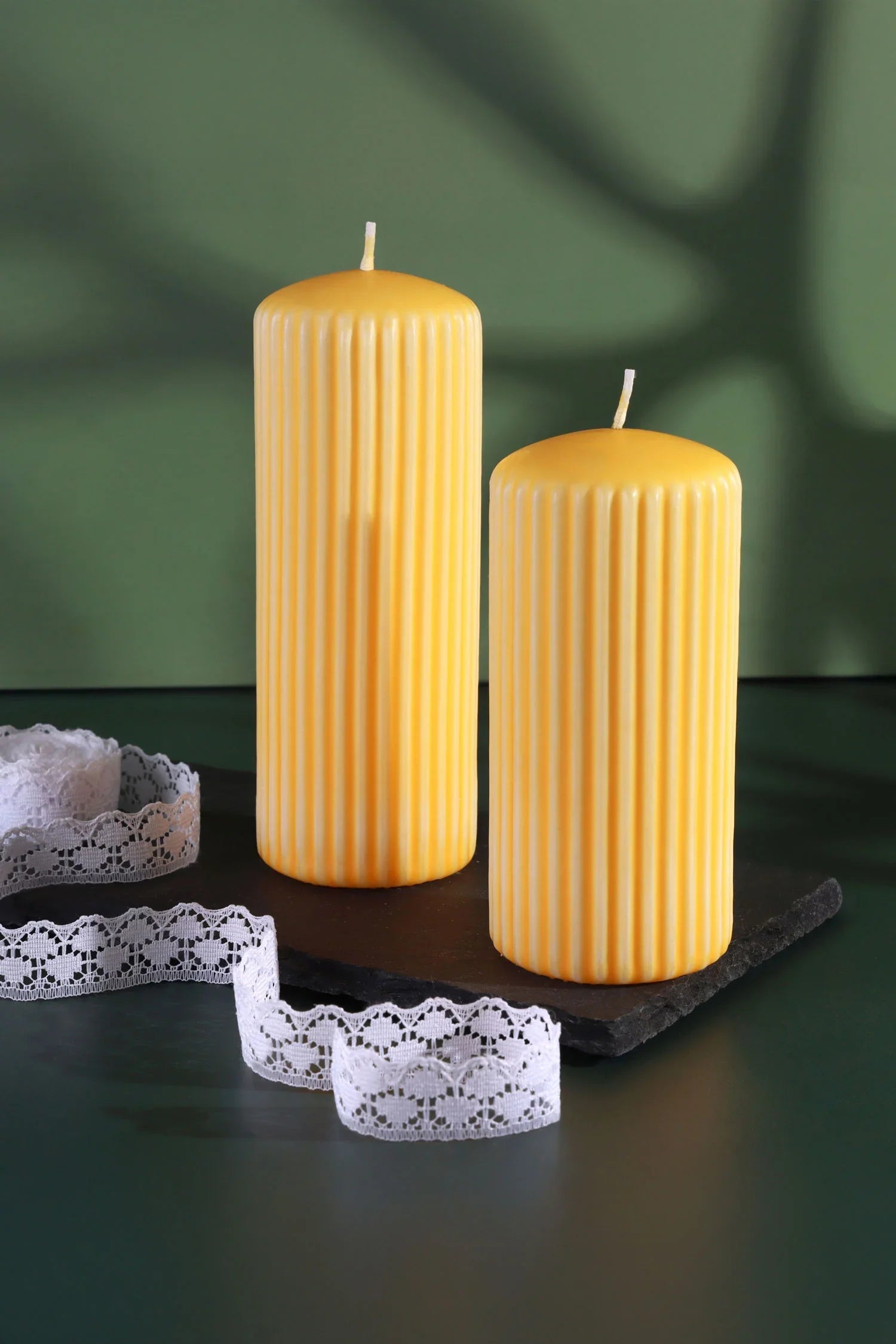
To contrast, choose a pillar that answers a colour already in the room — a deep red against a green kitchen, a soft yellow against a grey shelf, gold against a dark console. A contrasting candle becomes a small accent, and one well-placed accent is worth more than a whole row of matched neutrals. A ribbed pillar in soft yellow does exactly this on a pale surface — a single note of warmth that catches the eye.
As a general rule, keep bold colour to one or two pillars in a group and let the rest stay quiet. A cluster of five candles in five different bright colours reads as busy; a cluster of five in cream, cream, stone, stone and a single deep tone reads as designed.
Finish: ribbed, smooth, rustic and sculptural
Two pillars of the same size and colour can feel completely different depending on their surface. The finish sets the mood.
Ribbed and fluted
A ribbed or fluted pillar carries vertical lines down its length, catching the light along each ridge. It reads as a little more decorative and a little more contemporary, and it holds its texture even unlit — which matters, because a candle spends far more of its life unlit than lit. Ribbed pillars suit a mantel or a shelf where the candle is on display all day. The Fern pillar in amberstone and gold is a good example of texture doing the work.
Smooth
A smooth pillar is the quiet classic — no texture, no distraction, just clean column and colour. Smooth pillars are the right choice when the room is already doing plenty and the candle should recede. They also read as slightly more formal, which suits a dining table or a considered console.
Rustic and sculptural
Some pillars are cast with a deliberately irregular or sculptural surface — a knobbled, hand-finished texture, or a stacked, organic form. These are for rooms that lean relaxed rather than formal, and they work best standing alone where the shape can be read properly rather than lost in a crowd.
Scented or unscented?
Not every pillar needs to be scented, and there is a good case for keeping the two jobs separate. An unscented pillar is there for light and form — you can burn several at once, on a table or a mantel, without the scents competing. A single scented candle then does the fragrance work from one point in the room.
If you do want a scented pillar, keep it to one per room and choose a fragrance that suits the space — something warm and grounding for a living room, something cleaner and lighter for a bathroom. Our guide to scented candles covers fragrance families in more detail. For a table where people are eating, favour unscented pillars and let the food lead — the same principle that applies to dinner candles.
Where pillar candles go, room by room
The mantelpiece
A mantel is the natural home of the pillar candle, and the place people most often over-fill it. Three pillars of varied height at one end, balanced by a single object at the other, is almost always better than a symmetrical row. Our piece on styling a mantelpiece without cluttering it takes this further.
The dining table
Down the centre of a table, alternate a few pillars of different heights with low foliage or a shallow bowl. Keep the pillars either well below or well above seated eye level so people can see each other across the table — a candle at exactly eye height is the one thing to avoid.
The bathroom
A cluster of small pillars on a tray by the bath, or grouped on a shelf, turns a functional room into a restful one. Bathrooms take colour well — a bathroom is often where a bolder pillar earns its place.
Inside glass and hurricanes
A pillar inside a glass hurricane or a tall candle holder is protected from draughts and reads as more formal. This is the safest way to burn a pillar near soft furnishings, and the glass lifts a small pillar to a more generous height.
Burning a pillar properly
A pillar candle rewards a little care on the first burn. The first time you light it, let it burn long enough for the melt pool to reach the full diameter of the candle — usually an hour or two for a broad pillar. This prevents the candle from tunnelling, where the flame sinks a narrow well down the centre and leaves a rim of unburnt wax. Keep the wick trimmed to about five millimetres, and burn on a heat-safe surface away from draughts. Our full guide on how to burn a pillar properly covers the detail.
Building a set that works together
The most useful way to buy pillar candles is not one at a time but as a small, considered set — a few sizes, a shared palette, one accent colour. That gives you the pieces to style a mantel this week and a table next week without everything matching too neatly. Browse the full pillar candle collection, or step back to the wider candle collection to see how pillars sit alongside scented candles, dinner candles and holders.
Frequently asked questions
What sizes do pillar candles come in?
Pillar candles typically range from small pillars of around 7 to 12 centimetres tall up to large statement pillars of 15 centimetres and more. Small pillars group well and suit shelves and bathrooms; large pillars anchor a mantelpiece or a table on their own. Choose the size to suit the surface, and mix heights within a group rather than matching them.
How long do pillar candles burn?
Burn time depends on the diameter and height. A broad, tall pillar burns longer and more evenly than a slim one, and a wide pillar can last through a whole evening and many sittings. To get the full life from any pillar, let the first burn reach the full width of the candle so it doesn't tunnel.
Are ribbed pillar candles different from smooth ones?
Only in finish, not in function. Ribbed or fluted pillars carry vertical texture that catches the light and reads as a little more decorative — useful when the candle is on display unlit. Smooth pillars are quieter and slightly more formal. Both burn the same way; the choice is about the look of the room.
Should pillar candles be scented or unscented?
For a group of pillars, or for a dining table, unscented is usually better — you can burn several without the fragrances competing, and food isn't overwhelmed. Keep scent to a single candle per room. If you want a scented pillar, choose one fragrance suited to the space rather than several at once.
How many pillar candles should I group together?
An odd number almost always looks better than an even one. Three pillars of different heights make a considered cluster; five work on a longer surface. Keep the palette mostly quiet with one accent, and vary the heights so the group reads as arranged rather than lined up.
A final thought
A pillar candle is a small decision that changes a room more than its size suggests. Choose the size for the surface, the colour for the scheme, and the finish for the mood — and buy in small sets rather than singles, so you always have the pieces to arrange. Browse the full pillar candle collection when you are ready to put a few together.
Further reading
- Candle Care: How to Burn a Pillar Properly — The first-burn rule, wick trimming and how to stop a pillar tunnelling.
- The Mantelpiece: How to Style One Without Cluttering It — Where candles sit in a considered mantel arrangement.
- A Guide to Scented Candles — Fragrance families, burn time and choosing scent by room.