

The Journal · British Design
How Many Cabinet Knobs Does a Kitchen Need?
A typical British kitchen takes twenty-two pieces of visible hardware — eight base cupboard doors, six drawers, six wall cupboards and two tall larder doors — and thirty-four once you count the exposed hinges. A single cupboard run is six. A bathroom is six to ten. Nobody publishes these numbers, and getting them wrong is why so many kitchens end up part-finished. This is the full count, room by room, with the two diameters that cover almost every door (32mm and 38mm), the three finish classes and how each one ages, the solid brass screws that stop an aged hinge staining the door beneath it, and why you should order two more than you counted.
How many knobs does a kitchen actually need? It is the first question of any hardware decision and the one nobody answers — so here is the number, and the arithmetic behind it.
The short answer is twenty-two
A typical British kitchen — nine or ten base units, five or six wall cupboards, one tall larder — takes twenty-two pieces of visible hardware. Not "a few". Not "depends". Twenty-two.
We know this because we count them. Every week somebody orders four knobs for a kitchen, fits them, and comes back a fortnight later for the other eighteen, by which time the pattern they chose has moved on. The count is not a detail to sort out at the end. It is the thing that decides whether the room reads as one considered idea or as three separate shopping trips.
How twenty-two breaks down
Here is the arithmetic for a mid-sized kitchen. Yours will differ by a unit or two either way, but the shape of it holds.
| Element | Count | Hardware |
|---|---|---|
| Base cupboard doors | 8 | 8 knobs |
| Drawers (two stacks of three) | 6 | 6 knobs or cup pulls |
| Wall cupboard doors | 6 | 6 knobs |
| Tall larder or utility doors | 2 | 2 knobs |
| Total | 22 | 22 pieces |
Two things fall out of that table immediately. The first is that wall cupboards are half the room's hardware and the half people forget, because they stand at the worktop when they count. The second is that a double cupboard is two doors, not one unit — a mistake that costs six or eight pieces in an average kitchen and is the single most common reason an order comes up short.
Thirty-four, if you count the hinges
Twenty-two is the handle count. It is not the visible-metal count.
Swap the six drawer knobs for cup pulls and the total stays at twenty-two — a cup pull replaces a knob, it does not add to it. But if your cabinetry carries exposed hinges rather than concealed European ones, each door on show adds two more pieces of metal to the room. Six doors carrying visible hinges is twelve cabinet hinges, and twenty-two becomes thirty-four.
That number matters because hinges are chosen last, usually by whoever is fitting, usually in whatever finish the merchant had. Thirty-four pieces of hardware in a room and twelve of them picked by accident is how a kitchen ends up almost right.
A single run of cupboards: six
Not everyone is doing a whole kitchen. If you are replacing the hardware on one run — say two double base units and a two-drawer stack — the number is six. Four doors, two drawers.
Six is also the useful test quantity. If you are undecided between two patterns, six of each is enough to live with for a week and see which one you keep reaching past. A run is a complete visual unit; four is not enough to judge a pattern and eight is more than you need to.
The bathroom: six to ten
Bathrooms are smaller and stranger, and the range is wider because the storage varies so much.
| Element | Typical count |
|---|---|
| Vanity doors | 2 |
| Vanity drawers | 2 |
| Mirrored wall cabinet | 1–2 |
| Tall or under-sink storage | 0–4 |
| Room door | 1 |
| Total | 6–10 |
Note the last line. The bathroom is the one room where the door itself is usually part of the same decision — a cloakroom with a mismatched door knob is noticed immediately, because there is nothing else in the room to look at. Our door knobs and cabinet knobs share patterns for exactly this reason.
Size before pattern: 32mm and 38mm
Once you have the count, size is the next decision, and it is a shorter conversation than most people expect. Two diameters cover almost everything.
32mm is the working default. It suits wall cupboards, standard base doors, drawers up to around 600mm wide, and any door where the knob sits close to a frame or an adjacent unit. It is the size that disappears politely.
38mm is for weight and width — larder doors, wide pan drawers, tall utility units, and any door where a 32mm knob would look like a full stop on a long sentence. It is also the better choice on a door you pull hard, because there is more to hold.
Mixing the two within a room is correct, not a compromise: 38mm on the tall and wide, 32mm everywhere else. What is not correct is choosing by pattern first and discovering the pattern only comes in one diameter after you have counted twenty-two of them.
Finish, and the screws nobody asks about
Twenty-two pieces of hardware will age together or separately depending on one choice. Our finishes fall into three classes, and the classes are worth knowing before you count anything.
| Finish | Class | How it behaves |
|---|---|---|
| Satin brass | Lacquered | Sealed. Holds its colour. Will not darken. |
| Polished brass | Living | Bare. Mirrored at first, then softens and deepens with handling. |
| Aged brass | Living | Bare and already dark. Continues to move, more slowly. |
| Chrome | Plated | Hard, cool, stable. Does not patinate. |
The rule that follows is simple: do not mix a living finish and a lacquered one on the same run. Polished brass beside satin brass looks identical in the showroom and noticeably different after a year of hands on it, because one has moved and the other has not. Across a room, mixing classes is a legitimate decision — living brass on the brassworks pieces, chrome on the utility run — but within a single sightline, pick one class and stay in it.
Then the screws. Ceramic knobs ship with their fixing bolt; our hinges and pulls ship with solid brass screws — Ø3mm × 16mm, countersunk, slotted. Keep them. The reason is not tidiness. A steel screw in an aged brass hinge will rust, and the rust bleeds down the hinge and stains the door beneath it, which is a great deal of damage from the one component nobody thought about. If your cabinet doors are thicker or thinner than standard, order the fixing length you need before you fit, not after.
Count once, then order more than you counted
Add two to whatever number you arrive at.
Hand-painted ceramic varies from batch to batch — that is what hand-painted means. Two knobs from the same pattern, bought eight months apart, will be recognisably the same design and not quite the same object. If a knob is chipped during fitting, or a child works one loose, or you add a unit two years from now, a spare from the original batch is the difference between a repair nobody notices and a repair everybody does.
Two spares on twenty-two is a sensible margin. On a full cabinet hardware specification for a large kitchen, four. Keep them in the drawer with the fixing bolts and the fitting instructions, and label the bag with the pattern name — you will not remember it.
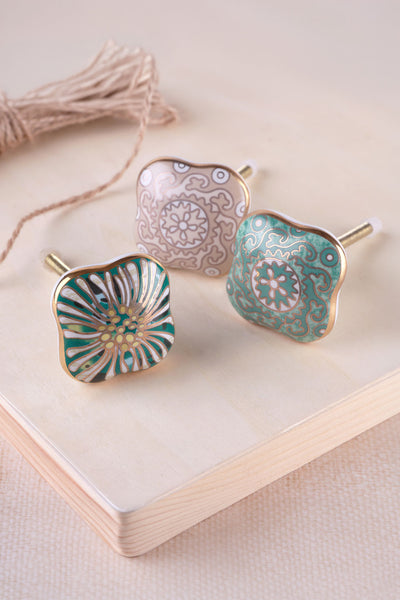
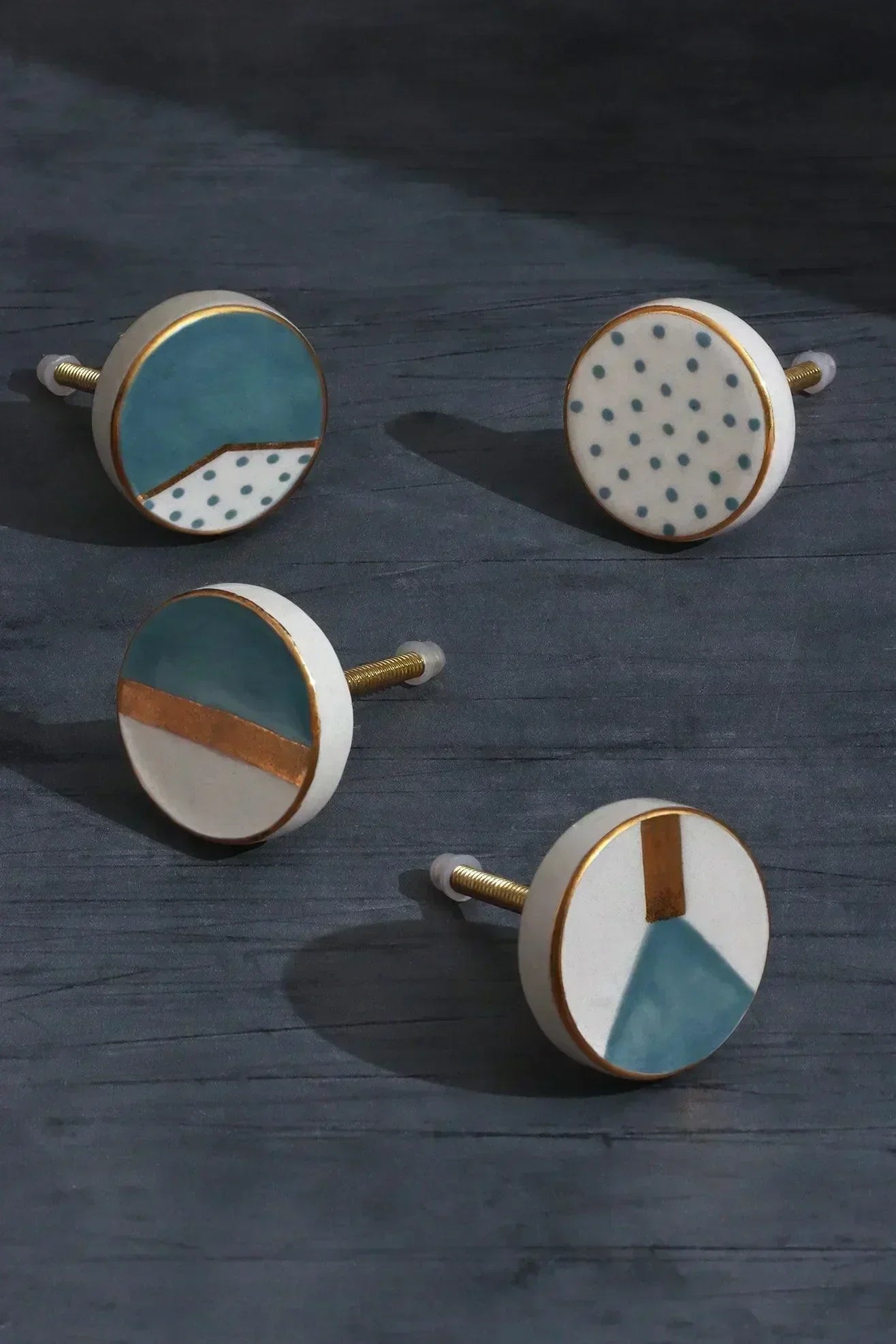
If you want a shortcut through all of this: the geometric and polka dot ceramic collection gives you a set of patterns that hold together across a whole room, the Milano ceramic cabinet knob carries across twenty-two pieces without ever becoming loud, and the hand-forged hammered cupboard knob is the one to look at if your cabinetry is heavy and painted dark. For drawers, cabinet pull handles are the alternative to counting six more knobs.
Frequently asked questions
How many knobs does an average UK kitchen need?
Twenty-two. That is eight base cupboard doors, six drawers, six wall cupboard doors and two tall larder or utility doors. Count doors rather than units — a double cupboard needs two knobs, not one — and remember the wall cupboards, which are roughly half the total and the half most often missed.
Do drawers take knobs or cup pulls?
Either, and it does not change the count — a cup pull replaces a knob one for one. Knobs keep a drawer run quiet and consistent with the doors above. Cup pulls give a wide or heavy drawer something to grip and draw a horizontal line across the run. On drawers wider than about 800mm, two knobs or one cup pull both work; one central knob will look under-scaled.
Should every cupboard door have the same knob?
Not necessarily, but every door in one sightline should share a finish class. A common approach is one pattern throughout the base and wall units, with a different diameter — 38mm rather than 32mm — on the tall larder to give it weight. Changing pattern between the kitchen and a separate utility or boot room is fine, because you never see both at once.
What size cabinet knob should I choose, 32mm or 38mm?
32mm for wall cupboards, standard base doors and drawers up to around 600mm wide. 38mm for larder doors, wide pan drawers and tall units. Using both in one kitchen is the correct answer far more often than using one — check that your chosen pattern is made in both diameters before you commit to twenty-two of it.
How many spare knobs should I order?
Two on a kitchen of twenty-two, four on a large specification. Hand-painted ceramic varies between batches, so a replacement bought later will be the same pattern but not quite the same piece. Spares from the original batch are the only way to make a future repair invisible.
A final thought
Twenty-two is not a large number. It is small enough that every piece is seen, touched daily, and either right or slightly wrong — and slightly wrong, twenty-two times over, is what makes a new kitchen feel like it belongs to somebody else. Count the doors, count the drawers, count the hinges, then choose once.
Start with the cabinet knobs and work outwards. With more than 700 verified reviews on Trustpilot and over 2,000 store reviews on Judge.me, our pieces are trusted in homes across the UK, US, Europe and Australia.