

The Journal · brass knobs
How to Choose Door Knobs That Finish a Room
Question: when does a room start to feel finished? For most homes, the answer hides in plain sight — on the doors. A designer's guide to choosing door knobs and cabinet hardware that look considered rather than installed, with ceramic, brass, chrome and glass options, room-by-room matching, and scale.
G · Stories · No. I · Home & Hardware
A G Decor Guide
Question: when does a room start to feel finished? Not when the walls are painted, or the furniture arranged, or the rug laid down. It's later than that — somewhere between the last decision and the last accessory. For most homes, the answer hides in plain sight, on the doors.
Door knobs are the smallest thing you touch every day and the easiest to ignore until they're wrong. A plain internal door disappears into the background. The right ceramic, brass, chrome or hand-painted knob makes the door part of the design — quietly, the way a designer would. This is a room-by-room guide to choosing hardware that looks considered rather than installed.
Why hardware is the designer's last move
Interior designers choose hardware late, not early. By the time they reach the door, the palette is set, the lighting is in, the fabric is chosen. The hardware then does something specific: it ties everything together with one repeated detail.
That's what makes it the cheapest meaningful upgrade you can make. A door knob costs less than a cushion, fits in your palm, and is touched dozens of times a day. It's the first thing the eye lands on when a door is closed, and the last thing a guest sees as they walk out.
Our customers describe G Decor knobs as "tiny works of art", and the language matters more than it sounds. Pattern, glaze depth and a brass base catch light in a way mass-produced hardware can't. If a room feels nearly finished but a little flat, the hardware is usually the missing layer.
Start with fit, not finish
Before falling in love with a colour or a pattern, make sure the knob will actually work on your door. Internal UK doors usually take a mortice knob set — two knobs joined by a square spindle that operates a latch inside the door. Cupboards, wardrobes and furniture take a cabinet knob, a single piece screwed directly through the door or drawer face.
Three quick checks before you order:
- Is the door fitted with a tubular latch (mortice knobs work) or a heavier mortice lock (in which case lever handles often fit better)?
- UK mortice knobs use an 8 mm spindle and sit on a round rose. Look at the existing rose to check it isn't hiding damage.
- For cabinet knobs, measure the existing screw hole. Vintage drawers and reclaimed kitchen units rarely match the modern M4 standard.
Once the fit is right, the design is the fun part — and much harder to get wrong.
Knob, lever or pull — choose by room
These three forms behave very differently in a room.
Knobs invite a closer look. They suit internal doors, wardrobes, cupboards and furniture where the hardware is meant to be part of the decoration. Lever handles disappear visually and feel more contemporary — good for high-traffic doors, children's rooms and anyone who needs extra grip. Pulls are directional. They tell the eye where to grip, and look strongest on cupboards, drawers and statement doors.
If the goal is character — a kitchen that feels less new-build, a bedroom that feels less rental — a decorative knob gives you the most design return for the smallest decision. Browse our full door hardware collection to see the range side by side.
Choosing your material
Ceramic — for colour, pattern, and the look of something handmade
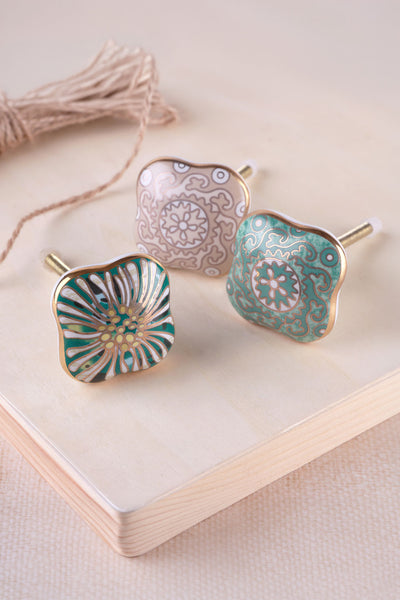
Hand-painted glazes catch light in a way metal cannot, and slight variation between pieces is part of the appeal. Ceramic is at its best in neutral rooms, painted furniture and country or cottage interiors. Our ceramic mortice door knobs and ceramic cabinet knobs are made in small batches and hand-finished, so no two are quite the same.
Brass — for warmth and heritage
Brass has weight, warmth, and a soft patina that develops over time. It belongs in heritage schemes, timber kitchens and warm neutral palettes. Pair brass-based ceramic knobs (the Milano Signature and Royal Gold sets are designed exactly this way) with brass picture frames, lamp bases or light switches so the metal tone repeats around the room.
Chrome and polished finishes — for clean lines
Chrome feels sharper and cooler. It suits bathrooms, modern kitchens and cooler colour palettes. A chrome-based ceramic knob like the Royal Blue Pattern gives you the precision of metal with the personality of ceramic.
Glass — for light and lift
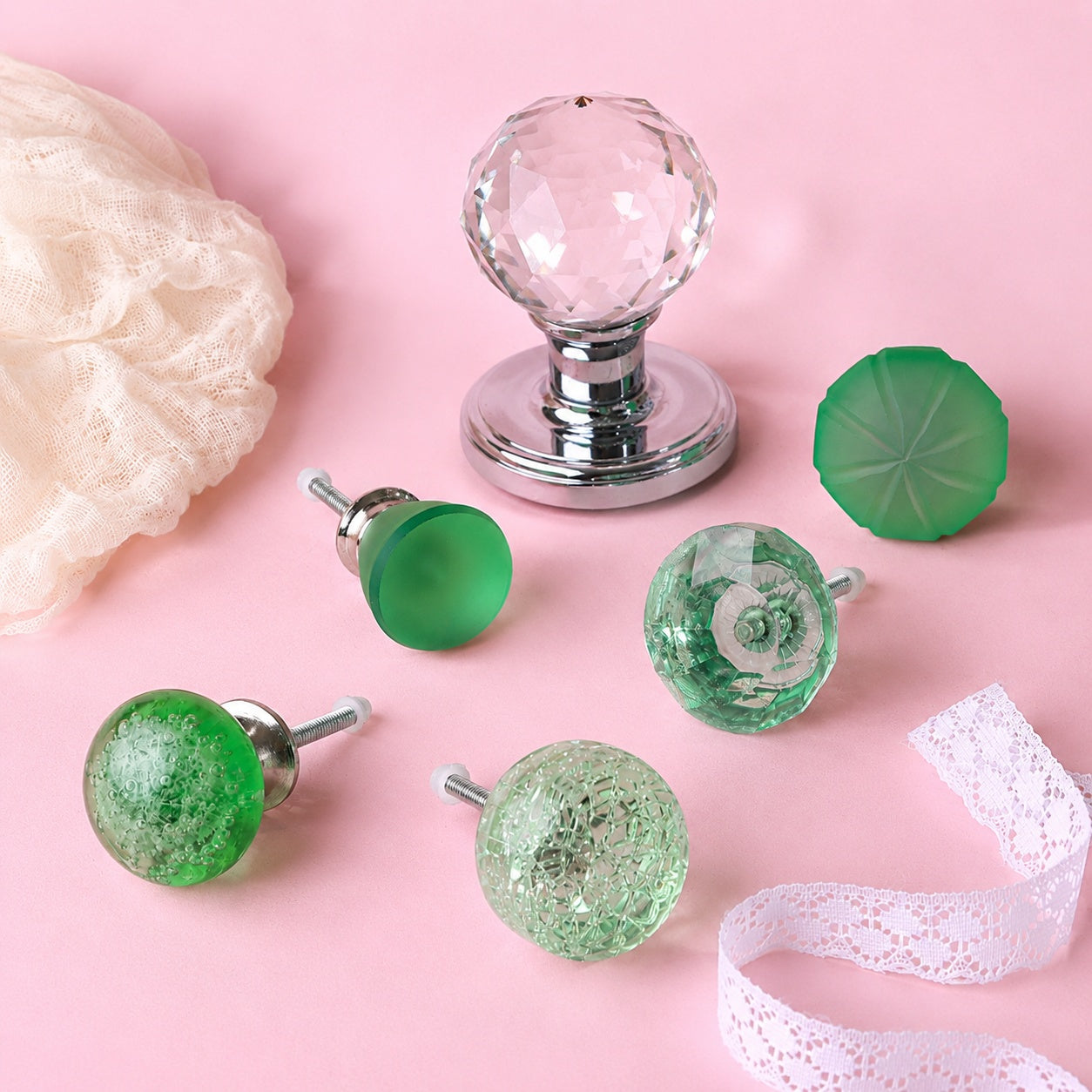
Cut glass and crystal knobs catch light and lift a dark hallway or a small bedroom instantly. Our Solid Crystal Mortice Door Knobs are a customer favourite because they look more expensive than they are and work in almost any colour scheme.
The one-detail rule
The safest design move is to repeat one element without matching everything. Matching every metal in a room can look like a showroom; repeating one finish or one colour looks considered.
A few combinations that work in real homes:
- Chrome bathroom fittings with a ceramic knob on a chrome base.
- Brass kitchen lighting with patterned ceramic cabinet knobs.
- Plain white internal doors with patterned knobs on a wardrobe or chest of drawers.
- Sage green kitchen cabinets with hand-painted ceramic knobs that pick up the green.
The pattern, not the perfection, is what makes a room feel designed.
Period homes, modern interiors, and the new-build problem
Hardware should respect the architecture without theatre.
- Victorian and Edwardian homes welcome ceramic, brass, glass and decorative backplates. Pattern is encouraged.
- Country cottages take hand-painted ceramic, wood and aged brass — anything warm and made by hand.
- Contemporary homes still benefit from pattern, but the strongest results come from cleaner silhouettes and a tighter palette.
- New-builds usually need more character, not less. Plain chrome levers leave a room feeling untouched. A single set of decorative knobs on a feature door — the master bedroom, a panelled hallway, the pantry — changes the whole space.
A useful rule when it gets confusing: let either the shape or the pattern be expressive, not both at once.
Scale matters more than people expect
A small cabinet knob looks lost on a tall internal door; an oversized knob overpowers a slim cabinet. A rough guide:
- Internal door knobs: 55–65 mm for standard UK doors. Should sit comfortably in the palm.
- Cabinet knobs: 25–40 mm for cupboards and drawers. Large enough to grip with two fingers.
- Statement furniture pulls: 100 mm+ on wide drawers and statement doors where the hardware is meant to be seen.
When updating older furniture, measure the existing fixing point first. Vintage drawers rarely match the modern standard.
The quiet luxury test
There's a simple test for whether hardware is doing its job: does it look intentional from across the room, and reward you when you stand right next to it?
Handmade ceramic knobs pass this test because painted detail, glaze depth and slight variation between pieces give each one more character than mass-produced hardware can. That character is what makes a small change feel like an upgrade rather than a repair.
Where to start in your house
If the room is almost finished but still flat, change the hardware before changing the furniture. A door knob, cabinet knob or handle is one of the fastest ways to add colour, texture and craft without repainting walls or replacing larger pieces.
A practical order of attack:
- Kitchen cabinet knobs — the biggest visible change for the least money. Start with cabinet pulls and handles or cabinet knobs.
- Bedroom and wardrobe knobs — pattern and colour without committing the rest of the room.
- Internal doors — the most under-loved surface in most homes. A full set of internal door knobs changes a hallway in an afternoon.
- Front door — last, because it's the most expensive change. Our front door hardware is sized and finished to take the weather.
Frequently asked questions
Do G Decor door knobs fit standard UK doors?
Yes. Our mortice door knob sets are designed for standard UK internal doors with a tubular latch and 8 mm spindle. Each product page lists exact dimensions and spindle size.
Are ceramic knobs durable enough for everyday use?
Yes — our ceramic knobs are kiln-fired and finished with a hard glaze designed for daily use. The metal base (chrome or brass) takes the structural load, while the ceramic provides the surface you see and touch.
How do I clean hand-painted ceramic knobs?
Wipe with a soft, slightly damp cloth. Avoid abrasive cleaners or alcohol-based sprays, which can dull hand-painted detail over time. Brass bases develop a natural patina; if you prefer a brighter look, a soft brass polish once or twice a year is enough.
Can I install door knobs myself?
Cabinet knobs are a five-minute job with a screwdriver. Mortice door knob sets are DIY-friendly when a tubular latch is already fitted — replacing the latch itself is a more advanced job and may need a tradesperson.
Do you ship to the US, Europe and Australia?
Yes. G Decor ships worldwide, with tracked delivery to the UK, Europe, the US and Australia. Shipping is calculated at checkout. Most international orders arrive within 5–10 working days.
What's the difference between a mortice knob and a cabinet knob?
A mortice knob is sold as a pair joined by a spindle and operates the latch on an internal door. A cabinet knob is a single knob that screws onto a cupboard, wardrobe or drawer front — it doesn't operate a latch.
A final note
Start with the metals and colours already in the room. Choose one detail to repeat. Then pick the knob that makes the door — or the drawer, or the wardrobe — feel deliberately part of the room, not added to it. Good door hardware doesn't shout. It makes a space look like every decision was considered, right down to the smallest one.
Explore G Decor's handcrafted internal door knobs and cabinet knobs when the goal is not just to open a door, but to make the final detail feel considered. With more than 700 verified reviews on Trustpilot and over 2,000 store reviews on Judge.me, our hardware is trusted in homes across the UK, US, Europe and Australia.
Further reading
- British Craft: How a Hand-Painted Knob Gets Made — The workshop, the hands, the kiln. Why hand-finished hardware looks alive.
- How to Choose Brass Finishes: A Material Guide — Natural, antique, polished and beeswax — a short guide to the brass finishes we work with.
- How to Choose Door Knobs: A Complete UK Guide — The complete UK reference: anatomy, materials, finishes, sizing, installation and care.