

The Journal · Colonial Revival
Historic Home Restoration: Sourcing Period-Correct Hardware
A guide for owners of American historic homes — sourcing period-correct cabinet knobs, pulls and door hardware for Federal, Victorian, Craftsman and Colonial Revival houses, in materials that read as native to the era.
An old house talks to you through its hardware. The knob in the palm — its weight, its finish, its way of turning in the hand — carries more of a house's period than the wallpaper or the trim ever will. Restoring one well begins with hearing what the house is already saying.
Why hardware carries an old house
In an American house built before 1940, the hardware was almost always the last piece to be replaced and the first to be lost. Cabinet doors were repainted a dozen times ; brass knobs and pulls, mother-of-pearl inlay, pressed-glass pulls, cast bronze escutcheons — these were the pieces that got prised off during a mid-century remodel and pitched into a bucket. Restoring an old house often begins with returning what a previous owner took away, and doing it in materials that read as native rather than as imitation.
The good news, for anyone owning a Federal, Victorian, Craftsman or Colonial Revival house, is that the material vocabulary of period hardware is small and well-defined. Get the material right, get the scale right, and the period reads correctly even when a replacement piece is entering the house for the first time. The old-house press — the tradition of careful, source-cited restoration journalism that has been in print for four decades — has taught two generations of owners this lesson, and the lesson is worth repeating : the material is more than half the story.
Federal (c. 1780–1830) — the elegance of restraint
Federal-period cabinetry — the built-in cupboards flanking a mantel, the tall corner cupboard in the dining room — carried the neoclassical vocabulary of Adam and Sheraton : thin brass rosettes, small oval or round knobs in polished brass, and pierced brass escutcheons around keyholes. The scale was slim ; the finish was bright brass, sometimes lightly patinated by 200 years of touch.
For a Federal-period built-in, a small polished brass knob at around 1" (25 mm) diameter reads correctly. Our Vintage Brass Cabinet Knob family carries the small-scale, thinner-profile pieces that belong on Federal joinery ; anything over 1 ¼" tends to read Victorian rather than Federal.
Victorian (c. 1840–1900) — inlay, glass and the ornamental urge
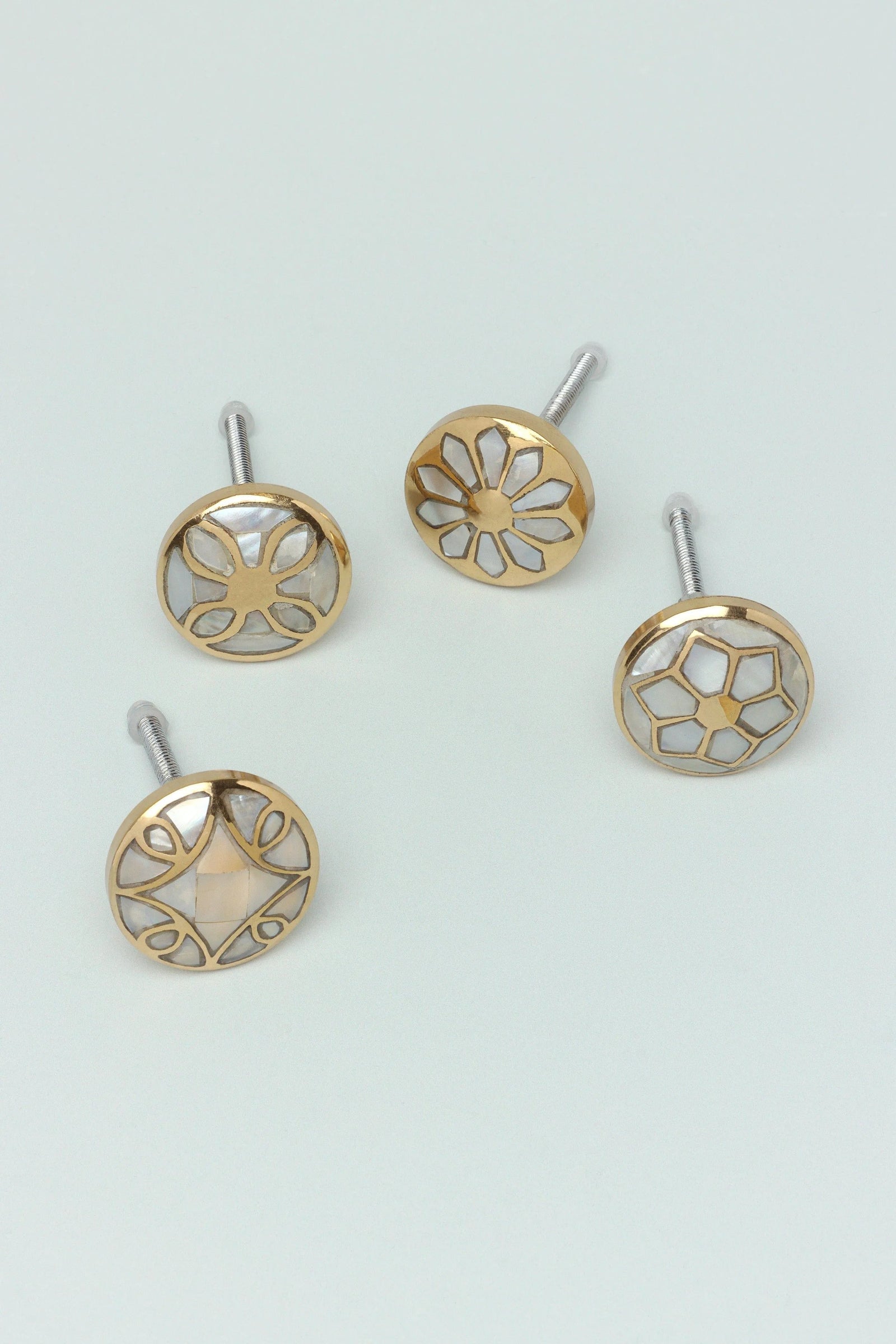
The Victorian house was the great period of ornamental hardware in America. On the more formal cabinetry — dining-room built-ins, china cupboards, dressers — mother-of-pearl inlay set into polished brass was widely specified, particularly in the middle-class Victorian houses of the 1870s and 1880s that borrowed from Anglo-Indian and Aesthetic Movement taste. In parlour and bedroom furniture, pressed-glass knobs — the great American invention of the period — carried through from the 1830s well into the twentieth century.
For a Victorian restoration, three families of hardware do most of the work :
- Mother of pearl inlay in polished brass — for china cupboards, dressers and dining-room built-ins. The Elizabeth Mother of Pearl Cabinet Knob in Polished Brass is the piece we most often recommend for a middle Victorian scheme.
- Faceted or diamond-cut glass on chrome or brass bases — for parlour furniture and bedroom cabinetry. The Diamond-Cut Crystal Glass Cabinet Knob catches gaslight (and electric light) exactly the way pressed glass was intended to.
- Solid brass rosettes and larger knobs — for the more architectural cabinetry of a High Victorian house. Anything from 1 ¼" to 1 ½" (32–38 mm) sits at Victorian scale ; the Federal reticence is gone.
Craftsman and Arts & Crafts (c. 1900–1930) — hammered honesty
The Craftsman house — Greene & Greene in California, Stickley in the Midwest, the ubiquitous bungalow across the country — turned deliberately away from Victorian ornament and toward hand-worked, honest metal. Cabinet hardware in a Craftsman kitchen or built-in was almost always hammered copper, forged iron, or oxidised brass with a matte finish. Nothing was polished, nothing was bright.
For a Craftsman restoration, the Hand Forged Hammered Beaten Cupboard Door Knob is the piece that reads native ; its slightly irregular surface, forged rather than cast, carries exactly the tactile honesty the movement was built on. On drawers, the Penny End Hand-Forged Iron Pull Handle in Black sits correctly on a quartersawn oak built-in ; the beeswax version reads better against a lighter oak.
Colonial Revival (c. 1900–1955) — the twentieth-century return
The Colonial Revival house is the great compromise of American residential architecture — twentieth-century construction wearing eighteenth-century clothing — and its hardware was correspondingly borrowed. Small polished-brass knobs, cut-glass pulls, brass ring pulls with plain backplates : the vocabulary of Federal hardware, applied to houses built with electric lights and central heat.
For a Colonial Revival kitchen, the reliable move is small polished-brass knobs on the upper cabinets and modest brass bar pulls on the drawers, with a set of faceted glass knobs reserved for the china cupboard or the built-in hutch. The Caspian Bubbles Clear Round Glass Cabinet Knob reads as native to a 1920s Revival house ; its faint imperfections carry the hand-blown quality the period valued.
Front doors — the outward face of the period
The front door is the piece a passer-by reads first, and its hardware carries the period more visibly than anything inside. A brass knocker, a substantial letter plate, a doorknob at the correct scale — these are the pieces that either place the house in its period or announce that the period has been overwritten. Our front door furniture collection is arranged specifically for restoration owners looking to return the correct read to a period façade.
Sourcing and specifying — three practical notes
- Solid, not plated. Period brass was solid brass throughout ; a plated reproduction will chip and dull in ways solid brass never does. If the piece feels light for its size, it is not the right piece.
- Unlacquered where possible. Lacquered brass keeps its day-one finish but never develops the patina an old house wants. Unlacquered brass ages with use, and that ageing is exactly what makes the piece read as native rather than as replacement.
- Order singly, not in sets. An old house rarely has a uniform run — some cabinets were replaced in the 1920s, others in the 1950s — and being able to fit a single piece precisely to a single door is worth more than a matched box of twelve. Every knob we sell is available as a single piece.
Frequently asked questions
What hardware is period-correct for a Victorian house?
Middle Victorian houses (c. 1870–1890) most often carried mother-of-pearl inlay set into polished brass on formal cabinetry, pressed or faceted glass knobs on parlour and bedroom pieces, and solid brass rosettes and knobs at 1 ¼"–1 ½" (32–38 mm) scale on architectural built-ins. Later Victorian and Aesthetic Movement pieces carried more ornamental cast brass ; earlier Victorian (1840s) sat closer to the smaller-scale Federal vocabulary.
Can I use modern hardware in a historic home?
Yes — provided the material and scale read correctly for the period. A modern piece cast in solid brass at the correct diameter, or a hand-forged iron pull in the Craftsman vocabulary, will read as native to a period house in a way a plated reproduction never will. Get the material and the scale right and the piece can be new without reading modern.
What size cabinet knob was standard in 1900s American homes?
For most turn-of-the-century American cabinetry, 1 ¼" to 1 ½" (32–38 mm) was the standard diameter, with smaller 1" knobs on lighter pieces such as parlour furniture and Colonial Revival built-ins. Craftsman-era hardware ran slightly larger and often flatter in profile ; Victorian ran to more ornamental cast shapes at the same nominal diameter.
Should hardware in a historic home be lacquered or unlacquered brass?
Unlacquered wherever the piece will be touched daily, so it can develop the natural patina that reads as native to an old house. Lacquered brass keeps its day-one finish but never ages, and in an historic setting the never-ageing quality tends to read as the wrong period. Interior door hardware, cabinet knobs and front-door pieces all benefit from being unlacquered ; the small extra care they need is a modest price for the way they wear.
A final thought
An old American house is not a museum piece and doesn't want to be one. It wants to be lived in, with the small, honest details that make it feel like the house it was designed to be — the brass rosette, the mother-of-pearl knob, the hammered pull that has been touched every day for a century and been made better by it. Return those pieces where they belong, and the house will do the rest.
✥
Explore the Brassworks Edit — solid brass, hand-forged iron, and inlay hardware for the American historic home.