

The Journal · brass knobs
Ceramic vs Brass vs Chrome Door Knobs: Which Finish Suits Your Home?
How does anyone choose between ceramic, brass, and chrome? A designer's comparison of the three finishes G Decor sells — when each one wins, which rooms they suit, and how to combine them without the room looking like a showroom.
G · Stories · No. II · Home & Hardware
A G Decor Comparison
Question: how does anyone actually choose between ceramic, brass, and chrome? You'd think it would be the easiest decision in interior design — pick a metal, move on. In practice, the finish does more design work than nearly anything else in a room, which makes it the decision people second-guess the most.
This is a comparison guide for the three finishes you'll really choose between when buying door knobs and cabinet hardware. Not a “best finish” verdict — different rooms, different homes, different finishes — but a designer's reasoning for when each one wins.
Why the finish matters more than the shape
A door knob's silhouette gives you the era; its finish gives you the mood. Shape signals tradition or modernity. Finish signals warmth or coolness, character or restraint, light or shadow. You can put the same round mortice knob in three different rooms and get three completely different effects — depending on whether it's a sea-blue ceramic, an aged brass, or a polished chrome.
The finish is also the part the eye lands on first when a door is closed. So before you compare prices or styles, compare what each finish is actually doing for the room.
Ceramic — when it wins
Ceramic is the finish for character. It carries colour, pattern, hand-painted detail and the slight variation that mass-produced hardware can't. That's why ceramic earns its place in rooms that are otherwise quiet: neutral bedrooms, painted kitchen cabinets, country cottages, hallways where every other surface is plain.
Three things ceramic does best:
- Colour without commitment. A blue ceramic knob brings cobalt or sea-tone into a room without painting a wall. The colour lives in the hardware, not the architecture, so you can change it in an afternoon.
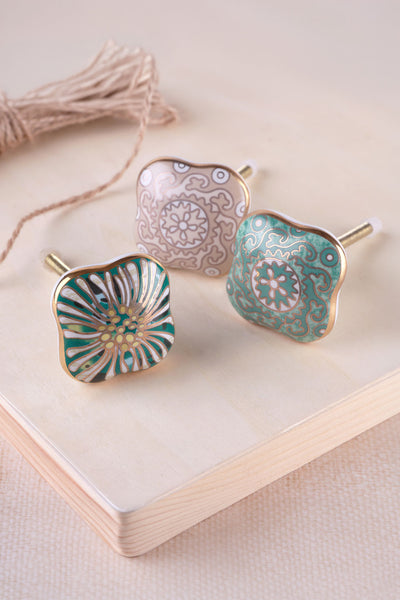
- Pattern done quietly. Hand-painted ceramic can carry a dot, a stripe, a floral — without overwhelming the space, because the canvas itself is small.
- Texture from a distance. Glaze depth and slight variation between pieces read as “considered” rather than “perfect”, which is the look most luxury interiors are after.
Where ceramic doesn't win: highly modern, minimalist interiors where the rest of the room is hard-edged metal and glass. In those spaces, the soft hand-painted feel can read as quaint instead of considered.
Browse our ceramic mortice door knobs and ceramic cabinet knobs — most are hand-painted in small batches with brass or chrome bases.
Brass — when it wins
Brass is the finish for warmth. Heavier than chrome, softer than steel, it picks up light like a warm metal should and develops a patina over time that polished finishes can't. That patina is part of the appeal — brass ages with the house, not against it.
Brass works best in:
- Heritage homes. Victorian, Edwardian, Georgian, period cottages — brass belongs to the architecture. Don't fight it.
- Timber kitchens and warm neutrals. The metal echoes wood tones and pairs with cream, ivory, sage, mushroom, and almost any earthy palette.
- Rooms with other brass accents. Picture frames, lamp bases, light switches, pendant lights — repeat brass once or twice and the room ties together.
Where brass struggles: very cool colour palettes (icy blues, true whites, slate greys) can make brass look out-of-place. There, chrome usually wins.
For brass-based hardware, look at our Milano Signature ceramic + brass set, or the Royal Gold with its honeycomb-pattern ceramic on a brass base.
Chrome and polished finishes — when they win
Chrome is the finish for restraint. Sharper, cooler, more architectural. Where brass adds warmth and ceramic adds character, chrome adds precision — clean lines, hard light, modernist confidence.
Chrome works best in:
- Bathrooms. Where every other fitting is chrome or stainless, the door hardware should match. Brass and ceramic can work too, but chrome is the safe luxury default.
- Modern kitchens. Especially handleless cabinetry, matte black appliances, marble or quartz worktops — chrome echoes the cool surfaces.
- Cool colour palettes. True whites, icy blues, slate greys, monochrome interiors.
A useful middle ground: ceramic knobs on chrome bases. Our Royal Blue Pattern ceramic knob sits on a chrome base — you get the personality of ceramic with the precision of metal.
And a word on glass
Glass and crystal aren't usually in the same conversation, but they should be. Cut crystal knobs catch light in a way no metal can — they brighten dark hallways and small bedrooms instantly. Our Solid Crystal Mortice Door Knobs are a customer favourite for exactly this reason. They look more expensive than the price suggests, and they work in almost any palette.
The one-detail rule, revisited
The mistake most rooms make is matching every metal. Showroom-perfect, but lifeless. The designer's rule is to repeat one element rather than match everything.
Three combinations that work in real homes:
- Chrome bathroom + ceramic-on-chrome door knob. The chrome base ties the door to the taps and shower fittings; the ceramic top adds quiet character.
- Brass kitchen lighting + patterned ceramic cabinet knobs. Brass repeated, ceramic adds the colour, the cabinets get personality without becoming busy.
- Plain white internal doors + patterned ceramic on the wardrobe. The doors stay quiet; the wardrobe becomes a feature. One detail of pattern, repeated nowhere else.
Which finish for which room
If you'd rather skip the philosophy and get a direct answer:
- Master bedroom: Ceramic in a soft colour, on a brass base. Calm and personal.
- Kitchen cabinets: Ceramic on brass if the kitchen has timber or warm neutrals; ceramic on chrome if it's a cooler, more modern palette; plain brass pulls if the cabinetry is the feature.
- Bathroom: Chrome, or ceramic on chrome. Brass can work in spa-style bathrooms with warm marble and timber, but it's a more committed choice.
- Hallway: Brass or glass. Both lift the space; both photograph well to anyone walking in.
- Children's room or playroom: Ceramic with pattern. Easier on small hands and immediately personal.
- Period home (any room): Brass, glass, or ceramic on brass. Avoid pure chrome in Victorian and Edwardian rooms.
- New-build that needs character: Ceramic with pattern, on a brass base. The single fastest way to make a new-build feel less new-build.
What to ignore
A few opinions that don't deserve as much airtime as they get:
- “Brass is dated.” Brass is a heritage finish — it's not dated, it's enduring. The brass-is-dated take comes from one specific 1980s polished-brass era that the brass-aware never liked anyway. Modern brass is warmer and more matte; it has nothing to do with the 80s look.
- “Chrome is cheap.” Polished chrome is a precision finish used by some of the most expensive door hardware brands in the world. Quality is in the manufacture, not the metal.
- “Mix all your metals.” You can — but you don't have to. The repeat-one-element rule is the simpler approach, and almost always reads as more considered.
Frequently asked questions
Can I mix ceramic and brass in the same room?
Yes. Many of our most popular ceramic knobs sit on a brass base, which means the room reads as “ceramic + brass” all at once. You can also pair plain brass cabinet pulls with patterned ceramic knobs on a feature door or wardrobe — repeat the brass, vary the ceramic.
Do brass door knobs tarnish?
Brass develops a patina over time — a slight darkening and softening that most people prefer. If you'd rather keep it bright, a soft brass polish once or twice a year is enough. Avoid abrasive cleaners.
Is chrome out of style?
No. Polished chrome is a permanent classic, especially in bathrooms and modern kitchens. What's gone out of style is heavy, ornate chrome — sleeker forms in chrome are more popular than ever.
Which finish is most durable?
All three finishes (high-quality ceramic, solid brass, plated chrome) are designed to last decades. Brass is arguably the most forgiving because the patina hides minor wear. Ceramic glazes are tough but can chip on hard impact. Chrome plating is the most consistent over time but can show scratches on highly polished finishes.
Can I change the finish later?
Door and cabinet knobs are deliberately easy to swap. Cabinet knobs take a screwdriver and five minutes. Mortice door knobs are slightly more involved (the spindle and rose need to fit your existing tubular latch) but still a DIY job in most cases.
A final note
If the choice is really between ceramic, brass, and chrome — and you're stuck — start with the metals already in the room. Echo what's already there, add character where it's missing. The best door hardware doesn't fight the rest of the space; it joins it, quietly.
Browse G Decor's full door knob collection or our cabinet hardware range. With more than 700 verified reviews on Trustpilot and over 2,000 store reviews on Judge.me, our hardware is trusted in homes across the UK, US, Europe and Australia.
Further reading
- British Craft: How a Hand-Painted Knob Gets Made — The workshop, the hands, the kiln. Why hand-finished hardware looks alive.
- How to Choose Brass Finishes: A Material Guide — Natural, antique, polished and beeswax — a short guide to the brass finishes we work with.
- How to Choose Door Knobs: A Complete UK Guide — The complete UK reference: anatomy, materials, finishes, sizing, installation and care.