



The Journal · British Design
The Wabi-Sabi of Hand-Painted Ceramic
Why hand-painted ceramic carries a warmth no machine can copy — wabi-sabi, crackle glazes, and the quiet beauty of imperfection in the considered British home.
Why does a machine-perfect surface leave us cold, while a glaze that crazed unpredictably in the kiln makes us reach out and touch it? The answer is older than any design movement: hand-painted ceramic carries the evidence of a person, and we are built to notice. The Japanese have a name for this way of seeing — wabi-sabi — and no material in the home expresses it better.
What wabi-sabi actually means (and what it doesn't)
Wabi-sabi is often flattened into a style — beige rooms, rough linen, a single branch in a vase. It is really a philosophy: the acceptance that nothing is finished, nothing is permanent, and nothing is perfect, and that beauty lives precisely in those three conditions. A wabi-sabi object is not carelessly made. It is carefully made by a hand that allowed the material its say.
What wabi-sabi is not, is an excuse for shoddiness. The crack must arrive honestly — through the kiln, the brush, the years of use — not through neglect. The distinction matters, because it is exactly the distinction between a hand-painted ceramic piece and a printed imitation of one. The first records a process; the second merely pictures it.
The hand in hand-painted ceramic
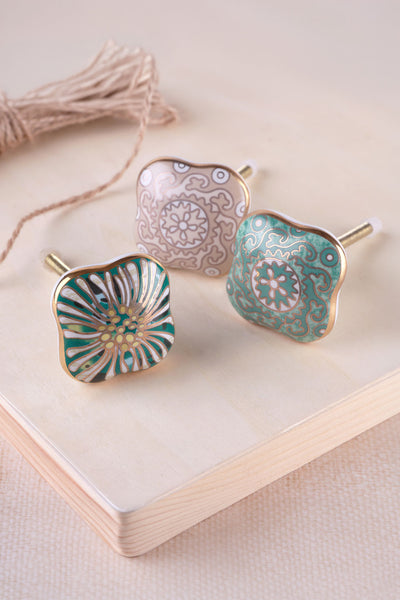
Watch a painter work a pattern around the curve of a door knob and you understand why no two come out the same. The brush loads unevenly. The wrist tires and recovers. The line thickens on the turn and thins on the straight. On a production line these would be errors to engineer away; in a craft workshop they are the signature being written.
This is why a wall of hand-painted ceramic door knobs in a workshop, all nominally the same design, reads like a crowd of siblings rather than a row of clones. Each has caught the pattern slightly differently, and the home that receives one receives something that exists nowhere else. In an age when most surfaces around us were extruded, moulded or printed, that singularity is quietly radical.
Painted, not printed
Run a fingertip over a printed motif and you feel glass-flat uniformity. Run it over a painted one and you feel the faint topography of the brushwork — pigment sitting a hair's breadth proud of the glaze, the pattern present to the hand as well as the eye. It is the difference between a signed letter and a photocopy of one.
Crackle glaze: the beauty that arrives in the kiln
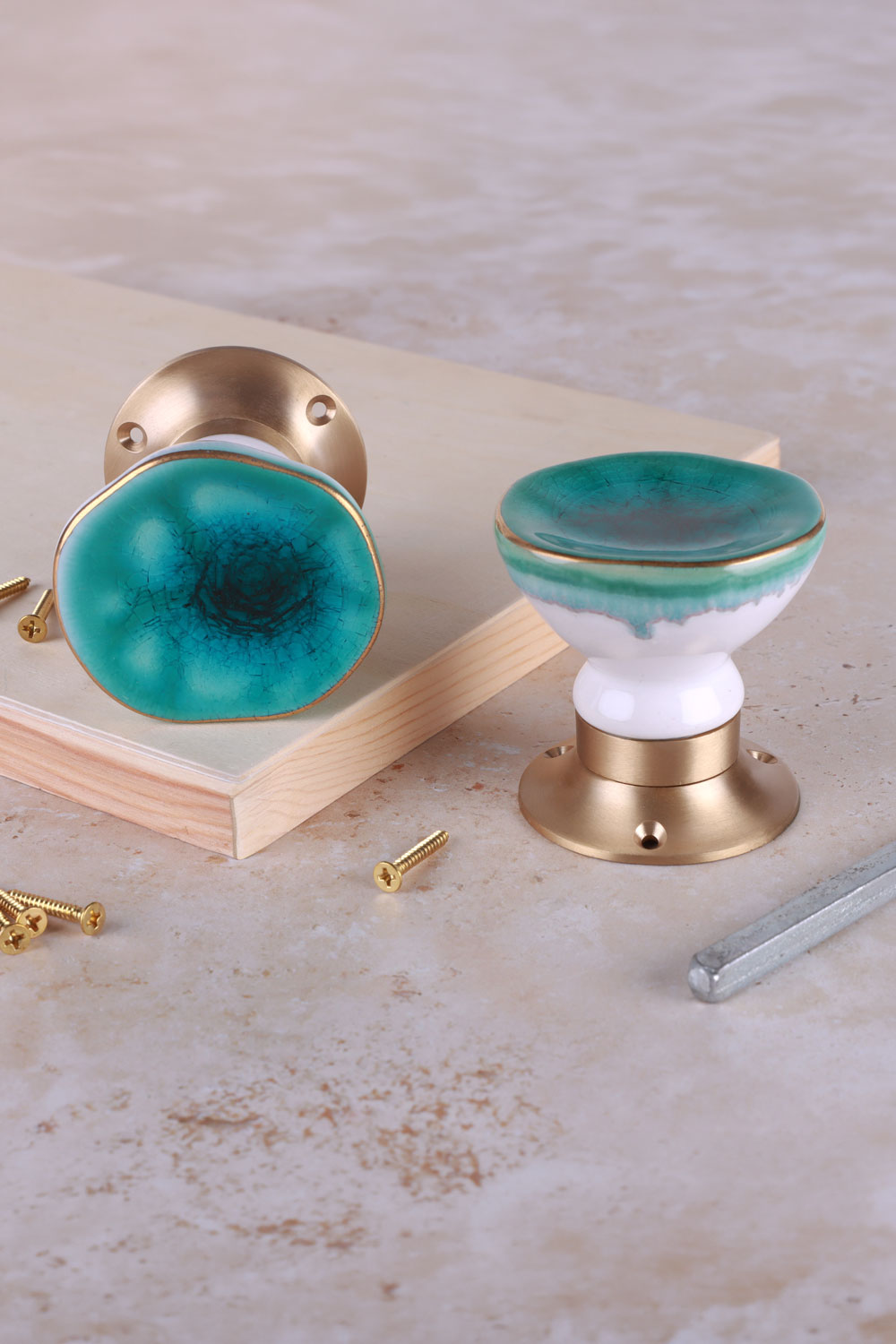
Of all ceramic finishes, crackle glaze is the most openly wabi-sabi, because its defining feature is surrendered to chance. As the piece cools after firing, the glaze contracts a fraction faster than the clay body beneath it, and a web of fine lines spreads across the surface — never twice in the same arrangement. The maker chooses the glaze, the temperature, the timing; the kiln chooses the pattern.
The Rhodes Sea Blue mortice door knobs show what this looks like when it is done with intent: a sea-washed blue under a crazed, glassy surface, seated on a solid brass base that gives the softness of the ceramic something certain to stand on. The crackle is not applied to the piece; it happened to the piece. That is the entire point, and the reason a crackle-glazed knob rewards the daily close attention a door knob uniquely receives — it is the one object in a room you actually hold every day.
Why imperfection reads as depth
There is a paradox at the heart of hand-finished objects: the irregularities that would count against a mass-made product are exactly what make a crafted one feel considered. The eye is a superb detector of human effort. It registers, faster than thought, whether a surface was touched by a person, and it assigns warmth accordingly.
Designers exploit this deliberately. A room furnished entirely with uniform, machine-made pieces can be handsome and still feel like nobody lives there. Introduce a few honestly hand-made details — a crackle-glazed knob, a hand-thrown bowl, a painted cabinet knob on an otherwise plain run of joinery — and the room acquires a pulse. The imperfect pieces vouch for the perfect ones.
Living with hand-painted ceramic, room by room
Because ceramic detail is small and rich, it works best where the hand and eye already go. On interior doors, a painted or crackle-glazed mortice knob turns the most repeated gesture of the day into a small pleasure. In the kitchen, hand-painted knobs on a painted shaker run give the joinery the one thing paint cannot: pattern with depth. In the hallway, a row of glazed ceramic wall hooks does honest work while reading as a collection rather than storage.
The restraint rule applies here as everywhere. Hand-painted ceramic is seasoning, not the dish — one patterned design per room, repeated, will always beat four patterns competing. Let plain painted timber, stone and metal do the quiet work around it, and the ceramic will carry the room's character on its own.
Pairing ceramic with brass
Ceramic and brass are natural companions because they age in sympathy: the glaze softens in appearance as fine wear accumulates, while the brass base and rose deepen from bright to burnished. A home fitted with both is a home that improves as it is used — the opposite of finishes that only ever degrade from their day-one best. It is why so many of our signature pieces marry the two materials.
Caring for ceramic that was made by hand
Hand-painted ceramic asks for very little: a soft dry cloth for dust, a barely damp one for marks, and nothing abrasive, ever. Avoid harsh sprays on painted surfaces — solvent chemicals can dull a glaze over time. Fit knobs with the correct fixings, snug rather than forced, since ceramic tolerates compression poorly.
Then let it live. The faint darkening of crackle lines over years, the soft polish where fingers land — this is not damage but biography. A wabi-sabi object is never finished; your household is simply the next chapter in how it is being made.
Frequently asked questions
What does wabi-sabi mean in home décor?
Wabi-sabi is a Japanese aesthetic philosophy that finds beauty in imperfection, impermanence and incompleteness. In the home it favours hand-made, natural and honestly aged surfaces — a crackle glaze, a hand-painted pattern, a patinated brass base — over machine-perfect uniformity.
Is every hand-painted ceramic knob unique?
Yes. Each piece is painted individually by hand, so brushwork, line weight and pattern placement vary slightly from knob to knob, and crackle glazes form a different web of lines on every piece in the kiln. Two knobs of the same design are siblings, never twins.
What is crackle glaze — is it a defect?
Crackle (or crazing) is a deliberate decorative effect created when the glaze contracts slightly faster than the clay body as it cools, producing a fine network of surface lines. On a crackle-glazed piece it is intentional and stable, sealed within the finish — a feature, not a flaw.
How do I care for hand-painted ceramic door knobs?
Dust with a soft dry cloth and lift marks with a barely damp one; avoid abrasive cleaners and harsh sprays, which can dull the glaze and painted detail. Fit fixings snugly rather than over-tightened. With this small amount of care, hand-painted ceramic hardware lasts for decades.
Does hand-painted ceramic suit modern homes as well as period ones?
Yes — arguably it does its best work in modern interiors, where crisp, plain surfaces benefit most from a detail with visible craft in it. In period homes it feels native; in contemporary ones it provides contrast, warmth and a human note the architecture may otherwise lack.
A final thought
Hand-painted ceramic is the rare material that gets more interesting the longer you look and the longer you live with it — the brushwork that wavers, the crackle that mapped itself, the glaze slowly softening under years of touch. That is wabi-sabi, not as a style to copy but as a truth to furnish by: choose the pieces that show the hand that made them. Begin with the hand-painted door knob collection and find the piece your home will finish making. With more than 700 verified reviews on Trustpilot and over 2,000 store reviews on Judge.me, our pieces are trusted in homes across the UK, US, Europe and Australia.