

The Journal · British Design
Mother of Pearl vs Marble Drawer Pulls — Statement Materials Compared
A considered comparison of mother of pearl and marble drawer pulls — where each statement material earns a drawer, where each fails, and how to use both in the same house without competing.
Both materials say — quietly, in the way only real materials can — that this drawer matters. They just say it in different registers. Mother of pearl catches light and gives it back iridescent; marble absorbs the room and returns it as weight.
Mother of pearl — what it is and does
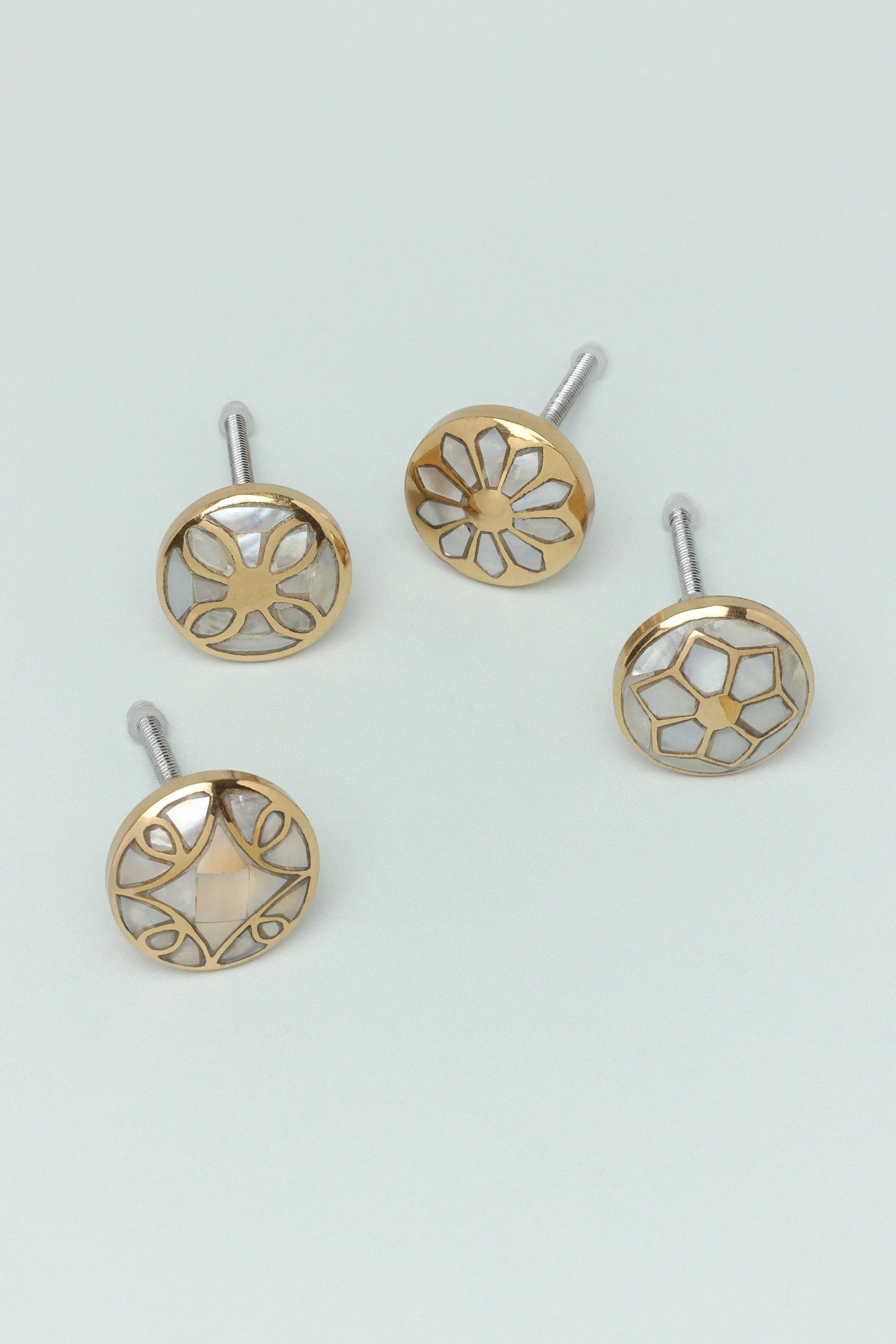
Mother of pearl is not stone. It is the interior lining of a shell — oyster in most of ours, occasionally abalone — cut into small tiles and set into a solid brass base. The material was called nacre by the French and is what an oyster spends its life producing, layer over layer, to protect itself from a grain of sand. That process produces the iridescence: light entering the surface refracts off the platelets of aragonite and returns as blue-green-pink-gold, depending on where you stand.
The consequence in a room is that a mother of pearl knob is never the same twice. Morning light gives it one range of colour; the low sun of an afternoon gives another; a candle at dinner gives a third. The knob does not sit quietly; it lives. This is the material's defining property and — depending on the room you are dressing — its greatest strength or its one liability. The Elizabeth Mother of Pearl Cabinet Knob in Polished Brass is our most-specified piece — an inlaid dome the size of a walnut, set on solid polished brass, ordered most often for jewel-box moments in an otherwise restrained scheme. The Papillon Royale Mother of Pearl and Brass Pull Handle is its more ambitious sibling — a decorative pull that reads as jewellery on the front of a drawer. Both sit within our signature pieces for a reason.
Marble — what it is and does
Marble is stone — a metamorphic limestone recrystallised under pressure, quarried most often from Carrara in Italy and from Turkey. Its defining property is not iridescence but weight. A marble knob in the hand has the density stone gives it; the surface is cool to touch and stays cool for longer than the ambient temperature. What the eye reads is quieter than mother of pearl but more architectural — a still surface, precisely veined, unique to the piece.
Where mother of pearl performs, marble sits. Its beauty is not in movement but in the way it holds a drawer open by its own weight of presence. It reads as material rather than as decoration, and this distinction matters — it is the reason marble suits kitchens where mother of pearl might read excessive. The Estella White Marble Cabinet Knob is our anchor piece in this register — a cabochon of natural white marble turned smooth and set into a slim brass collar. The Estella Grey Marble Cabinet Knob offers the same form in a range of quietly veined greys.
Where mother of pearl wins
Mother of pearl is at its best in small rooms and single-drawer applications where the light in the room is going to move over the course of a day. Its natural habitats:
- Powder rooms — a single mother of pearl knob on a vanity carries a room that is already leaning ornamental. The material rewards close viewing, which is what a powder room invites.
- Dressing rooms and closets — the drawer that holds the jewellery deserves a jewel on the front of it. This is the most literal use of the material.
- A single statement drawer in an otherwise restrained kitchen — the pantry, or the drawer that holds the good silver. One mother of pearl piece against a run of plain brass reads intentional.
- Bedside tables in the primary bedroom — a soft, iridescent piece next to the lamp, catching the last light of the evening.
Where marble wins
Marble suits the rooms where the surface itself is doing architectural work — where you want material weight without the visual noise of iridescence. Its strengths:
- A statement kitchen island — a run of marble knobs on the drawers under the island reads as considered when the island itself is stone. The materials speak to each other.
- A bathroom vanity — marble on marble; the knobs disappear into the counter's own material vocabulary, or contrast with it in the same family.
- Contemporary kitchens with a limited palette — marble adds material interest without breaking the discipline. Mother of pearl would read as decoration; marble reads as the material the room is already made of.
- A kitchen where you want quiet rather than movement — north-facing spaces, cool colour palettes, rooms that lean architectural rather than romantic.
The mix
The two materials rarely belong in the same room, but they belong easily in the same home. A common and considered scheme in a well-considered house: mother of pearl in the powder room and the dressing room, marble in the primary bathroom and the kitchen island. Each material lives in the space that suits it, and the house reads as coherent because each room commits.
Within a single room, mixing mother of pearl and marble tends to read as indecisive. Both are statement materials, and both compete for the same attention. The rule most designers observe is one statement material per room — supported by plain solid brass, ceramic or hand-painted pieces from the wider cabinet hardware range on the surrounding cabinetry.
Frequently asked questions
Are mother of pearl knobs suitable for a kitchen?
Yes, but as an accent rather than as the primary hardware. A single mother of pearl piece on a statement drawer — the pantry, the spice drawer, the drawer that holds the silver — reads considered. A full run of mother of pearl on every drawer tends to read as excessive in a working kitchen. Save the full run for a dressing room or bathroom.
Is marble durable enough for cabinet hardware?
Yes. The marble we use is polished and sealed at the factory, and the small footprint of a knob makes it far more durable in that form than a full counter or floor tile. Wipe with a soft cloth; avoid abrasive cleaners and acidic products. A marble knob will last as long as the cabinetry it sits on.
Can I mix mother of pearl and marble in the same kitchen?
Rarely. Both materials are visually assertive, and using them together tends to read as indecisive rather than layered. The reliable rule is one statement material per room, supported by quieter finishes. The two can — and often should — live in the same house, but in different rooms.
How do I care for mother of pearl and marble hardware?
Both ask only for a soft, dry or lightly damp cloth. Avoid abrasive cleaners and anything acidic — vinegar and citrus etch both nacre and stone. The brass bases can be buffed gently if you prefer them bright, or left to patinate; the inlay and the stone themselves should never be polished with product.
Which material suits a period home better?
Both have period precedent. Mother of pearl sits naturally in Victorian and Edwardian interiors, where inlay work was prized; marble reads as easily in a Georgian scheme as in a contemporary one. Choose by the room's light and palette rather than by era alone — a north-facing room favours marble's stillness, a candle-lit one favours nacre.
A final thought
Mother of pearl and marble drawer pulls answer the same question in opposite voices — one with light, one with weight. Decide which register the room is already speaking in, commit to it, and let the surrounding hardware stay quiet. Explore both materials in our cabinet knobs collection and give the drawer that matters the piece it deserves. With more than 700 verified reviews on Trustpilot and over 2,000 store reviews on Judge.me, our pieces are trusted in homes across the UK, US, Europe and Australia.